

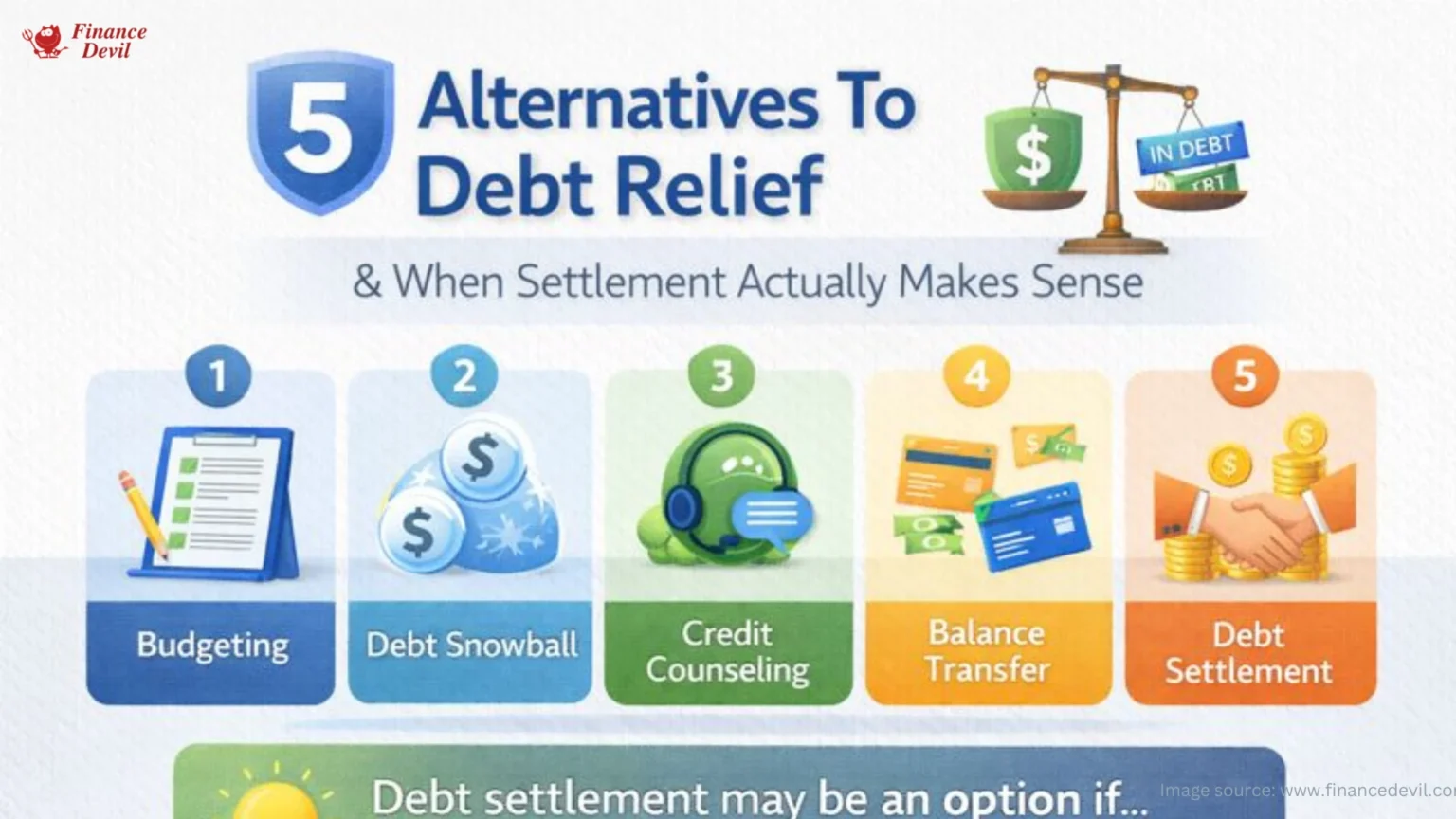
Debt relief companies promise quick fixes but these 5 strategies could save your credit score AND get you debt-free faster.
Here’s the truth: Debt relief companies can slash what you owe, but they often trash your credit in the process. The good news? You’ve got options that put YOU in control and many of them work faster than you’d think.
Why Skip Traditional Debt Relief?
Debt relief companies typically ask you to stop making payments while they negotiate. That’s 3-6 months of mounting late fees, angry creditors, and serious credit damage. Plus, there’s zero guarantee your creditors will even play ball. Before you go that route, try these alternatives that protect your financial future.
1. Negotiate Directly With Your Creditors
Here’s the secret: Creditors would rather work with you than send your account to collections. One phone call could change everything.
How it works: Call your credit card company, explain your situation honestly, and ask for a hardship program. Many will reduce your interest rate to 0-6% or pause payments for 3-6 months.
Expected savings: $200-500/month in interest charges alone.
Real example: Sarah owed $12,000 across three cards at 24% APR. After calling each creditor, she got her rates dropped to 6%, saving her $2,160 in interest over 12 months.
Action step: Call during business hours (not weekends) and ask specifically for the “hardship department.” Have your monthly budget ready to share.


2. Try the Debt Avalanche Method
Stop overpaying on interest. This free strategy can save you thousands without any program fees.
How it works: List all debts by interest rate. Pay minimums on everything, then throw every extra dollar at the highest-rate debt. Once that’s gone, attack the next highest rate.
Expected savings: $3,000-7,000 over 3-5 years compared to paying minimums.
The numbers: If you have $20,000 in debt at an average 19% APR, the avalanche method can save you $4,800 in interest and get you debt-free 2 years faster than minimum payments.
Action step: Download a free debt payoff calculator (unbury.me is great) and enter your numbers today. Seeing your payoff date makes it real.
Pro tip: Combine with the “no-spend challenge.” Pick one category monthly (like dining out) and redirect that cash to your highest-rate debt. Most people find an extra $150-300/month this way.
3. Balance Transfer Credit Card (The 0% Hack)
Get 12-21 months of interest-free breathing room. This is the fastest way to stop hemorrhaging money on interest.
How it works: Transfer high-interest balances to a card offering 0% APR for 12-21 months. You’ll pay a one-time 3-5% transfer fee, but every payment goes straight to principal.
Expected savings: $150-400/month in interest charges.
The math: Transfer $10,000 at 22% APR to a 0% card. Even with a $350 transfer fee, you save $2,200 in Year 1 interest. That’s $1,850 in your pocket.
Best for: People with credit scores of 670+ who can commit to aggressive payoff.
Action step: Check your pre-qualified offers at CardMatch.com (no credit score impact). Apply for cards with the longest 0% periods; current top picks offer 18-21 months.
Warning: If you don’t pay off the balance before the 0% period ends, you’re back to square one. Set up autopay for at least the minimum, and aim to clear it in 15 months.
4. Debt Consolidation Loan
Turn 5 payments into 1 with a lower rate. Simplify your life AND save money.
How it works: Take out one personal loan to pay off multiple high-interest debts. You’ll have one fixed monthly payment at a lower interest rate.
Expected savings: $100-300/month through lower rates and extended terms.
Real scenario: Consolidate $15,000 in credit card debt (22% APR) into a 3-year personal loan at 11%. Your payment drops from $685/month to $492/month, saving you $193 monthly plus $3,000 in total interest.
Best for: People with decent credit (640+) who need payment relief NOW.
Action step: Get rate quotes from at least 3 lenders. Try your local credit union first (they often beat online lenders by 2-3%). Most let you check rates with no credit impact.
Level up your game: After consolidating, freeze or cancel your paid-off credit cards. This removes temptation and prevents the “double debt trap,” where you rebuild balances while still paying the consolidation loan.
5. Tap Into Home Equity (If You’re a Homeowner)
Use your home equity to crush high-interest debt. This is the heavy hitter for homeowners.
How it works: A Home Equity Line of Credit (HELOC) or home equity loan typically offers rates of 7-10%, WAY below credit card rates. You borrow against your home’s equity to pay off expensive debt.
Expected savings: $300-600/month for every $25,000 borrowed.
The power play: Replace $25,000 in credit card debt (22% APR = $458/month in interest alone) with a HELOC at 9% ($188/month). That’s $270 saved every single month.
Best for: Homeowners with at least 15-20% equity who are COMMITTED to not running up credit cards again.
Critical warning: Your home is collateral. Miss payments and you risk foreclosure. Only use this if you’re disciplined about not accumulating new debt.
Action step: Check your home’s current value on Zillow or Redfin, then multiply by 0.80. Subtract your mortgage balance; that’s roughly your available equity.
When Debt Settlement Actually Makes Sense
Sometimes, despite your best efforts, traditional methods won’t cut it. Consider professional debt settlement if:
- You’re facing bankruptcy: Settlement is less damaging than Chapter 7 and you keep more assets
- You’re 90+ days behind: Credit is already damaged; settlement might be your best recovery path
- You literally can’t afford minimums: If you’re choosing between rent and credit cards, settlement offers a realistic out
- You have $10,000+ in unsecured debt: The fee structure makes sense at this threshold
Reality check: Settlement typically takes 2-4 years, costs 15-25% of enrolled debt in fees, and tanks your credit score initially. But it can reduce your total debt by 30-50%, which beats drowning in payments you can’t afford.
Your Quick Win Summary
Total potential savings: $3,000-7,000 annually depending on your debt load
Time investment: 2-4 hours to research and implement one strategy
Difficulty level: Beginner to intermediate (we gave you the exact steps)
Best for: Anyone with $5,000+ in high-interest debt who wants to avoid credit damage
FAQ: Your Burning Questions Answered
Q: Will these strategies hurt my credit score?
A: Most alternatives IMPROVE your score over time. Balance transfers and consolidation loans cause a small temporary dip (5-10 points) but recover quickly as you pay down balances. Negotiating with creditors doesn’t hurt your score unless you stop making payments.
Q: How quickly will I see results?
A: Interest savings hit immediately. With the avalanche method, you’ll see your first debt eliminated in 6-18 months depending on your situation. Balance transfers and consolidation work from Day 1—your next payment goes further.
Q: What if I have bad credit (under 600)?
A: You’ve got options. Start with direct creditor negotiation (no credit check required). Credit unions often approve consolidation loans for members with lower scores. If those don’t work, consider a secured personal loan or settlement as a last resort.
Q: Can I use multiple strategies at once?
A: Absolutely! Negotiate lower rates with creditors, THEN transfer balances to 0% cards, THEN attack remaining balances with the avalanche method. Stack strategies for maximum impact.
Q: How much does debt settlement cost vs. these alternatives?
A: Settlement companies charge 15-25% of your enrolled debt (typically $3,000-6,000 in fees). These alternatives cost $0-350 (balance transfer fees) plus your effort. You do the math.
Take Action Today
Here’s your game plan:
- This week: Call your highest-interest creditor and request a rate reduction
- This month: Check your balance transfer or consolidation loan options
- This quarter: Implement the avalanche method and track your first debt payoff
The average person using these strategies cuts their debt payoff timeline by 18-30 months. That’s real money back in your pocket, money you can use for emergencies, savings, or finally taking that vacation.
Ready to crush your debt? Start with the easiest win: that phone call to your creditor. You’ve got nothing to lose and potentially hundreds of dollars a month to gain.
Remember: Every dollar you save on interest is a dollar that goes toward becoming debt-free. These strategies work but only if you start today.