


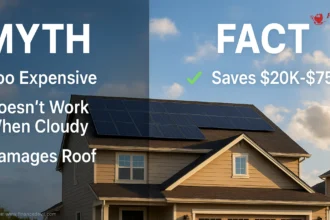
Most homeowners save $20,000-$40,000 over 25 years by going solar, and with the federal solar tax credit covering 30% of installation costs, there’s never been a better time to make the switch.
The Challenge: Rising electricity bills are eating into your budget, but you’re not sure if solar is right for your home or how to take advantage of available incentives. Let’s break down the five clear signs it’s time to go solar and exactly how to claim your tax credit.
1. Your Electricity Bills Keep Climbing
If you’re paying $150+ per month for electricity, solar can cut those costs by 70-100%. The average American household spends $1,500-$2,000 annually on electricity, money that could be going toward a solar system that pays for itself in 7-10 years.
What this means for you: Generate your own clean energy and lock in predictable costs for 25+ years, protecting yourself from utility rate increases that typically rise 3-5% annually.
2. Your Roof Gets Plenty of Sunlight
If your roof receives 4-5 hours of direct sunlight daily with minimal shading from trees or buildings, you’re an ideal solar candidate. South-facing roofs are optimal, but east and west orientations work well too.
Bonus: A roof in good condition (less than 15 years old) means you won’t need costly repairs before installation.
3. You Want Energy Independence
Tired of power outages or relying entirely on the grid? Solar panels paired with battery storage give you backup power during outages and the freedom to use stored energy during peak-rate hours, saving even more money.
4. You’re Staying in Your Home 5+ Years
Solar systems typically pay for themselves within 7-10 years through electricity savings. If you plan to stay put, you’ll enjoy years of virtually free power. Planning to sell? Homes with solar sell 4.1% faster and for more money, according to Zillow research.


5. You Want to Reduce Your Carbon Footprint
Switching to solar offsets 3-4 tons of carbon emissions annually, equivalent to planting 100 trees each year. If environmental impact matters to you, solar is one of the most effective actions you can take.
How to Claim Your Solar Tax Credit (2025 Guide)
The federal solar Investment Tax Credit (ITC) lets you deduct 30% of your total solar installation costs from your federal taxes. Here’s exactly how it works:
What’s Covered:
- Solar panels and equipment
- Installation labor costs
- Battery storage systems
- Permitting and inspection fees
How to Claim It:
- Install your solar system in the tax year you’re claiming
- Complete IRS Form 5695 (Residential Energy Credits)
- Attach it to your Form 1040 when filing taxes
- The credit reduces what you owe dollar-for-dollar
Example: A $25,000 solar system = $7,500 tax credit. If you owe $10,000 in federal taxes, your bill drops to $2,500. Any unused credit rolls over to future tax years.
Important: The 30% rate is available through 2032, then drops to 26% in 2033. Acting now maximizes your savings.
Compare Your Solar Options
| Factor | Rooftop Solar | Ground-Mount Solar | Community Solar |
| Best For | Strong roof, homeowner | Large property, roof unsuitable | Renters, shaded properties |
| Cost Range | $15,000-$30,000 | $18,000-$35,000 | No upfront cost |
| Tax Credit | Yes (30%) | Yes (30%) | No direct credit |
| Savings | 70-100% of bills | 70-100% of bills | 10-15% of bills |
What to Do Next
Ready to see how much you could save? Here’s your action plan:
- Get 3 Free Solar Quotes – Compare pricing, equipment, and financing options from certified installers in your area
- Ask About Incentives – Beyond the federal tax credit, check for state rebates and utility programs
- Schedule a Site Assessment – Professionals will evaluate your roof, sun exposure, and energy needs
- Review Financing Options – $0-down solar loans, leases, and PPAs make solar accessible without upfront costs
Most homeowners are surprised by how affordable solar has become. With the 30% tax credit, improved technology, and competitive pricing, the payback period is shorter than ever.
Frequently Asked Questions
Can I claim the solar tax credit if I finance my system?
Yes—you claim the credit based on the full system cost, regardless of how you pay. You own the system, you get the credit.
What if I don’t owe enough in taxes to use the full credit?
No problem. The unused portion rolls over to the next tax year, giving you multiple years to capture the full benefit.
Do I need to own my home to claim the credit?
Yes—homeowners who purchase their solar systems qualify. Leased systems don’t qualify because the leasing company owns the equipment.
When does the 30% tax credit expire?
It’s available at 30% through December 31, 2032, then decreases to 26% in 2033 and 22% in 2034.
Get Your Personalized Solar Savings Estimate Today
Find out exactly how much you could save with solar, and how to maximize your tax credit. Get free quotes from top-rated installers in your area, compare options side-by-side, and take the first step toward energy independence.
Transparency note: We may receive compensation when you connect with solar providers through our site, at no cost to you. We recommend options based on quality, service, and value.