

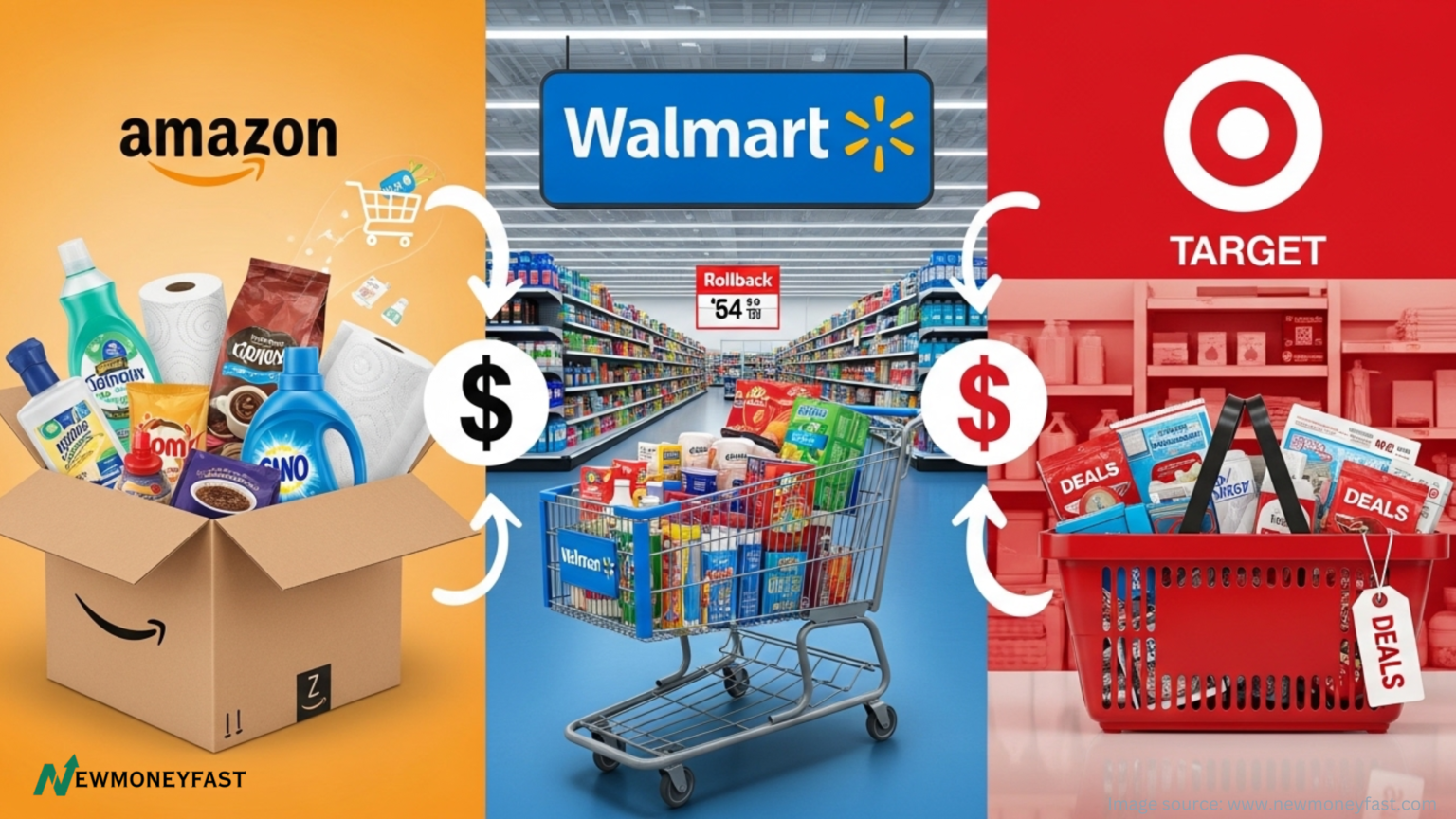
Meta Description: Amazon, Walmart, or Target: Which store saves you the most money on everyday essentials? We break down prices, memberships, and hidden savings by category so you shop smarter every time.
Featured Image Alt Text: Side-by-side comparison of Amazon, Walmart, and Target shopping bags with price tags and savings percentages on household essentials
You shop at all three. But you are almost certainly leaving $500 or more on the table every year by buying the wrong things at the wrong store.
Amazon, Walmart, and Target each have a sweet spot. Knowing which store wins on groceries, household staples, tech, and memberships is the single fastest way to cut your shopping bill without changing what you buy.
Here is the full breakdown, category by category.
| QUICK WINS AT A GLANCEGroceries: Walmart wins on staples; Target competes with promo dealsHousehold essentials: Walmart is cheapest for name brands; Target store brands beat Walmart on priceElectronics and appliances: Amazon wins, often by a wide marginMemberships: Walmart+ ($98/yr) undercuts Amazon Prime ($139/yr) with comparable perksBest power move: Stack store loyalty with Subscribe and Save to cut 10-15% off your recurring orders |
1. Groceries and Fresh Food: Walmart Takes the Crown
When it comes to raw grocery prices, Walmart consistently wins. Its scale and supply-chain efficiency keep prices lower than both Amazon and Target on most staples.
A recent price analysis by LendEDU found that in the Food and Beverage category, both Walmart and Target beat Amazon by 4.61% and 7.30%, respectively. That means Amazon is actually the most expensive option for most groceries.
On a side-by-side checkout for a week of groceries, The Krazy Coupon Lady found that a pound of chicken breast costs $2.57 at Walmart vs. $2.56 at Target with the Circle Card discount. The margin is razor-thin, but Walmart wins without requiring a loyalty card.



The action step here is straightforward: buy your groceries at Walmart first, and only switch to Target when you have a Circle deal that beats Walmart’s shelf price.
Action: Download the Walmart app and check Rollback deals before your weekly shop. You can save $15-30 per trip just from Rollbacks on items you already buy.
Grocery Price Snapshot (Selected Items)
| Item | Amazon | Walmart | Target (no discount) | Target (Circle Card) |
|---|---|---|---|---|
| Chicken Breast (per lb) | $3.20+ | $2.57 | $2.69 | $2.56 |
| Charmin Toilet Paper | Varies | $7.97 | $7.59 | $7.21 |
| Bounty Paper Towels | Varies | $16.94 | $16.14 | $15.33 |
| Dawn Dish Soap | Varies | $2.94 | $2.84 | $2.70 |
| Clorox Bleach | Varies | $8.24 | $8.07 | $7.67 |
Sources: The Krazy Coupon Lady, LendEDU price analysis
2. Household Essentials: It Depends on Brand vs. Store Brand
For name-brand cleaning products, toiletries, and paper goods, Walmart wins again. But here is where it gets interesting: Target’s Up and Up store brand can actually undercut Walmart’s branded equivalents on items like paper towels, baby wipes, and cleaning supplies.
If you are a brand loyalist, shop Walmart. If you are open to generics, Target’s store brand is a legitimate money saver that rivals or beats Walmart pricing while giving you a better in-store experience.
Amazon plays differently here. The Subscribe and Save program unlocks up to 15% off household staples when you have five or more subscriptions active in a single delivery. If you are already buying detergent, toilet paper, dish soap, and pet food on a regular basis, this compounds fast.
| POWER TIP: The Subscribe and Save StackOne consumer tracked their Amazon Subscribe and Save savings against store shopping for six months and found a consistent $34-$59 in monthly savings on about 15 core household items. That is up to $708 per year without stepping foot in a store.The sweet spot: use Amazon Subscribe and Save for non-perishable household items you buy every month. Use Walmart or Target for fresh food and items currently on promo. See this real-world comparison for the full breakdown. |
3. Electronics and Appliances: Amazon Wins, and It Is Not Close
In the Kitchen and Appliances category, LendEDU’s analysis found that Target was 1.17% more expensive and Walmart was 9.30% more expensive than Amazon in total. Neither store came close to beating Amazon on a single appliance item.
For tech accessories, Walmart does compete on budget electronics: off-brand TVs, headphones, and entry-level laptops. But for anything mid-range and above, Amazon is your default start, especially if you have Prime and can compare third-party sellers.
Action step: Before buying any electronic item over $40, do a three-way price check. Amazon almost always wins, but Walmart’s Rollback section occasionally pulls a surprise.
4. Memberships: Walmart+ Is the Underrated Value Play
This is where most shoppers leave serious money on the table. The membership math matters more than people realize.
| Membership | Annual Cost | Monthly Cost | Free Delivery Min. | Streaming Bonus |
|---|---|---|---|---|
| Amazon Prime | $139/yr | $14.99/mo | $35 (or Prime free) | Prime Video |
| Walmart+ | $98/yr | $12.95/mo | $35 | Paramount+ or Peacock |
| Target Circle 360 | $99/yr | $8.99/mo | $35 (same-day) | None |
| No membership | $0 | $0 | Varies by store | None |
Amazon Prime at $139/year is $41 more than Walmart+ at $98/year. Walmart+ also includes either a Paramount+ or Peacock Premium subscription (worth up to $10.99/month), plus 10 cents off per gallon at over 13,000 gas stations. For a household filling up once a week, the gas savings alone can recoup the annual membership fee.
If you shop at Walmart regularly, Walmart+ practically pays for itself. CNBC Select’s comparison confirmed that both memberships offer free same-day delivery on $35+ orders, but Walmart+ does it at a $41/year discount.
| VERDICT: Which Membership Wins?Heavy Amazon shopper: Amazon Prime is worth it for speed, selection, and Prime Video.Regular Walmart grocery shopper: Walmart+ pays for itself fast with free delivery and gas savings.Target loyalist: Target Circle (the free version) gives you most of the savings without the membership fee. Only upgrade to Circle 360 if you order same-day delivery multiple times per month.Best combo: Walmart+ plus a free Target Circle account gives you coverage at two of the three stores at the cost of one membership. |
5. Clothing: Style vs. Price Is a Real Trade-Off
Walmart wins on price for basics: socks, plain tees, and budget seasonal items. Target wins on perceived value with its in-house lines like A New Day and Goodfellow and Co., which price closer to department store quality at discount prices.
A price comparison on Rebate Key found that a simple black blouse at Target starts at $15.00, while the same search on Walmart starts at $22.81. For women’s clothing, Target frequently wins on both selection and price. For children’s shoes, Walmart flips the script with more affordable options from brands like Skechers.
For Amazon, clothing is a mixed bag. Branded items are often competitive, but quality on unbranded apparel is unpredictable. Stick to Target or Walmart for clothing unless you are buying a specific brand.
The Smart Shopper’s Split Strategy: Use All Three
Here is the play that saves the most money without any heroics:
- Walmart for weekly groceries, name-brand cleaning supplies, and budget electronics.
- Amazon Subscribe and Save for 10-15 recurring household staples: detergent, dish soap, pet food, vitamins, paper goods.
- Target for clothing, home decor, and any week where a Circle deal beats Walmart’s shelf price. Use the free Target Circle account, not the paid membership.
- Price-check before any $40+ purchase across all three. The 2-minute comparison pays for itself immediately.
| THE 30-DAY SPLIT STRATEGY CHALLENGEFor the next 30 days, apply the split strategy above to your shopping. Track where you spend each week and compare it to your average monthly grocery and household bill.Most households save $60-$120 in the first month simply by shifting five to ten recurring purchases to the cheaper store for each category.Tag someone who shops at all three stores and share this breakdown with them. |
Visual Content Suggestions
- Infographic: Side-by-side winner badges per category (Groceries, Household, Electronics, Clothing, Memberships) with store logos and price differentials
- Comparison chart: Annual membership cost vs. estimated savings for Amazon Prime, Walmart+, and Target Circle 360
- Decision flowchart: ‘What are you buying today?’ leading to the recommended store
- Table graphic: Subscribe and Save 15% calculator showing monthly and annual savings for a basket of 10 common household items
FAQ
Is Amazon cheaper than Walmart overall?
Not overall. LendEDU’s 50-item analysis found that Walmart was 1.73% cheaper than Amazon across the full basket, and both Amazon and Target beat Walmart specifically in Food and Beverage. Amazon wins clearly in electronics and appliances, where Walmart can be up to 9.30% more expensive.
Is Target ever cheaper than Walmart?
Yes, in specific situations. With the Target Circle Card’s 5% discount, Target regularly beats Walmart on household essentials like paper towels and dish soap by $0.20 to $0.80 per item. Target’s Up and Up store brand also undercuts Walmart’s branded prices on items like baby wipes and cleaning supplies. The Krazy Coupon Lady notes that gift card promos can stack on top of this for even bigger wins.
Is Walmart+ worth it vs. Amazon Prime?
For most households that grocery shop regularly, Walmart+ at $98/year delivers comparable delivery benefits to Amazon Prime at $139/year, plus 10 cents off per gallon at gas stations and a streaming subscription (Paramount+ or Peacock). CNBC Select’s breakdown confirms both offer free same-day delivery on $35+ orders. If you primarily use Prime for video streaming and fast shipping on diverse products, Prime is worth the premium. If you are a grocery-first shopper, Walmart+ wins on cost.
Does Amazon Subscribe and Save really save that much?
Yes, especially when you hit five or more subscriptions in a single delivery window. Amazon’s Subscribe and Save program offers up to 15% off in that scenario, with no membership required beyond a standard Amazon account. One real-world tracker reported savings of $34 to $59 per month on 15 core household items, which adds up to $408-$708 per year.
What is the best store for clothing?
Target wins for adult clothing with better style at slightly lower prices than Walmart on branded items. Walmart wins for children’s clothing and budget basics. Amazon works well for specific brands but is less reliable for unknown clothing sellers due to inconsistent sizing and quality.
| START SAVING MORE ON EVERY SHOPPING TRIPThe fastest way to put money back in your pocket is to shop smarter, not less. Set up Amazon Subscribe and Save for your top 5 recurring household items today and start earning your 15% discount automatically.Compare the top Amazon Subscribe and Save categories here | Get your free Target Circle account | Start your Walmart+ free trial |
Sources
- LendEDU: Amazon vs. Walmart vs. Target Price Comparison
- The Krazy Coupon Lady: Target vs. Walmart Price Comparison 2025
- MarketMaze: Amazon vs Walmart Prices in 2025
- Amazon: Subscribe and Save Program
- CNBC Select: Amazon Prime vs. Walmart+
- The Krazy Coupon Lady: Is Walmart+ Worth It?
- Rebate Key: Target vs. Walmart Price Comparison
- MotherJones.us: Amazon Subscribe and Save vs. Store Prices
Affiliate Disclosure: New Money Fast may earn a commission when you sign up for services or purchase products through links on this page. This does not affect our editorial recommendations. We only feature services we believe deliver real value.