

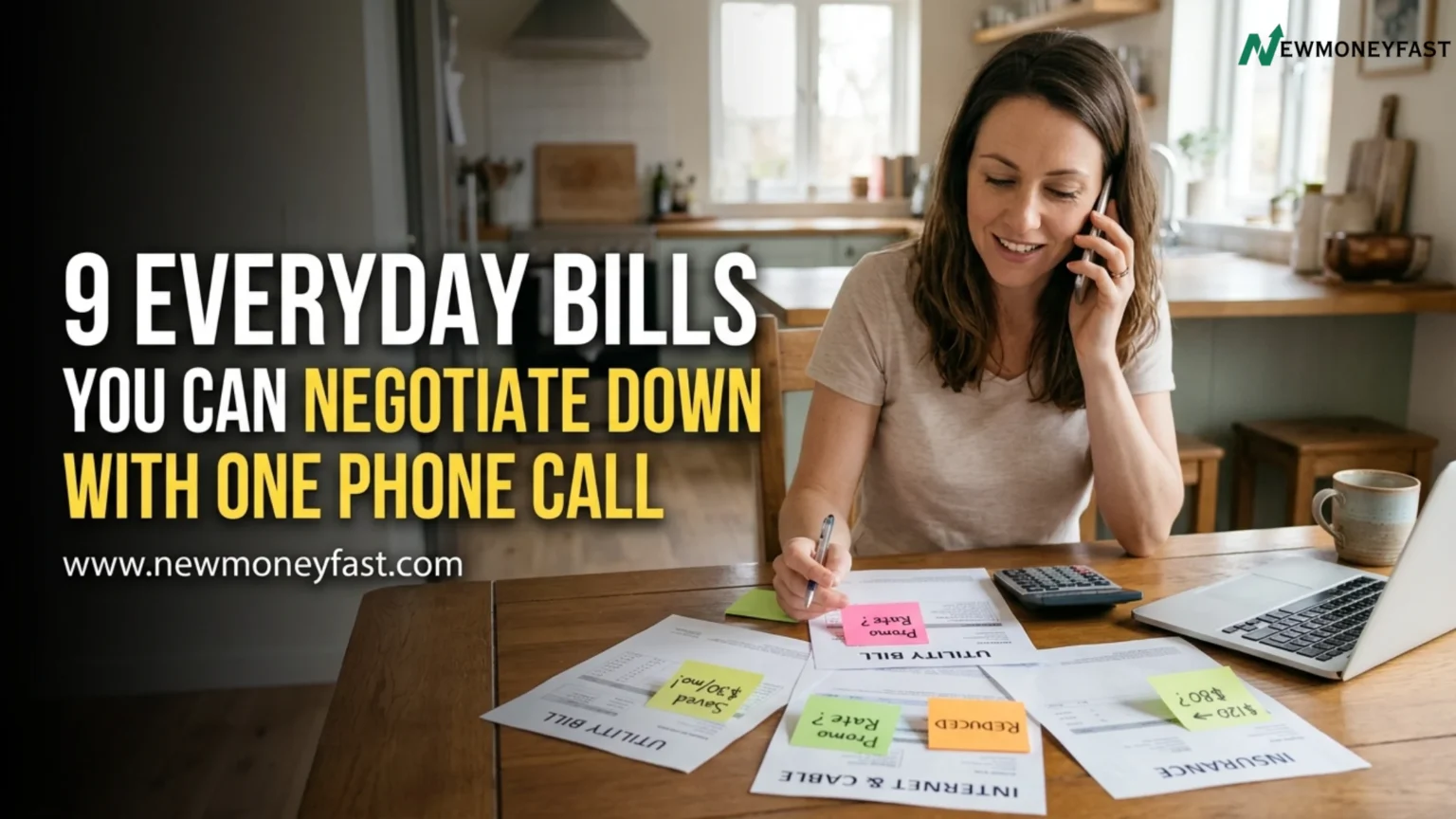
Yes, you can lower many monthly bills with one phone call, and the odds are better than most people think. In LendingTree’s 2026 survey, 84% of cardholders who asked for a lower interest rate got one. This guide covers nine bills worth calling about, what to say, and what each call can realistically save.
| KEY TAKEAWAYS• 84% of cardholders who asked for a lower APR got one, with an average cut of 6.3 percentage points (LendingTree, 2026).• The national full-coverage car insurance average is $2,241 a year, but similar drivers can see quotes $100 to $200 a month apart (Insurify, Oct 2026).• Subscriptions: 59.9% of people have at least one unused paid subscription, costing about $26.79 a month on average (Self Financial, 2026).• Median U.S. rent is $1,388 with a 7.0% vacancy rate, which gives renters real leverage (Apartment List, Sept 2026).• Timing matters: call 1 to 4 weeks before a renewal or promo ends. |
Why is now the best time to negotiate bills lower?
Fees and expiring promos keep pushing bills up, and renewals and holiday spending are close. A few calls this week can free up cash before year end. Each item below stands on its own, so pick the three that match your bills.
The 9 bills worth a phone call
1. Which car insurance bill can you lower with a call?
How It Works: Auto insurance is the biggest bill most people can renegotiate without moving. A re-rate can surface unclaimed discounts (bundling, telematics, low mileage, paid-in-full), and a competing quote gives you leverage.
Real Example: Insurify puts the national full-coverage average at $2,241 a year (Oct 21, 2026) and says similar drivers can see quotes $100 to $200 a month apart. NerdWallet shows the spread by company: GEICO averages $2,020 a year for full coverage, Allstate $3,210.
Estimated Savings: $120 to $600 a year from discounts alone; more with a far lower competing quote. Your state, age, and record drive the result.
Best For / Skip If: Best for anyone who has not shopped in two years. Skip if you just had an at-fault accident, since every quote will be high.
Action Step: Get two competing quotes, then call your insurer 3 to 4 weeks before renewal and ask for a full discount review.
2. Can you negotiate homeowners insurance?
How It Works: Yes, but you rarely haggle on price. You raise the deductible, add protective devices, confirm your roof age, and ask for a multi-policy discount.



Real Example: NerdWallet reports a national average of $2,490 a year for $400,000 of dwelling coverage (May 2026), from $1,940 at USAA to $4,235 at American Family.
Estimated Savings: $100 to $500 a year. A higher deductible lowers premium but raises your out-of-pocket cost after a claim.
Best For / Skip If: Best for owners with newer roofs or a bundle option. Skip a higher deductible if you could not cover it in cash.
Action Step: Ask: “Which discounts am I missing, and what is my premium at a $2,500 deductible?”
3. How do you cut your home internet bill?
How It Works: Promo rates usually end after 12 to 24 months and the price jumps. Say you are considering canceling and you are routed to a retention team with offers the regular line cannot give.
Real Example: The average listed plan costs about $75.72 a month, with a $63 median, and equipment rental adds $10 to $20. Fixed wireless averages about $45, a strong competing price to quote.
Estimated Savings: $10 to $30 a month, or $120 to $360 a year.
Best For / Skip If: Best for anyone past a promo period with a competitor at their address. Skip if you have one provider and already pay a low price.
Action Step: Call 1 to 2 weeks before the promo ends with two competitor prices in hand.
4. Is it worth negotiating your cell phone bill?
How It Works: Mostly through plan fit and loyalty credits. Price locks often do not cover fees, so review every add-on and fee line.
Real Example: Droid Life documented in January 2026 that carriers raised fees even on price-locked plans. T-Mobile advertises a 5-year lock and Verizon a 3-year lock; AT&T has made no price lock promise.
Estimated Savings: A $10 monthly credit saves $120 a year; removing an unused line saves more.
Best For / Skip If: Best for multi-line families and legacy plans. Skip mid-promotion, since changes can forfeit device credits.
Action Step: List every add-on and fee in your carrier app, then call and ask which are removable.
5. Will your credit card company lower your APR?
How It Works: Annual percentage rate (APR) is the yearly interest rate on a card balance. Issuers often say yes to on-time payers, and the same call can get a one-time late fee waived.
Real Example: LendingTree’s 2026 survey found 84% of cardholders who asked for a lower rate got one, with an average cut of 6.3 percentage points.
Estimated Savings: About $315 a year on a $5,000 balance (our simple math, not a LendingTree figure).
Best For / Skip If: Best for on-time payers carrying a balance. Skip if you missed payments recently.
Action Step: Call the number on your card: “I have been a customer for years. Can you lower my APR?”
6. How do you negotiate a hospital or medical bill?
How It Works: Request an itemized bill, check for duplicate charges, then ask about financial assistance. Nonprofit hospitals must have a policy under IRS section 501(r), and many offer prompt-pay discounts or payment plans.
Real Example: A patient with a $4,800 bill who meets a hospital’s income thresholds can see the balance cut sharply or erased. Each hospital sets its own thresholds, so ask for the written policy.
Estimated Savings: Highly variable, so we will not promise a figure. Asking is free and billing teams expect it.
Best For / Skip If: Best for surprise bills. Skip paying by card until the itemized bill is reviewed.
Action Step: Ask billing for the itemized statement and assistance application, and a hold on collections during review.
7. Can you negotiate your rent?
How It Works: Often, especially at renewal in softer markets. Landlords weigh a vacant unit against a small discount, so offer a longer lease or on-time history for a freeze.
Real Example: Apartment List reports a national median rent of $1,388 in September 2026, down 0.4% year over year, with a 7.0% vacancy rate.
Estimated Savings: $50 off a month is $600 a year; one free month at the median is $1,388.
Best For / Skip If: Best for clean-record renters in high-vacancy markets. Skip mid-lease with a small landlord.
Action Step: Pull three comparable listings and email a specific number 60 to 90 days before renewal.
8. Will your bank waive fees?
How It Works: Banks often waive maintenance fees and one-off overdraft fees for long-term customers who ask. If refused, a no-fee account is the stronger move.
Real Example: The National Consumer Law Center estimates banks collected more than $12 billion in overdraft and NSF fees in 2025. Fees run from $15 at Wells Fargo to $30 at Regions; Capital One, Citibank, American Express, and Ally charge none.
Estimated Savings: $15 to $30 per waived overdraft; a dropped maintenance fee saves its full annual cost.
Best For / Skip If: Best for a single recent fee. Skip if you overdraft often; fix the pattern first.
Action Step: Call the number on your debit card and ask for a courtesy waiver.
9. Which gym and subscription charges can you cut?
How It Works: Both are built for inertia. A cancel request often triggers a retention rate, and many services offer a pause.
Real Example: Self Financial’s March 2026 survey found 59.9% of people have an unused paid subscription, costing $26.79 a month on average. Truemed lists a $65 monthly gym average, or $780 a year.
Estimated Savings: About $321 a year from the unused-subscription average (our math).
Best For / Skip If: Best for anyone who has not reviewed statements in 90 days. Few reasons to skip.
Action Step: Export 90 days of card activity, circle every recurring charge, and cancel or negotiate the top three.
Which bills are worth the most effort? Side-by-side
| Bill | Typical cost (source) | Best script line | Savings potential | Effort |
|---|---|---|---|---|
| Car insurance | $2,241 a year (Insurify) | “I have a lower quote, can you match it?” | $120 to $600 a year | Medium |
| Home insurance | $2,490 a year (NerdWallet) | “What discounts am I missing?” | $100 to $500 a year | Medium |
| Internet | $63 median (CNET) | “I am thinking of canceling.” | $120 to $360 a year | Low |
| Cell phone | Varies by plan | “Which fees can you remove?” | $120+ a year | Low |
| Credit card APR | 6.3 point avg cut (LendingTree) | “Can you lower my APR?” | About $315 on $5,000 | Low |
| Medical bills | Varies | “Send the itemized bill and assistance form.” | Highly variable | High |
| Rent | $1,388 median (Apartment List) | “Can we freeze rent on a 12-month renewal?” | $600+ a year | Medium |
| Bank fees | $15 to $30 per overdraft | “Please waive this as a courtesy.” | $15 to $30 per fee | Low |
| Gym and subscriptions | $35.03 a month (Self) | “Cancel, unless there is a better rate.” | About $321 a year | Low |
How do you run the call? A simple 5-step script
- Prepare: have your account number, current price, and one competing offer in front of you.
- Open politely: “I have been a customer for X years and want to keep my service, but the price is higher than I can justify.”
- Ask for retention or loyalty: if the first agent cannot help, ask to be transferred.
- Anchor with a number: name the price you want, not just “a discount.”
- Confirm in writing: get the new rate, the end date, and a confirmation email.
| LEVEL UP: PICK YOUR NEGOTIATION LEVEL• Beginner: Call your bank and ask to waive one fee. Time: 10 minutes.• Pro: Negotiate your internet and card APR in the same week. Time: 1 hour.• Expert: Get two competing quotes, then renegotiate car insurance and rent. Time: 3 hours. |
| THE 7-DAY CHALLENGEMake one call a day this week. Track what you save in a note. Tag a friend who is paying a promo price they forgot about, and post your result with #NMFBillChallenge. |
| QUICK WINS BOX• Total potential: roughly $1,000 to $2,500 a year if you land four to six of these (our estimate from the ranges above; results vary).• Time investment: 10 to 30 minutes per call.• Difficulty: Easy to Medium (medical bills are the hardest).• Best for: anyone with a recent price increase, an expiring promo, or a renewal within 60 days. |
FAQ: Negotiating bills
Can you really negotiate bills with just a phone call?
Yes, many bills are negotiable. LendingTree’s 2026 survey found 84% of cardholders who asked for a lower APR received one. Results vary by company and your account history.
What is the best day and time to call?
There is no proven best time, but calling on a weekday morning with time to spare helps. Call 1 to 4 weeks before a renewal or promo ends so you have leverage.
What should I say to get a lower bill?
Say you value the service but need a lower price, then name a competing offer and a target price. Ask for the retention team if the first agent cannot help.
Will negotiating hurt my credit score?
Usually no. Asking for a lower APR or a fee waiver is not a credit inquiry, though closing a card can affect your utilization. Ask the issuer before agreeing to anything that changes your account.
Which bill should I negotiate first?
Start with the easiest: a bank fee, a card APR, or an internet promo. These take 10 minutes and build confidence for bigger calls like insurance and rent.
Sources
- LendingTree survey on lower credit card rates, via KCTV5, Sept 2, 2026
- Insurify, Average Cost of Car Insurance, Oct 21, 2026
- Insurify, Car Insurance Costs Climb in First Half of 2026, Aug 11, 2026
- NerdWallet, Average Car Insurance Cost, 2026
- NerdWallet, Average Home Insurance Cost, May 2026
- PocketGuard, Average Internet Bill (Allconnect, CNET data), updated Oct 15, 2026
- Droid-Life, carrier price lock coverage, Jan 8, 2026
- IRS, Section 501(r) financial assistance policies
- Apartment List, October 2026 Rental Market Recap
- National Consumer Law Center, overdraft fee issue brief, June 3, 2026
- Self Financial, Cost of Unused Paid Subscriptions 2026
- Truemed, Gym Membership Prices, updated Oct 6, 2026
- Achieve via Stacker, 7 common bills you can negotiate, Aug 17, 2026
- FCC Consumer Complaint Center