

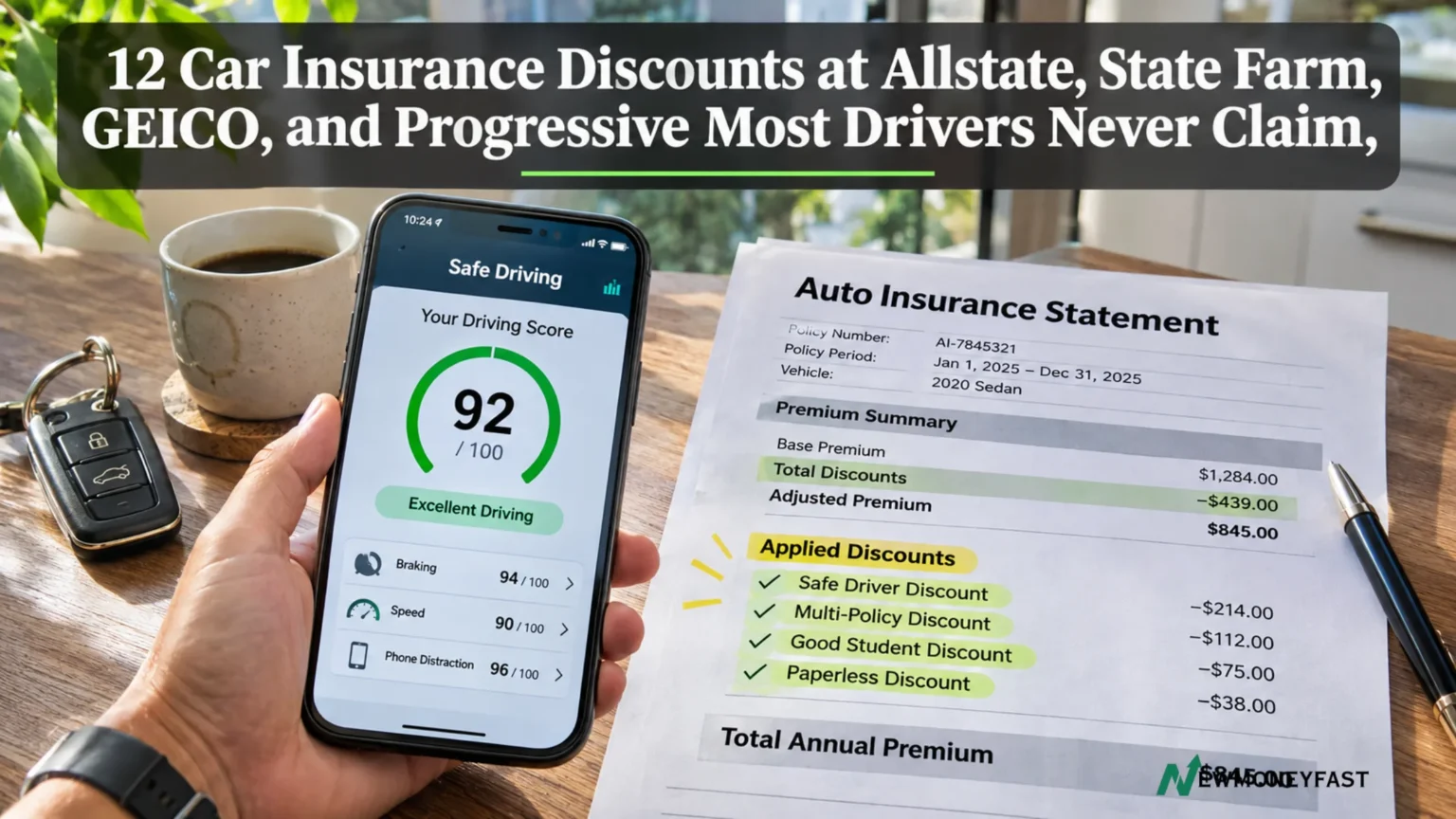
You can likely lower your car insurance by claiming discounts you already qualify for. At Allstate, State Farm, GEICO, and Progressive, single discounts range from a few percent to 25% or 30%, and many stack. The catch: several only apply when you ask, enroll in an app, or update your policy details.
| KEY TAKEAWAYS: State Farm’s Drive Safe & Save program can cut premiums by up to 30% based on how you drive (State Farm).GEICO offers up to 25% for insuring multiple vehicles, up to 15% for military members, and up to 12% for federal employees (GEICO).Progressive says customers who save with Snapshot average $328 a year, and its auto customers average seven discounts (Progressive).Allstate’s multiple policy discount can save up to 25% when you bundle auto and home (CNBC Select).Full coverage now averages $2,697 a year, so every 10% in discounts is worth about $270 (Bankrate). |
Why Are So Many Car Insurance Discounts Left Unclaimed?
Most drivers do not know what is in their policy. In J.D. Power’s 2026 U.S. Auto Insurance Study, only 58% of customers said they fully understand their policy, down 4 points from 2025, and 30% reported an insurer-initiated premium increase (J.D. Power). If you do not know what you are paying for, you will not spot the discounts you are missing.
Prices are still high even as the market cools. Bankrate puts average full coverage at $2,697 a year, up about 12% since 2024 (Bankrate). That makes a 15-minute discount review one of the highest-paying calls you can make this month.
12 Discounts to Claim Before Your Next Renewal
1. Safe-Driving App (Telematics) Discount
How it works: Telematics means your insurer uses a phone app or plug-in device to score how you drive: braking, speed, phone use, and time of day. You usually get a small discount just for enrolling. Your renewal discount then depends on your score.
Real example: State Farm’s Drive Safe & Save offers savings of up to 30%, with availability varying by state (State Farm). GEICO’s DriveEasy goes up to 25% (AutoInsurance.org). Progressive says drivers who save with Snapshot average $328 a year (Progressive). Allstate’s version is Drivewise.
Estimated savings: On a $2,697 policy, a 15% telematics score is worth about $405 a year.
Pros: Largest single discount available to drivers of any age.
Cons: Progressive Snapshot and GEICO DriveEasy can raise rates for risky driving, and you share driving data.



Best for: Daytime commuters with smooth, low-mileage driving.
Skip this if: You often drive late at night, brake hard in heavy traffic, or share the car with a teen who will.
Action step: Ask your insurer: “Can this program raise my rate in my state?” Enroll only if the answer works for you.
2. Multi-Policy (Bundle) Discount
How it works: Buying auto plus home, renters, or condo insurance from one company usually earns a discount on one or both policies. Even renters insurance can trigger it. Progressive also gives a homeowner discount when your house is insured elsewhere.
Real example: Allstate advertises up to 25% for bundling auto and home (CNBC Select). Progressive says home and auto bundlers save an average of 7% on auto (Progressive). Compare.com lists State Farm’s multi-policy savings at up to 17% (Compare.com).
Estimated savings: 7% to 25% on the auto premium, about $189 to $674 on a $2,697 policy.
Pros: One bill and one app for multiple policies.
Cons: The bundle price can still lose to two separate cheaper policies.
Best for: Homeowners and renters with a clean claims history.
Action step: Get a bundled quote and two separate quotes, then pick the lower total, not the bigger discount.
3. Multi-Car Discount
How it works: Insuring two or more vehicles on one policy spreads the insurer’s costs, so each car costs less. Some insurers count motorcycles, ATVs, or trailers too. Vehicles usually need to be kept at the same address.
Real example: GEICO offers up to 25% on most coverages for multiple vehicles (GEICO). Progressive’s multi-car customers save 12% on average (Progressive). Compare.com lists State Farm at up to 20% (Compare.com).
Estimated savings: 12% to 25%, often the biggest automatic win for families.
Pros: Applies automatically once cars share a policy.
Cons: Roommates or relatives may not qualify everywhere.
Best for: Couples and families with two or more cars.
Action step: If your household’s cars sit on separate policies, request a combined quote at your next renewal.
4. Good Student Discount
How it works: Full-time students with strong grades are statistically safer drivers, so insurers reward a B average or a 3.0 GPA. It is one of the few levers parents have against teen premiums. You must send proof, such as a report card, usually each year.
Real example: State Farm offers up to 25% until the student turns 25 (State Farm). GEICO offers up to 15% and Progressive averages 10% (GEICO; Progressive). Adding a teen raises average full coverage to $5,675 a year (Bankrate).
Estimated savings: $568 to $1,419 a year at 10% to 25% on a $5,675 teen-driver policy.
Pros: Large, reliable savings that renew while grades hold.
Cons: Lost if grades slip or the student drops below full time.
Best for: Families with drivers aged 16 to 24.
Action step: Email this semester’s report card or transcript to your agent the day it posts.
5. Student Away at School Discount
How it works: If a student on your policy attends school far from home without a car, they only drive when visiting. Insurers lower the rate for that reduced risk. Distance rules vary by insurer and state.
Real example: State Farm, GEICO, and Progressive all list a student away or distant student discount (State Farm; GEICO; Progressive). None publish a fixed percentage, so ask for the exact figure.
Estimated savings: Varies by state and insurer. Often stacks with good student.
Pros: Keeps the student covered for holiday visits.
Cons: Lost if the student takes a car to campus.
Best for: Parents of college students home for winter break.
Action step: Before winter break, call and confirm the campus address and that no car is at school.
6. Young Driver Training Discount
How it works: Insurers reward new drivers who finish an approved training program. State Farm’s Steer Clear uses videos and trip logging. GEICO and others offer driver training and defensive driving discounts that vary by state.
Real example: WalletHub reports Steer Clear can save up to 15% for drivers under 25 with no at-fault accidents or tickets in three years (WalletHub). GEICO lists driver training and defensive driving discounts (GEICO).
Estimated savings: Up to 15% for eligible drivers under 25.
Pros: Free or low-cost, and it builds better habits.
Cons: Takes a few weeks of logged drives to complete.
Best for: Drivers under 25 with a clean record.
Action step: Ask for the enrollment link today so the discount lands by the next renewal.
7. Accident-Free and Clean Record Discount
How it works: Staying free of at-fault accidents and violations earns a growing discount. Some insurers apply it automatically, while new customers often need to prove history from a prior insurer. It is the reward for doing nothing wrong.
Real example: GEICO offers up to 22% after at least one accident-free year (GEICO). WalletHub reports State Farm’s accident-free discount at up to 25% after three years (WalletHub). Allstate’s safe driving rewards give $100 a year, up to $500 (Jerry).
Estimated savings: Up to 22% to 25%, plus Allstate’s deductible-style rewards.
Pros: Grows with time and needs no app.
Cons: One at-fault claim can wipe it out for years.
Best for: Drivers with three or more clean years.
Action step: Ask: “Is my accident-free discount applied, and at what tier?” Get the answer in writing.
8. Military, Federal Employee, and Group Membership Discounts
How it works: These are affinity discounts, meaning you save because of where you work or a group you belong to. GEICO leads here with discounts for service members, federal workers, and hundreds of alumni, professional, and employer groups.
Real example: GEICO offers up to 15% for active, retired, Guard, and Reserve members, up to 25% for emergency deployment, and its Eagle discount of up to 12% for federal employees (GEICO). GEICO lists 500+ partner groups.
Estimated savings: Up to 12% to 15%, or up to 25% while deployed.
Pros: Easy to verify and often overlooked.
Cons: Strongest at GEICO; others vary by state and group.
Best for: Military families, federal workers, and union or alumni members.
Action step: List every employer, association, and alumni group you belong to, then ask which ones qualify.
9. Early Signing and Early Shopper Discount
How it works: Insurers reward planners. If you buy a new policy days before your current one ends, you look like a lower-risk customer than someone switching at the last minute. This is one of the easiest discounts to grab when switching.
Real example: Allstate’s Early Signing discount applies when you sign at least seven days before the policy starts, worth up to 10% according to Finder (Finder). GEICO lists an early shopper discount (GEICO).
Estimated savings: Up to 10% on a new Allstate policy.
Pros: Costs nothing except good timing.
Cons: Only applies when you start a new policy.
Best for: Anyone shopping at renewal.
Action step: Set a reminder 30 days before renewal and sign any new policy at least 7 days early.
10. Online Quote, E-Signature, and Paperless Discounts
How it works: Digital customers cost less to serve, so insurers share some savings. Quoting online, signing documents electronically, and choosing email billing each can earn a small discount. They stack.
Real example: Progressive reports average savings of 7% for an online quote and 9% for signing online, plus a paperless discount (Progressive). Allstate calls its paperless discount eSmart (CNBC Select).
Estimated savings: Up to 16% combined at Progressive, by its own averages.
Pros: Takes minutes to set up.
Cons: Mostly for new policies; existing customers may only get paperless.
Best for: Self-service shoppers.
Action step: Start your next quote online, even if you finish by phone, and switch to paperless today.
11. Pay-in-Full, Autopay, and Responsible Payer Discounts
How it works: Monthly billing costs insurers money, so they reward people who pay upfront or automatically. Some also reward a clean payment history. Installment fees you avoid add to the savings.
Real example: Progressive offers pay-in-full and automatic payment discounts (Progressive). Allstate has FullPay, worth up to 10% according to Finder, plus EZ Pay and Responsible Payer discounts (Finder; CNBC Select).
Estimated savings: Up to 10% for paying in full at Allstate, plus avoided installment fees.
Pros: Guaranteed savings once set up.
Cons: Paying six months at once can strain a December budget.
Best for: Drivers with an emergency fund or year-end bonus.
Skip this if: Paying upfront would push you onto a credit card balance.
Action step: Ask for both prices: monthly with autopay, and paid in full. Choose the lower total you can afford.
12. New Car and Vehicle Safety Discounts
How it works: Newer cars and safety features lower claim costs, so insurers price them in. Anti-theft devices, airbags, and anti-lock brakes can each trim certain coverages. These usually apply automatically, but VIN errors can block them.
Real example: GEICO offers up to 15% for vehicles three model years old or newer (GEICO). Allstate gives a new car discount to the first owner (CNBC Select). Compare.com lists State Farm’s passive restraint discount at up to 40% on medical coverage (Compare.com).
Estimated savings: Up to 15% on certain coverages for new cars.
Pros: Mostly automatic.
Cons: Applies to specific coverages, not your whole premium.
Best for: First owners of 2025 to 2027 model-year vehicles.
Action step: Check that your policy lists the correct VIN and trim level so every safety feature counts.
How Do Allstate, State Farm, GEICO, and Progressive Compare?
Discounts start from different base prices, so compare the insurer before the coupon.
| Insurer | Avg. full coverage | AM Best | J.D. Power 2026 | Best for |
|---|---|---|---|---|
| GEICO | $179/mo | A++ (Superior) | Rated; did not lead a region | Military and federal workers, multi-car families |
| Progressive | $223/mo | A+ (Superior) | Rated; did not lead a region | Online shoppers and Snapshot-friendly drivers |
| State Farm | $239/mo | A+ (Superior), lowered from A++ Nov 2025 | Led Northwest region, 667 vs. 644 national | Teen and student drivers, telematics savers |
| Allstate | $267/mo | A+ (Superior), affirmed | Rated; did not lead a region | Home and auto bundlers, new-car owners |
Rates: CarInsurance.com, Quadrant Information Services data for a 40-year-old with good credit and a clean record driving a Honda Accord LX, page updated Sep 22, 2026. Ratings: AM Best via Carrier Management, Insurance.com, and the J.D. Power 2026 U.S. Auto Insurance Study. Your quote will vary by state, age, vehicle, and driving and credit history.
Which Car Insurance Discounts Does Each Insurer Offer?
Figures are the maximum or average each company or a named reviewer publishes. Blank cells mean no published figure, not that the discount is missing.
| Discount | Allstate | State Farm | GEICO | Progressive |
|---|---|---|---|---|
| Safe-driving app | Drivewise | Up to 30% | Up to 25% | $328/yr avg for savers |
| Bundle | Up to 25% | Up to 17%* | Offered | 7% avg (home + auto) |
| Multi-car | Offered | Up to 20%* | Up to 25% | 12% avg |
| Good student | Smart Student | Up to 25% | Up to 15% | 10% avg |
| Accident-free | $100/yr rewards, up to $500 | Up to 25%* | Up to 22% | Continuous insurance |
| Affiliation | Ask agent | Ask agent | Military 15%, federal 12% | Ask agent |
| Early signing | Up to 10%* | Not published | Early shopper | Not published |
| Online and paperless | eSmart | Not published | Internet quote | 7% quote, 9% sign online |
| Pay in full | FullPay, up to 10%* | Not published | Paid in full | Offered |
| New car or safety | New car | Passive restraint, up to 40% on medical* | New vehicle, up to 15% | Not published |
* Third-party figure (Compare.com, WalletHub, Finder, or Jerry) where the insurer does not publish one. Company figures come from State Farm, GEICO, Progressive, and CNBC Select’s Allstate review. Availability and amounts vary by state. Checked November 14, 2026.
Level Up: Your Challenge
| THE 15-MINUTE DISCOUNT CALL CHALLENGECall your insurer this week and read this script: “Can you list every discount on my policy, and every one I qualify for but am not getting? I am comparing quotes before renewal.”Beginner: Turn on paperless and autopay. Five minutes.Pro: Add a bundle or multi-car quote and send proof of good grades.Expert: Enroll in the telematics app, then re-shop three insurers 30 days before renewal and sign early.Post your before-and-after premium with #NMFDiscountCall. |
| QUICK POLLWould you let an app track your driving for a 20% discount? Yes, no, or only if it cannot raise my rate? Tell us below.Tag a friend whose teen just got a license. The good student discount alone could be worth over $1,000 to them. |
| QUICK WINSTotal potential savings: About $270 to $810 a year on a $2,697 full coverage policy if your discounts add up to 10% to 30%Time investment: 15 to 30 minutes on the phone, plus about six months in a telematics programDifficulty: EasyBest for: Multi-car households, students, military and federal families, and anyone renewing in the next 60 days |
Frequently Asked Questions
What is the biggest car insurance discount in 2026?
The biggest car insurance discounts are telematics, bundling, and multi-car savings. State Farm’s Drive Safe & Save reaches up to 30%, while Allstate’s bundle and GEICO’s multi-vehicle discount each reach up to 25% (State Farm; GEICO).
Can you stack car insurance discounts?
Yes, most discounts stack. Progressive says its auto customers average seven discounts (Progressive). Some combinations are restricted by state or by the insurer, so ask for a written list of what applies.
Can a safe-driving app raise my insurance rate?
Yes, at some insurers. GEICO says risky driving in DriveEasy can increase rates, and Progressive’s Snapshot can also raise rates in many states (Insurify). Ask whether your state’s version can surcharge before you enroll.
How often should I ask my insurer about discounts?
Ask at every renewal, usually every 6 or 12 months. Also call after any life change, such as new grades, a new car, a move, marriage, or a new job with an affinity group.
Is it worth switching insurers just for discounts?
Switching is worth it only if your total price drops after discounts. Progressive says drivers who switch and save cut nearly $750 on average, though results vary (Progressive). Compare at least three quotes with the same coverage limits.
| SEE WHICH INSURER GIVES YOU THE MOST DISCOUNTSCompare personalized quotes from Allstate, State Farm, GEICO, Progressive, and more in one place, with every discount you qualify for applied.[AFFILIATE LINK: The Zebra / Policygenius car insurance quote tool]Quote tools are comparison services, not insurers. Your final price comes from the insurer you choose. |
Sources
- State Farm: Auto insurance discounts
- GEICO: Car insurance discounts
- GEICO: Discount savings table (membership page)
- Progressive: Auto insurance discounts
- Progressive: Car insurance overview (Snapshot and discount averages)
- CNBC Select: Allstate car insurance review
- Finder: Allstate car insurance review
- Jerry: Allstate auto insurance review 2026
- Compare.com: State Farm car insurance discounts
- WalletHub: State Farm discounts
- AutoInsurance.org: GEICO DriveEasy review (2026)
- Bankrate: Average cost of car insurance
- Bankrate: True cost of auto insurance press release (teen driver cost)
- CarInsurance.com: Best car insurance companies (Sep 2026)
- J.D. Power: 2026 U.S. Auto Insurance Study
- Carrier Management: AM Best downgrades State Farm Mutual to A+
- Insurify: GEICO DriveEasy review
- Insurance.com: Insurance company financial ratings (AM Best)