
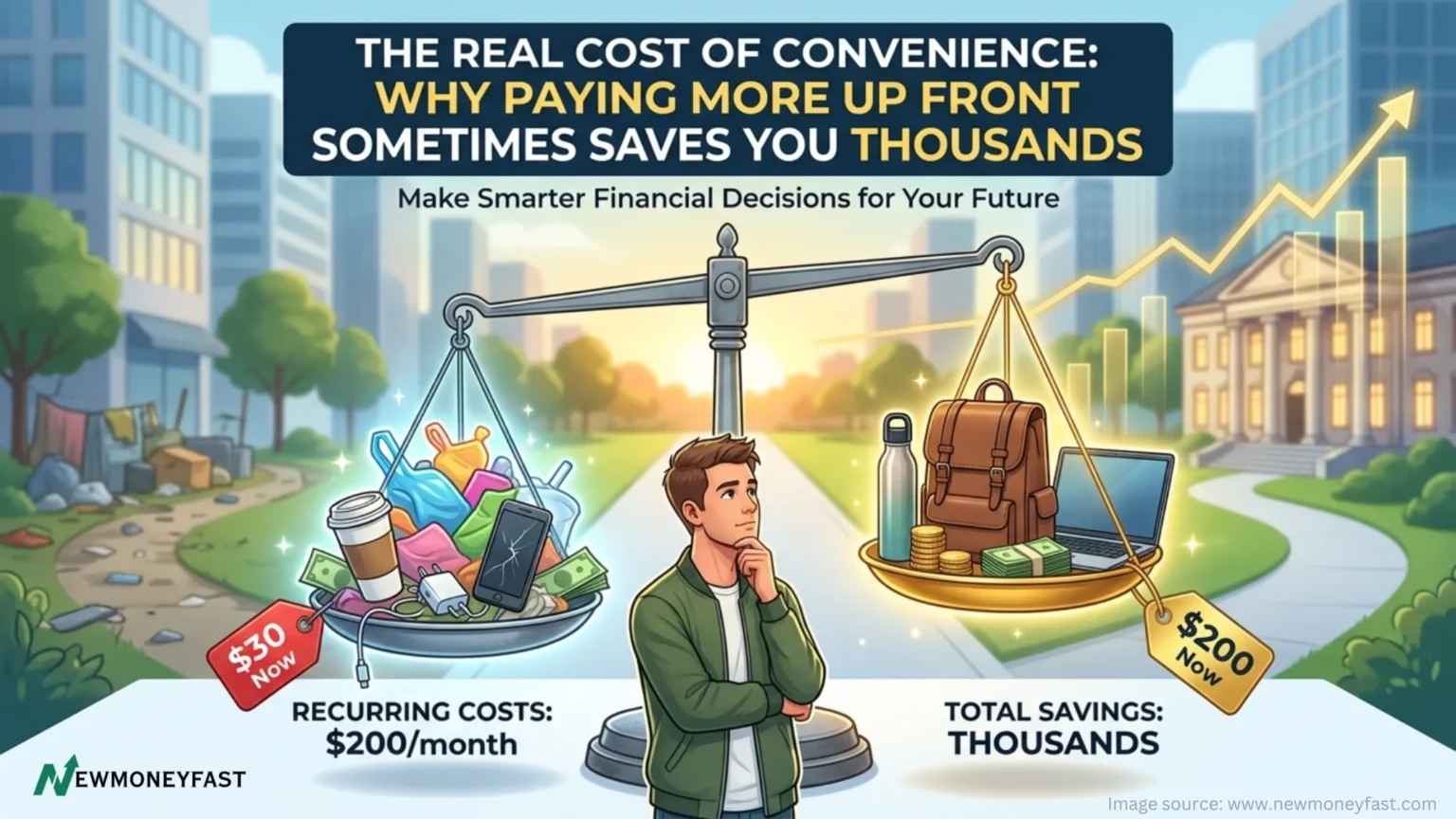
Convenience is not free. It just hides the price tag really, really well.
The average American now spends over $1,566 a year on food delivery alone, and that number does not even touch the subscriptions, single-use buys, and cheap-then-replace purchases draining accounts month after month. But here is the flip side nobody talks about: sometimes paying more up front is the smartest financial move you can make.
The trick is knowing which is which. This guide breaks down exactly where convenience is quietly costing you thousands and exactly where spending more now saves you a fortune later.
| THE NUMBERS THAT SHOULD MAKE YOU PAUSE$1,566/year: what the average American spends on food delivery apps$219/month: average monthly subscription spending, yet people estimate just $8671%: how much more a DoorDash order costs vs. the same meal at the restaurant63%: of Americans admit they have been burned by buying the cheap version of something |
Part 1: Where Convenience Is Quietly Bleeding You Dry
Before you can play smart financial offense, you need to know where convenience is playing defense against your wallet. These are the four biggest hidden drains that most people wildly underestimate.
1. The Food Delivery Trap
Food delivery feels like a $15 meal. It is actually a $33-plus event by the time you factor in delivery fees, service charges, menu markups, and a tip.
A Self Financial study found that DoorDash charges 71.1% more than buying directly from the restaurant. That same McDonald’s order costing $36.95 in-store rings up to $63.21 when delivered. UberEats is not far behind at $62.60, a 69.4% markup.
And Americans are not ordering occasionally. The average person places 54.4 food delivery orders per year, spending roughly $152 per month or $1,844 annually on delivery alone. That is a car payment. That is a vacation. That is real money.
| THE REAL COST MATHIf you order food delivery 3 times per week at an average of $33 per order:Monthly cost: $396Annual cost: $4,752The same meals cooked at home (batch cooking): approx. $594/yearPotential annual savings: $4,158 |
The Fix: Use delivery strategically, not habitually. Limit to 2 to 3 orders per week max, use DashPass or Uber One memberships to cut fees when you do order, and pick up directly from the restaurant whenever possible. That alone slashes the markup immediately.


2. The Subscription Perception Gap
Here is a stat that should stop you cold: the average American spends $219 per month on subscriptions but estimates they only spend about $86. That is a 2.5x gap between what they think they pay and what actually leaves their account every single month.
The average person is paying for 8.2 active subscriptions including streaming, food delivery passes, fitness apps, software, and more. Most people cannot name all of them without checking their bank statement.
| ACTION STEP: Right now, open your bank app and search “subscription.” List every recurring charge. Cancel anything you have not used in 30 days. Most people find at least $40 to $80 in zombie subscriptions they forgot about. |
For more on this, see our full guide: Your Subscriptions Are Draining $200 a Month Without You Knowing.
3. The Cheap-Then-Replace Cycle
The cheap blender. The budget sneakers. The discount kitchen knife that bends on the first carrot. Over six in ten Americans (63%) admit they have been burned by buying the cheap version of a product, according to a study reported by StudyFinds.
Consider the math on a blender: a $20 model that breaks in six months versus a $100 model that lasts five years. Over five years you spend $200 on cheap blenders versus $100 on the quality one, and you also lose time, frustration, and the convenience of having a blender that actually works when you need it.
The cycle is the same across tools, clothing, appliances, and electronics. The cheap version feels like the smart financial choice. It is usually the most expensive one over time.
4. The Single-Use Mindset
Bottled water. Individually-packaged snacks. Paper towels instead of reusable cloths. Coffee pods instead of ground coffee. These feel like small decisions. Stacked across a year, they represent hundreds of dollars in the convenience premium, the invisible surcharge you pay for not buying in a smarter format.
A single-serve coffee pod costs roughly $0.70 to $1.00 per cup. A bag of quality ground coffee runs about $0.15 to $0.20 per cup. If you brew two cups a day, the switch saves $365 to $584 per year without changing anything about your morning ritual.
The Convenience Premium: What You Actually Pay
These side-by-side comparisons show how the convenience markup adds up across everyday spending:
| Category | Convenience Cost | Smarter Alternative | Annual Savings |
|---|---|---|---|
| Food delivery (3x/week) | $4,752/year | Batch cook + 1 delivery/week | $2,800+ |
| Coffee pods (2 cups/day) | $511-$730/year | Ground coffee, same quality | $370-$580 |
| Bottled water (1/day) | $365-$730/year | Filter pitcher or tap | $300-$680 |
| Cheap shoes (replace 2x/year) | $120-$200/year | Quality pair, 3-5 year lifespan | $60-$120 |
| Cheap blender (replace every 6 mo) | $40+/year | Quality blender, 5-year lifespan | $20-$40 |
| Zombie subscriptions | $80-$150/month est. | Cancel unused services | $960-$1,800/yr |
Part 2: When Paying More Up Front Wins Every Time
This is where the narrative flips. Not all “convenience” spending is wasteful. And not all expensive purchases are bad value. There are categories where the higher upfront cost is actually the cheaper long-term choice, and recognizing them is the mark of a genuinely smart spender.
1. Quality Everyday Items You Use Constantly
The rule is simple: the more you use something, the more the cost per use metric matters. A $300 quality chef’s knife used twice a day for 15 years costs you $0.05 per use. A $30 knife you replace every 18 months costs you $0.11 per use, and it also makes cooking more frustrating.
Categories where quality wins:
- Running shoes. Performance shoes protect your feet and last 400 to 500 miles. Budget options technically cover the same distance but often lead to pain and potential medical costs far exceeding the price difference.
- Mattress. A quality mattress ($800 to $1,500) lasting 10 years costs $80 to $150 per year. A budget mattress ($300) lasting 3 years costs $100 per year, and it also affects your sleep quality and back health.
- Kitchen appliances. A reliable stand mixer, cast-iron pan, or quality blender pays dividends every single day for a decade or more.
- Outerwear and work clothing. A $200 winter coat worn for 10 years costs $20 per year. A $50 coat replaced every 2 seasons costs $25 per year and adds up to $250 over the same span.
2. Warehouse Club Memberships
Paying $65 per year for a Costco membership or $50 for Sam’s Club feels like an upfront cost. For most households it is actually a financial accelerator. Nearly 1 in 3 American households now holds a warehouse club membership, and families with typical spending can easily save $2,000 or more annually on groceries, household staples, and gas.
Costco’s Executive membership ($130/year) pays 2% cash back on purchases. Spend $6,500 per year at Costco, and the membership pays for itself before you count any actual price savings.
| SMART MOVE: If you are already spending $150+ per week at a regular grocery store, a warehouse club membership likely pays for itself in the first month. Our upcoming comparison of Costco vs. Sam’s Club breaks down exactly which membership earns more based on your shopping patterns. |
3. Preventive Care That Avoids Huge Bills
This one applies beyond products. Skipping a $100 dental checkup to “save money” is a classic example of convenience thinking costing you dearly. A single cavity filling runs $150 to $300. A root canal runs $1,000 to $3,000. The $100 cleaning is not an expense; it is a hedge.
The same logic applies to:
- Car maintenance. A $50 oil change every 5,000 miles prevents a $3,000 to $5,000 engine repair. This is not frugality; it is math.
- Home weatherstripping and caulking. A $10 to $15 tube of caulk around drafty windows can cut heating and cooling costs by up to 15% annually, as we covered in our utility bill guide.
- Quality cookware. Invest once in a cast-iron skillet or stainless steel pan and you eliminate the recurring cost of replacing Teflon pans that wear out every 1 to 2 years.
4. Buying in Bulk on Non-Perishables
Bulk buying is one of the cleanest examples of paying more up front to spend less overall. Toilet paper, laundry detergent, olive oil, canned goods, and coffee purchased at warehouse prices typically run 20 to 40% less per unit than the same items bought individually at a grocery store.
The catch: bulk buying only saves money on things you will actually use before they expire, and only if it does not trigger you to use more faster (a documented phenomenon with items like snack foods and paper towels). Stick to true household staples: cleaning supplies, canned goods, rice, pasta, and personal care items.
The 3-Question Framework: Should You Pay More or Less?
Before every significant purchase, run it through this three-question test. It takes 30 seconds and prevents years of regret in either direction.
| THE NEW MONEY FAST BUY-SMART FRAMEWORKQuestion 1: How often will I use this?Daily or weekly users: buy quality. Monthly or occasional users: buy the cheaper version or rent/borrow.Question 2: What is the cost per use?Divide the price by estimated uses over its lifespan. A $200 item used 1,000 times costs $0.20 per use. A $50 item used 100 times costs $0.50 per use. The expensive item is cheaper.Question 3: What is the cost of the alternative?Is this a convenience purchase to avoid a task or a genuine need? If it is avoidance, ask, “How much is that avoidance actually costing you per year at your current frequency?” |
| THE 30-DAY CONVENIENCE AUDIT CHALLENGEWeek 1: Pull your last 30 days of bank and card transactions. Highlight every convenience purchase: delivery fees, subscriptions, single-use items, and impulse cheap buys.Week 2: Calculate the annual cost of your top 3 convenience habits. Multiply one month by 12. Write the number down. Stare at it.Week 3: Pick one quality upgrade you have been avoiding. Use the cost-per-use calculation to decide if the higher price is actually the cheaper long-term choice.Week 4: Cancel at least one convenience subscription you rarely use. Redirect that money to either a quality purchase you have been delaying or your savings goal. |
Keep Building Your Money Momentum
Changing your relationship with convenience spending is one of the highest-leverage financial moves you can make. Pair this mindset shift with these other New Money Fast guides for maximum impact:
- Your Utility Bills Are Too High: Here Are 7 Fixes That Save $80 a Month
- Your Subscriptions Are Draining $200 a Month Without You Knowing
- 10 Things You Are Paying Too Much for Right Now (And the Apps That Fix Each One)
- Free vs. Paid Budgeting Apps: Which One Actually Helps You Save More?
Frequently Asked Questions
Is it always worth buying the more expensive version of something?
No, and that is the whole point. The quality premium only makes financial sense for items you use frequently and that benefit from durability. A cheap pen, a budget candle, or a store-brand cleaning spray are all fine. The quality rule applies to things with high daily-use frequency: shoes, kitchen tools, mattresses, outerwear, and appliances.
How do I calculate cost per use?
Divide the purchase price by the number of times you expect to use the item over its lifetime. A $150 cast-iron skillet used 500 times costs $0.30 per use. A $25 non-stick pan that lasts 200 uses before warping costs $0.13 per use upfront but $0.50 per use across five years of replacements. Time your replacements, and the cheaper pan becomes the more expensive one.
What is the fastest way to find out how much I am spending on convenience?
Search your bank statement or credit card app for recurring charges and delivery-related merchants. Apps like Rocket Money and YNAB can automatically categorize and surface your biggest convenience spending categories within minutes of setup.
Are warehouse club memberships actually worth it?
For most households that spend over $200 per month on groceries and household goods, yes. The math typically breaks even within the first month of regular shopping, and both Costco and Sam’s Club offer potential annual savings of $2,000 or more for typical families. The key is buying only items you will use before they expire or spoil.
What if I genuinely do not have time to cook? Is delivery always a bad idea?
Delivery is not inherently bad, but using it as a daily default is expensive. A hybrid approach works well: batch cook 2 to 3 nights per week, keep simple ready-to-eat staples on hand (rotisserie chicken, pre-cut vegetables, canned goods), and allow yourself 1 to 2 delivery nights as planned treats rather than default panic meals. That shift alone can save over $2,000 per year.
| YOUR MONEY IS SMARTER THAN YOUR HABITSEvery dollar you spend on convenience is a dollar that chose speed over strategy. Start choosing differently.Run the 30-Day Convenience Audit. Calculate your real annual delivery spend. Find one quality upgrade that beats your current replace-and-repeat cycle.Explore more fast, proven wins at newmoneyfast.com. |