

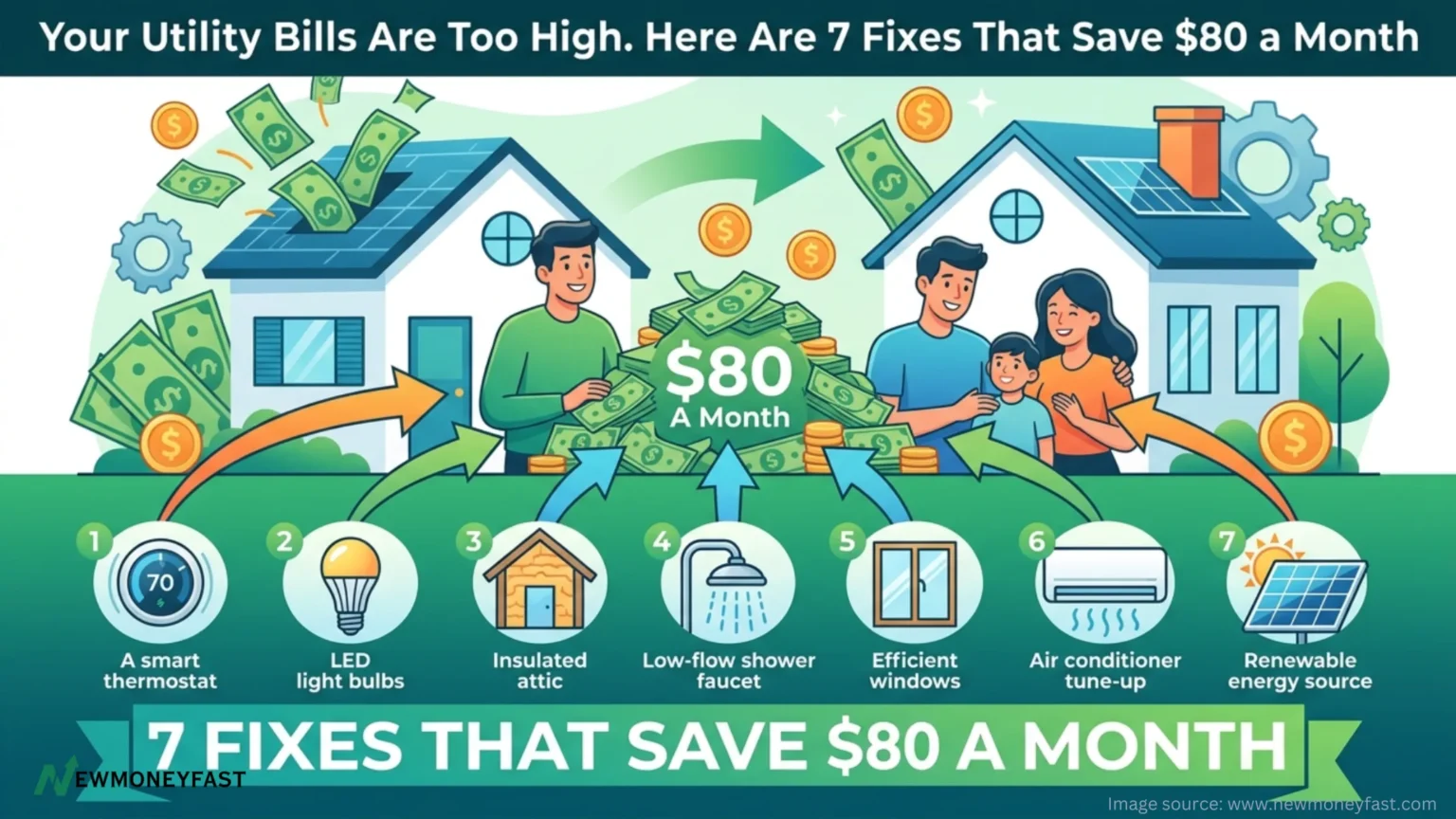
The average American household is now paying over $600 a month on utility bills. And here’s the gut punch: most of that money is pure waste.
Phantom power, inefficient thermostats, and zero-effort leaks are silently draining your account every single month. But with 7 targeted fixes, you can claw back $80 or more every month without giving up a single comfort.
Electricity costs alone have risen 26% over the past five years, pushing the average electric bill to $163/month as of May 2026. Add in gas, water, internet, and trash and you’re looking at a $600+ monthly drain. The good news? Most of the fixes below require zero major renovation and can be done this weekend.
| QUICK WINS SUMMARYTotal Potential Savings: $80 to $200+ per monthTime Investment: 30 minutes to set up most fixesDifficulty Level: Beginner-friendly, no tools required for mostBest For: Renters, homeowners, families, anyone with a monthly utility bill |
The 7 Fixes That Actually Lower Your Utility Bills
Fix 1: Hunt Down Your Phantom Power Loads
Most people have no idea their electronics are still drinking electricity while turned off. This invisible drain is called phantom load, or standby power, and it accounts for 5 to 10% of the average home’s total electricity use, according to the U.S. Department of Energy.
That adds up to between $100 and $183 per year, straight into your utility company’s pocket for absolutely nothing.
The biggest culprits: gaming consoles, cable boxes, smart TVs, desktop computers, and coffee makers all draw power around the clock even when you’re not using them.
| ACTION STEP: Pick up a smart power strip ($20 to $40 on Amazon) and plug your TV, gaming console, and entertainment system into it. One click cuts power to all of them. Or grab a Kill-A-Watt meter to identify your biggest phantom drains in minutes.Estimated Savings: $10 to $15 per month |
Fix 2: Install a Smart Thermostat This Weekend
Heating and cooling eat up 45 to 55% of your total energy bill, according to the EIA. That means your thermostat is the single biggest lever you have.
Switching to a smart thermostat like a Nest or Ecobee delivers 10 to 15% savings on heating and cooling costs, based on multiple utility field studies. Ecobee claims some users save up to $284 per year.



Unlike a manual thermostat, a smart thermostat learns your schedule, knows when you’re home, and adjusts automatically. You stop paying to heat or cool an empty house.
| ACTION STEP: A Nest Thermostat starts at $99 and can pay for itself in under a year. Most installs take under 30 minutes with a screwdriver. Check Energy Star’s rebate finder first, because many utility companies offer $50 to $100 back on smart thermostat purchases.Estimated Savings: $10 to $25 per month |
Fix 3: Switch Every Bulb to LED Tonight
Lighting accounts for around 15% of an average home’s electricity use. According to the U.S. Department of Energy, switching to LEDs saves the average household $225 per year in energy costs alone.
LED bulbs use at least 75% less energy than incandescent bulbs and last 15 to 25 times longer. A 10-pack of LED bulbs on Amazon runs about $12. That’s one of the highest return-on-investment upgrades you can make to your home.
| ACTION STEP: Go room by room tonight and swap out every incandescent for an LED equivalent. Focus on rooms where lights stay on longest: kitchen, living room, and home office. You’ll see the savings on your very next bill.Estimated Savings: $15 to $20 per month |
Fix 4: Track Your Usage With a Free Energy App
You cannot cut what you cannot measure. That’s why energy monitoring is one of the fastest ways to find hidden waste. Apps like Sense, Emporia Vue, and your utility’s own app show you exactly which appliances are draining the most power in real time.
If you’re in California, OhmConnect actually pays you cash and gift cards for reducing energy use during peak hours. For everyone else, Arcadia connects to your existing utility account and can automatically enroll you in community solar credits, no panels required.
| ACTION STEP: Download your utility company’s free app right now and check your usage history. Most utilities show a breakdown by appliance category. Spot the spike, fix the habit.Estimated Savings: $10 to $30 per month once you identify and fix high-usage culprits |
Fix 5: Fix the Leaks You Cannot See
A single dripping faucet can waste 3,000 gallons of water per year, according to the EPA. A running toilet? Up to 200 gallons per day. These are not just environmental issues, they are money leaks.
Beyond faucets: check your dishwasher door seal, washing machine hose connections, and water heater for slow drips. Also check for air leaks around doors and windows. Sealing gaps with weatherstripping ($8 to $15 at any hardware store) can slash your heating and cooling costs by up to 15%.
| ACTION STEP: Drop a dye tablet (free from many water utilities) into your toilet tank. If color appears in the bowl without flushing, you have a running toilet losing money every single hour. Fix a flapper valve for under $5.Estimated Savings: $8 to $25 per month depending on severity |
Fix 6: Run Appliances During Off-Peak Hours
This is a strategy most people have never heard of, and it is completely free. Many utilities use time-of-use (TOU) pricing, which means electricity costs more during peak demand hours (usually 4 PM to 9 PM on weekdays) and less overnight and on weekends.
Shifting your dishwasher, laundry, and EV charging to off-peak windows can cut your electric bill by 10 to 20% in deregulated states. Even in states with flat rates, running energy-intensive appliances at full loads (not half-loads) improves efficiency.
| ACTION STEP: Log into your utility’s website and look for a TOU or time-of-use rate plan. Set your dishwasher’s delay start feature to run at 10 PM. In deregulated states like Texas, Ohio, and Pennsylvania, compare electricity providers at ElectricChoice.com for instant rate savings.Estimated Savings: $10 to $25 per month |
Fix 7: Audit Your Bill and Negotiate Like a Pro
Here’s the fix most people never even try. You can call your utility company and ask for a lower rate, a budget billing plan, or a bill credit. Utility companies have programs that most customers never access because they never ask.
Low-income assistance programs (LIHEAP), budget billing, and levelized payment plans are available at most major utilities. Also check if your provider offers a free home energy audit, a service many utilities offer at no cost that identifies exactly where you’re losing money.
| ACTION STEP: Call your utility’s customer service line and say: “I’m looking to reduce my monthly bill. What rate plans, rebates, or programs are available to me?” Then ask specifically about free energy audits and budget billing options.Estimated Savings: $5 to $20 per month just from switching rate plans |
Your 7-Fix Savings Snapshot
Stack all 7 fixes and your monthly savings add up fast. Here’s the breakdown:
| Fix | What You Do | Est. Monthly Savings | Difficulty |
|---|---|---|---|
| 1. Phantom Loads | Smart power strip, unplug idle devices | $10 to $15 | Easy |
| 2. Smart Thermostat | Install Nest or Ecobee | $10 to $25 | Easy |
| 3. LED Bulbs | Swap all incandescents | $15 to $20 | Easy |
| 4. Energy App | Track + eliminate waste | $10 to $30 | Easy |
| 5. Fix Leaks | Seal faucets, windows, doors | $8 to $25 | Easy/Medium |
| 6. Off-Peak Scheduling | Run appliances overnight | $10 to $25 | Easy |
| 7. Negotiate Bills | Call your utility, ask for deals | $5 to $20 | Easy |
Combined Total: $68 to $160 in monthly savings. Most people land comfortably above the $80 mark.
| THE 30-DAY UTILITY KNOCKOUT CHALLENGEWeek 1: LED swap + smart power strip installed. Take a photo of your current bill.Week 2: Smart thermostat set up. Download your utility app and check your usage baseline.Week 3: Fix leaks, seal drafts, shift laundry to off-peak hours.Week 4: Call your utility company. Ask about rate plans, rebates, and free energy audits.Win: Compare your new bill to the photo from Week 1. Share your savings in the comments below. |
Keep the Savings Rolling
Lowering your utility bills is just one piece of the puzzle. Once you’ve freed up that $80+ per month, put it to work. Check out these New Money Fast guides to build real financial momentum:
- Free vs. Paid Budgeting Apps: Which One Actually Helps You Save More?
- Your Subscriptions Are Draining $200 a Month Without You Knowing
- 10 Things You Are Paying Too Much for Right Now (And the Apps That Fix Each One)
| VISUAL CONTENT SUGGESTIONS FOR DESIGN TEAM1. Before/After Graphic: Monthly utility bill at $610 vs. after-savings bill at $510, side-by-side with dollar bills or a piggy bank icon2. Phantom Load Infographic: Illustrated home floor plan showing which devices draw standby power and their annual cost3. Savings Progress Tracker: 30-day challenge calendar graphic, checkboxes for each fix, shareable for social media4. App Screenshot Collage: Screenshots of OhmConnect, Arcadia, Sense, and a utility company app on mobile screens |
Frequently Asked Questions
How much can I realistically save on my utility bills each month?
Most households that apply all 7 fixes save between $68 and $160 per month. The $80 figure is a conservative middle estimate. Your actual savings depend on your current usage, your home size, and your state’s electricity rate. Households in high-rate states like Connecticut and California typically save more.
Do I need to own my home to use these strategies?
No. Fixes 1, 3, 4, 6, and 7 work for renters. LED bulbs, smart power strips, energy apps, off-peak scheduling, and negotiating your own account are all renter-friendly. Smart thermostats require landlord approval but many landlords welcome them since they protect the property.
How quickly will I see results on my bill?
LEDs and phantom-load fixes show up on your very next bill. Smart thermostat savings typically appear within 1 to 2 billing cycles. The full combined impact of all 7 fixes usually becomes visible within 30 to 60 days.
Are free energy apps safe to use with my utility account?
Apps like Arcadia and OhmConnect connect via your utility’s official login portal using read-only access. They cannot change your account or make payments. Always download from official app stores and check the app’s privacy policy before connecting.
What if my utility company does not offer a time-of-use plan?
Even without TOU pricing, running appliances at full loads during non-peak hours improves efficiency. If you live in a deregulated state, you can also compare electricity providers at ElectricChoice.com to switch to a cheaper rate instantly. Deregulated states include Texas, Ohio, Pennsylvania, New York, Illinois, New Jersey, and more.
| START SAVING THIS WEEKYour utility company is counting on you to do nothing. Prove them wrong.Pick just ONE fix from this list and implement it today. Then come back tomorrow and do another one.Want more strategies like these? Explore the full New Money Fast savings library for more fast, proven wins. |
Sources
- U.S. Energy Information Administration: Lighting Choices to Save You Money
- Electric Choice: Average American Electric Bills by State (May 2026)
- Move.org: Utility Bills 101 – Average Monthly Cost of Utilities by State
- EnergySage: Energy Vampires – Phantom Loads Overview
- CLIQ For Home: How Much Can a Smart Thermostat Actually Save You? (2026)
- U.S. News Money: How to Estimate Utility Costs in 2026
- OhmConnect: Save Money by Saving Energy
- Electric Choice: Best Energy Tracking Apps and Devices (2026)
- Gas South: Reducing Phantom Energy Use
- Fox Sells Faster: Average Utility Bills by State in 2026