

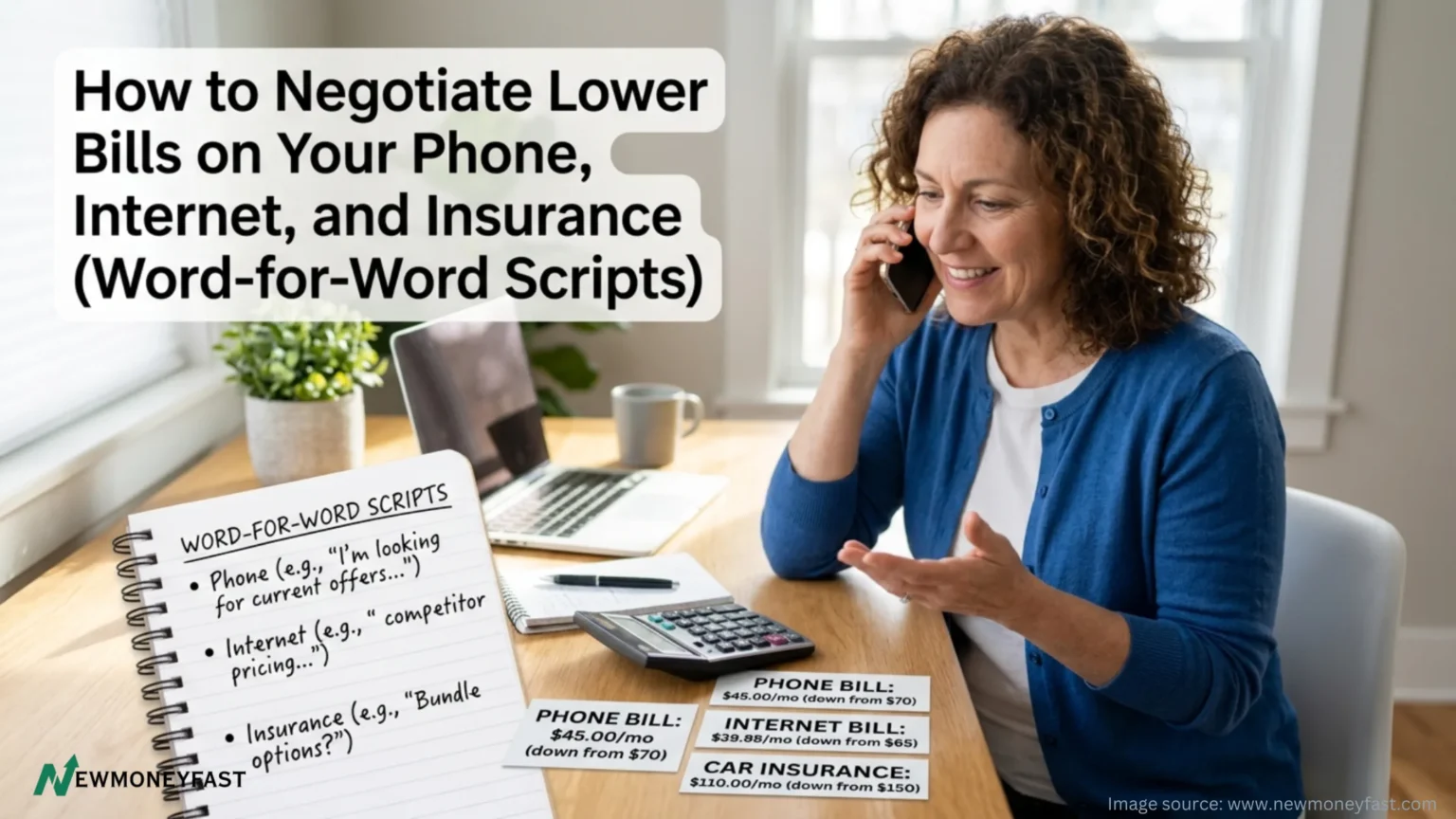
Your phone company, internet provider, and insurance company are all counting on you to do exactly one thing: nothing.
Research from LowerMySubs analyzing 2,000+ documented customer negotiations found that 87% of American households never negotiate their recurring bills, despite the fact that carriers and providers actively budget for retention discounts that never get claimed. The average household that does negotiate saves $200 to $400 per year across just two or three bills with two phone calls and 45 minutes of preparation.
This guide gives you the exact framework and word-for-word scripts that work for cell phone, internet, and car insurance bills. No experience required. No confrontation necessary. Just a calm, prepared phone call and the right words at the right moment.
| WHAT TWO PHONE CALLS CAN SAVE YOUPhone bill: Average single line $70 to $100/month. Negotiation or switching saves $15 to $40/month ($180 to $480/year)Internet bill: Average $75 to $81/month. Negotiation saves $10 to $40/month ($120 to $480/year)Car insurance: Shopping and stacking discounts saves $500 to $1,500+/year for most driversCombined annual savings potential: $300 to $600+ from phone and internet alone; $500 to $1,500+ on insuranceNegotiation success rate: 65 to 75% for internet and phone calls when using the retention department approach |
Before You Call: The Mindset That Gets Results
Most people approach bill negotiation as a confrontation. That is the wrong frame entirely. The right frame is: you are a loyal customer reviewing your options, and you are giving the company an opportunity to keep your business before you make a decision.
The two most important things to understand before picking up the phone:
- Retention departments have real authority. When you call general customer service and ask for a lower rate, they often cannot help you. When you ask to be transferred to the retention or loyalty department, you reach agents who have actual budgets to apply credits, discounts, and promotional rates. Always ask to speak to retention.
- Research is your leverage. Know what competitors are offering before you call. Check competitor prices online for 10 minutes, write down one specific competing offer with a dollar amount, and have it ready to cite. Vague complaints get vague responses. Specific competing quotes get specific discounts.
What You Are Likely Overpaying Right Now
Check your bills against these 2026 benchmarks. If you are paying significantly above the reasonable range, you have negotiation leverage.
| Bill | Average Paid | Reasonable Range | Negotiation Leverage |
|---|---|---|---|
| Cell phone (1 line) | $70 to $100/month | $25 to $55 (MVNO) | High, MVNOs use same towers |
| Cell phone (family) | $160 to $200/month | $80 to $120 (MVNO family) | Very high, large annual gap |
| Home internet | $75 to $81/month | $40 to $60/month | A high 73% saw increases in 2026 |
| Car insurance | Varies widely | Shop 5+ quotes | Cannot negotiate rate; must shop |
Part 1: How to Lower Your Phone Bill
Step 1: Know Your Numbers Before You Call
Log into your account and find:
- Your current monthly base rate (not including taxes/fees)
- Your actual data usage for the last 3 months (most people pay for unlimited but use under 10GB)
- How long you have been a customer: longer tenure = more retention leverage
- Your device payment status: if your phone is paid off, you have no contractual obligation keeping you locked in
Step 2: Research One Competing Offer
Spend 10 minutes on Mint Mobile, Visible, or Consumer Cellular and note a specific plan price for comparable data. Write it down. You will cite it during the call.



The critical insight on MVNOs: Mint Mobile, Visible, and Consumer Cellular all run on the same Verizon, T-Mobile, or AT&T towers as the major carriers. Same coverage, significantly lower prices. This is your strongest negotiating card.
Step 3: Call and Ask for Retention
Call the customer service number on your bill. When the representative answers, say, “I need to speak with someone in your retention department, please.” Do not explain why. Just ask to be transferred.
| PHONE BILL NEGOTIATION SCRIPT — WORD FOR WORD“Hi, my name is [your name] and I have been a customer for [X years]. I love the service.”,“But I have been reviewing my options because my bill has gotten quite high.” “I have been comparing plans and I found that [competitor name] is offering [specific plan]”,“with [X GB of data] for $[specific amount] per month. That would save me about $[amount] per month.” “Before I make any decisions, I wanted to call and ask: is there anything you can do?”“Lower my rate or match something closer to that price?” — PAUSE. Let them speak. Do not fill the silence. If they offer something, say, “That sounds interesting. Can you confirm exactly what my newmonthly rate would be, including all fees and taxes?” If they say they cannot help, “I understand. Is there a supervisor or someone in yourretention department I could speak with? I really do want to stay, but I need to makethis work financially.” |
| WHAT TO EXPECTThe most common outcomes: a loyalty credit of $10 to $20/month for 6 to 12 months, a plan downgrade that better matches your actual usage, or a promotional rate match. A real customer negotiated her bill from $110 to $87 for three lines by using this exact approach. If the rep cannot help, ask for retention directly or call back different agents have different authority. |
The MVNO Option: When Negotiation Fails, Switch
If your carrier will not budge, the MVNO switch is one of the most impactful money moves available in 2026. WhistleOut research found that the average American family wastes $2,200 per year overpaying for wireless plans versus what MVNOs charge for equivalent coverage.
Mint Mobile unlimited plan: $30/month. Visible unlimited: $25/month. Both run on major network infrastructure. If you are paying $80+/month per line at a major carrier, switching to an MVNO is an instant $50 to $70 per month saving per line with no service quality difference for most users.
Part 2: How to Lower Your Internet Bill
Why This Call Works
ISPs spend $250 to $400 to acquire each new customer, according to industry research. That math makes keeping an existing customer enormously valuable. Retention agents exist specifically to prevent you from leaving, and they have direct ability to apply credits and promotional rates.
The most powerful timing: call when your promotional rate expires (usually after 12 to 24 months) or when a competitor has entered your area. Check BroadbandNow or AllConnect for competing ISPs at your address before calling.
Before You Call: 3-Minute Prep
- Find your current monthly rate on your last statement (the base rate, not the total with fees)
- Note how long you have been a customer; 2+ years is strong leverage
- Look up one competing offer at your address with a specific dollar amount
- Check if you are renting a modem/router for $10 to $15/month; buying your own pays for itself in 6 months
| INTERNET BILL NEGOTIATION SCRIPT WORD FOR WORD“Hi, I have been a customer with you for [X years] and I am calling because my bill has…”“gone up significantly since my promotional period ended.” “I have been looking at other options and [competitor name] is offering [speed] Mbps for…”“$[amount] per month at my address. That is considerably less than what I am currently paying.” “I would really like to stay with you, but I need to get my bill closer to that range.”,“Is there a loyalty rate or promotional plan you can offer me to keep my account?” — PAUSE. Listen. If they offer a discount, say, “Great. What will my exact monthly rate be after this discount?And how long does it last? Can you send me confirmation in writing?” If they say no, “I understand. Can you transfer me to your retention department?I really want to work this out before I make a decision.” If retention also says no: “Okay, in that case I will need to think about whether Ishould make a switch. Can I call back within the next week if I decide to stay?” |
| WHAT YOU CAN TYPICALLY WINMost customers who reach the retention department and cite a specific competitor quote save between $10 and $40 per month according to BroadbandNow consumer research. That is $120 to $480 per year for a single phone call. Additionally, ask them to remove your modem rental fee if you own your equipment, and ask whether there is a loyalty credit available for long-term customers. Both are separate from the rate discount and are often applied independently. |
The Modem Rental Hack
If you are renting a modem or router from your ISP for $10 to $15 per month, buy your own and eliminate that charge entirely. A compatible modem costs $60 to $100 on Amazon. It pays for itself in 5 to 8 months, then saves you $120 to $180 per year indefinitely. Check your ISP’s compatibility list before purchasing.
Part 3: How to Lower Your Car Insurance Premium
The Honest Truth About Insurance Negotiation
Car insurance is different from phone and internet. State insurance departments regulate rates using fixed pricing formulas, which means you cannot negotiate a lower rate in the traditional sense agents do not have the same discretionary authority that telecom retention departments have.
What you can do is far more powerful: you can shop competing quotes aggressively, stack available discounts, and adjust your policy intelligently. MoneyGeek analysis found that rates for identical coverage vary by $1,248 to $8,520 annually between insurers. Shopping 5+ quotes and claiming all eligible discounts saves most drivers $500 to $1,500 per year without changing coverage.
Step 1: Run 5 Quotes Before Renewing
Do this once per year, at least 2 to 3 weeks before your renewal date. Use The Zebra, NerdWallet Insurance, or Policygenius to get multiple quotes simultaneously. The comparison tools are free and take 10 minutes.
If you find a materially better quote (typically $50+ per month lower), you have two options: switch immediately or call your current insurer with the competing quote and ask whether they can review your policy for discounts.
| CAR INSURANCE CALL SCRIPT WHEN YOU HAVE A COMPETING QUOTE“Hi, my policy comes up for renewal next month and I have been reviewing my coverage.”, “I received a quote from [competitor name] for $[amount] per month for the same coverage.”,“That is $[difference] less than I am currently paying with you.” “Before I make a switch, I wanted to ask: can you review my account and see if there are”,“Are there any discounts I am not currently receiving that could bring my premium closer to that range?” — LISTEN for any discount offers. Also, specifically ask:“Am I getting the multi-policy discount if I have home or renters insurance?”“Is there a good driver or safe driver discount I qualify for?”“Would raising my deductible from $500 to $1,000 significantly reduce my premium?”“Am I being charged for any add-ons I may not need, like roadside assistance or rental coverage?” |
Discounts to Always Ask About Explicitly
Most insurers have discounts that are never automatically applied. Customers must ask for them specifically. Always request each of these in writing before finalizing your policy:
| Discount Type | Typical Savings | Who Qualifies |
|---|---|---|
| Multi-policy (bundle home + auto) | Up to 25% | Anyone who bundles policies |
| Good driver / claims-free | 15% to 25% | 3+ years without claims or tickets |
| Pay-in-full upfront | 5% to 15% | Anyone who pays annually |
| Paperless + autopay | $5 to $15/mo | Anyone who enrolls |
| Low mileage | Up to 20% | Under 7,500 to 10,000 miles/year |
| Safety features | 5% to 15% | Anti-lock brakes, airbags, anti-theft |
| Telematics / usage-based | 10% to 30% | Safe drivers who share driving data |
| Higher deductible | 10% to 20% | Drivers who rarely file claims |
| THE INSURANCE SHOPPER RULEShop your insurance once per year, every year, without exception. Loyalty to an insurance company costs you money. The best rate is usually with a competitor, not your current provider. If you get a significantly lower quote, switch. Canceling mid-term typically results in a prorated refund for unused premium. |
Your 2-Hour Bill Audit Action Plan
Set aside two hours this weekend. Three phone calls can save you $300 to $600 per year from phone and internet alone, plus potentially $500 to $1,500+ on insurance. Here is the exact sequence:
| THE NEW MONEY FAST BILL NEGOTIATION GAME PLAN30 Minutes Before You Call:Pull your last 3 bills for phone and internet. Note your current rates. Check one competitor price for each service. Write the competitor name and price on a notepad you will have during the call.Call 1 (30 min): Phone BillUse the phone script above. Ask for retention. Cite your competitor quote. Accept or decline the offer. If declining, note the rep name and offer details for a callback.Call 2 (30 min): Internet BillRepeat with the internet script. Ask for retention. Ask about the modem rental separately. Confirm any new rate in writing via email or chat log.30 Minutes: Insurance QuotesRun 5 quotes on The Zebra or NerdWallet. If you find a rate more than $50/month lower, call your insurer with the insurance script. If not, you now know you have a competitive rate nothing to do.After the Calls: Calculate your annual savings. Transfer the monthly savings amount to a dedicated savings account or toward your highest-rate debt. |
What to Do When They Say No
A refusal is not the end of the negotiation. Here are your follow-up moves:
- Call back a different day. Different agents have different authority and discretion. A no from one rep does not mean a no from all of them. Give it 3 to 5 days and try again.
- Ask for a supervisor. Say, “I appreciate your time. Would it be possible to speak with a supervisor to see if there are any additional options available?” Supervisors often have access to discounts frontline reps cannot apply.
- Use a bill negotiation service. Apps like Rocket Money and BillCutterz will negotiate on your behalf. Rocket Money charges 35 to 60% of the first year of savings if successful. For people who hate making calls, this trades some savings for zero effort.
- Actually switch. The most powerful move of all. A customer who follows through on switching costs the company $250 to $400 in new customer acquisition costs on the replacement. Sometimes the best deal is with the competitor.
| THE BILL NEGOTIATION CHALLENGEThis weekend (Days 1 to 3): Prep your bill notes and competitor prices. Make Call 1 (phone). Make Call 2 (internet).Day 5 to 7: Run 5 insurance quotes. Call your insurer with a competing quote if you found a better rate.Day 14: Confirm any new rates have been applied correctly on your account. Check that no surprise fees appeared.Day 30: Calculate total monthly savings. Multiply by 12. That is your annual number. Comment below with your result. |
Keep Cutting Costs Across Every Category
Bill negotiation is one layer of your savings strategy. Stack it with these other New Money Fast guides for the full picture:
- Your Subscriptions Are Draining $200 a Month Without You Knowing
- Your Utility Bills Are Too High: 7 Fixes That Save $80 a Month
- Overpaying for Car Insurance? The 15-Minute Audit That Could Save You $600 a Year
- The Real Cost of Convenience: Why Paying More Up Front Sometimes Saves You Thousands
| VISUAL CONTENT SUGGESTIONS FOR DESIGN TEAM1. Script Cards: Each of the three word-for-word scripts formatted as a printable, shareable card in brand colors: one for phone, one for internet, one for insurance, optimized for saving to camera roll and using during a call2. Savings Calculator Graphic: An illustrated annual savings breakdown showing Phone ($240/year) + Internet ($300/year) + Insurance ($600/year) stacked, with a total of $1,140/year highlighted3. Before/After Bill Comparison: Side-by-side showing a phone bill at $95/month before vs. $72/month after and internet at $81 vs. $55, with annual savings labeled designed as a shareable social graphic4. 2-Hour Action Plan Timeline: A simple visual timeline breaking down the two-hour bill audit into 4 blocks: Prep (30 min), Phone Call (30 min), Internet Call (30 min), Insurance Quotes (30 min) with estimated savings shown at the end of each block |
Frequently Asked Questions
Does calling your phone or internet company actually work?
Yes, for most callers. LowerMySubs documented a 65 to 75% success rate for customers who reached the retention department and cited a specific competitor price. The key variables: how long you have been a customer (longer = more leverage), whether a competitor actually serves your area (real alternative = real threat), and whether you ask for the retention department rather than general customer service. Calling without a competing quote, or speaking only to frontline agents, significantly lowers your success rate.
How often should I negotiate my bills?
Phone and internet bills should be reviewed once per year. Promotional rates typically expire after 12 to 24 months, so call proactively about a month before your promotional period ends before the higher rate kicks in rather than after. For car insurance, run a fresh quote comparison at every policy renewal, which is typically every 6 or 12 months.
What if I am under contract? Can I still negotiate?
Yes. Being in a contract does not prevent you from negotiating it; it just prevents you from leaving without an early termination fee. You can still call and ask for a loyalty credit, a rate review, or additional account credits. Long-term customers often have more leverage, not less. And if your plan has been grandfathered at a higher rate than currently available plans, ask specifically whether you can switch to a current promotional plan without resetting your contract.
Is it worth using a bill negotiation service like Rocket Money?
It depends on your comfort level with phone calls. Services like Rocket Money negotiate on your behalf and charge 35 to 60% of the first year of savings if successful. If negotiating yourself saves you $300 per year, you keep $300. If Rocket Money saves you $300 but charges 40% ($120), you net $180. The DIY approach is always more profitable but if the idea of making these calls has been stopping you for months, paying the fee is still far better than doing nothing. For the insurance side, The Zebra and NerdWallet comparison tools are completely free.
What should I do with the money I save from negotiating?
Transfer the monthly savings amount immediately to a dedicated account so it does not evaporate back into discretionary spending. If you have high-interest credit card debt, redirect the savings there; every dollar applied to a 22% APR balance saves you $0.22 per year in interest compounding every year until that balance is gone. For people who are debt-free, a high-yield savings account paying 4 to 5% APY is the cleanest place to park it. See our debt avalanche guide and our high-yield savings account rankings for the next steps.
| YOUR BILLS ARE NEGOTIABLE. YOUR PROVIDERS ARE COUNTING ON YOU NOT TO KNOW THAT.Two hours. Three calls. Scripts in hand. $300 to $600+ per year back in your pocket.Schedule the calls this weekend. Pull up the scripts. Make the first call today.More fast savings guides at newmoneyfast.com. |
Sources
- LowerMySubs: How to Negotiate Any Subscription Bill: 2,000+ Documented Negotiations, 65-75% Success Rate
- Reviews.org: State of Consumer Media Spending 2025: Average phone bill: $58; internet: $68
- T-Mobile: What Is the Average Phone Bill Per Month in 2026? $141/month per J.D. Power
- WhistleOut: Average Families Waste $2,200/Year Overpaying for Wireless Plans
- PocketGuard: Average Internet Bill Per Month 2026: $76 to $81 Average
- CompareInternetHub: How to Negotiate Your Internet Bill: ISP Customer Acquisition Cost $250-$400
- MoneyGeek: Can You Negotiate Car Insurance Rates? $1,248 to $8,520 Annual Variation Between Insurers
- CNBC Select: Best Bill Negotiation Services 2026: Rocket Money Charges 35-60% of Savings
- Time Money: How to Negotiate for Lower Bills: Real Consumer Savings Examples
- Yahoo Finance: Bill Negotiation: How to Save Money on Monthly Bills: Negotiation Scripts