

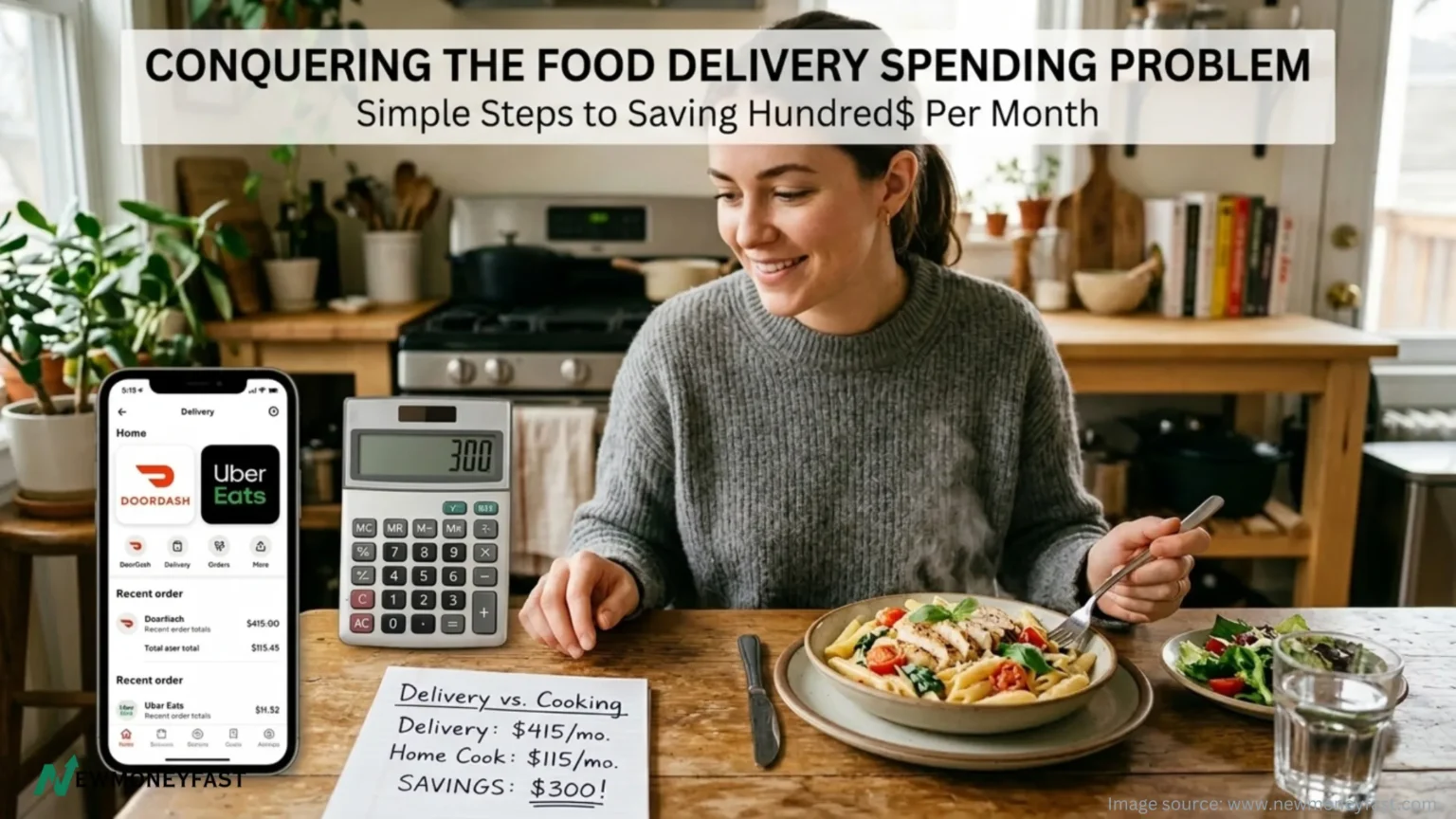
You did not decide to spend $300 a month on food delivery. It just sort of happened, one tired evening at a time.
The average American now spends over $1,566 per year on food delivery, about $130 per month, ordering 3.7 times per month at an average cost of $35.42 per order. Frequent users spending 3+ times per week are easily at $300 to $400 every single month. And unlike most spending categories, most of that money is pure overhead: delivery fees, service charges, menu markups, and convenience premiums that vanish the moment you close the app.
The solution is not to quit delivery cold turkey. That never sticks. The solution is to keep the convenience while systematically eliminating the waste the fees, the markups, and the mindless default orders so delivery stays in your life as a treat, not a drain.
| THE TRUE COST OF A $15 DELIVERY ORDERMenu price: $15.00 (often 15-25% more than in-restaurant price due to commission markup)Delivery fee: $2.99 to $5.99Service fee: $3.50 to $5.50 (15-25% of subtotal)Tip (20%): $3.00 to $5.00What you actually pay: $24.49 to $31.49Real markup vs. cooking at home: 63% to 110% more per meal |
The Hidden Fee Architecture You Are Paying Every Time
Most people look at food delivery and think they are paying the menu price plus a small delivery fee. The reality is a layered fee structure designed to be invisible until you are already committed to the order.
Here is what is actually on your receipt:
| Fee Type | What It Is | Typical Range | Avoidable? |
|---|---|---|---|
| Delivery fee | Distance-based charge to the driver | $2.99 to $7.99 | Yes, with membership |
| Service fee | Platform’s cut (15-25% of subtotal) | $3 to $8+ | Partially with membership |
| Menu markup | Restaurants charge more on apps | 15% to 25% more | No switch to pickup |
| Small order fee | Charged for orders under a minimum | $2 to $5 | Yes, order above the minimum. |
| Priority fee | Optional faster delivery | $1.99 to $4.99 | Yes, opt out always |
| Tip | For the driver (keep 100%) | 15% to 25% | Don’t tip your drivers |
A 2026 study by Self Financial found that a McDonald’s order costing $36.95 in-store rings up to $63.21 on DoorDash, a 71.1% markup. That gap is not random. It is the engineered result of platform commissions, menu markups, and fee stacking that most users never see in totality.
7 Fixes That Cut Your Delivery Bill Without Cutting Your Delivery
Fix 1: Get the Right Subscription and Use It Strategically
If you order delivery regularly and do not have a membership, you are paying $3 to $8 in delivery fees on every single order. DashPass ($9.99/month) and Uber One ($9.99/month) both eliminate delivery fees on eligible orders over the minimum threshold.
The break-even math: DashPass claims average savings of $5 per order. At just 2 orders per month, the membership pays for itself. Real-world tracking of 30+ orders found DashPass saves approximately $24 per month and Uber One saves $45 per month when you factor in ride credits. For anyone ordering 3+ times per month, one subscription is non-negotiable.

The free route: Amazon Prime members ($14.99/month) get Grubhub+ included at no extra cost. If you already have Prime, activate this immediately; it is free and provides $0 delivery on orders over $12 and 10% back on pickup.
- DashPass: $9.99/month | Best for frequent DoorDash users in suburban areas | Also free through Chase Sapphire/Freedom cards
- Uber One: $9.99/month | Best for combined food + ride savings | Members save $22 to $36/month on average per Uber
- Grubhub+: Free with Amazon Prime | Best baseline for any Prime subscriber | Activate immediately in the Grubhub app
Fix 2: Always Choose Pickup Over Delivery When You Can
This is the single most impactful change most people can make. Pickup eliminates the delivery fee, the service fee, and in many cases the menu markup itself because several major platforms charge restaurants lower commission rates for pickup orders, which means lower prices for you.
A pickup order on DoorDash or Uber Eats typically costs $5 to $12 less than the same order delivered. On a family order, that is $60 to $120 per month in savings for the simple act of picking the food up yourself. If the restaurant is within 10 minutes, pickup is almost always the smarter financial choice.
Bonus: both DashPass and Uber One provides 10% off pickup orders as well, so you save on the reduced price too. Stack pickup + membership for the maximum per-order saving.
Fix 3: Use the Price Comparison Trick Before Every Order
The same restaurant can have meaningfully different prices across apps. DoorDash and Uber Eats both allow restaurants to set their own pricing, and many restaurants price differently on each platform. A 2026 comparison by Savings Grove found that the same burrito bowl could vary by $2 to $4 between apps on top of different delivery fee structures.
Before ordering, spend 30 seconds checking both DoorDash and Uber Eats for the same restaurant. Factor in your active subscriptions. The cheapest total is not always from the app you default to. Apps like Takeout.AI automatically compares prices across platforms useful for households that order frequently.
Fix 4: Stop Paying the Small Order Fee and Priority Fees
Two fees that require almost zero effort to eliminate:
The small order fee ($2 to $5) is charged when your subtotal falls below a minimum threshold. Check the threshold before ordering, typically $10 to $12, and add one extra item if needed to clear it. The fee you save is almost always worth more than the item costs.
The priority delivery fee ($1.99 to $4.99) gets your food there faster. Most people select it by default without thinking about it. In 2026, 41% of respondents reported choosing priority delivery regularly, which is $1.99 to $4.99 per order for roughly 10 to 20 minutes of difference. Skip it unless you genuinely need it. Over 8 orders per month, this alone saves $16 to $40.
Fix 5: Change How You Order — Not Just What You Order
The most expensive delivery habit is not the type of food you order. It is the frequency pattern using delivery as your default meal solution rather than a deliberate treat.
The hybrid approach that saves the most without feeling like deprivation:
- Meal prep 2 to 3 dinners on Sunday. Batch cooking removes the tired-at-6pm trigger that sends most people to DoorDash by default
- Keep emergency meal staples at home: rotisserie chicken, pre-cooked grains, jarred sauces, quality frozen options so the fallback when plans collapse is not the delivery app
- Budget delivery as planned treats, not emergency rescues. Decide in advance which nights are delivery nights. Planned delivery feels indulgent. Panic delivery feels wasteful.
- The 2-day rule: if you ordered delivery in the last 2 days, make a different choice tonight. This simple friction point cuts impulsive reorder cycles significantly
Fix 6: Stack Credit Card Rewards on Every Delivery Order
If you are going to order delivery anyway, make sure you are earning maximum rewards on every transaction. Several credit cards offer 3x to 5x points or cashback on food delivery purchases:
- Chase Sapphire Preferred: 3x points on dining, including delivery + free DashPass (worth $120/year alone)
- American Express Gold Card: 4x points at restaurants worldwide + $10/month in Uber Cash ($120/year)
- Capital One Savor: 3% cashback on dining and delivery permanently; no annual fee version available
Stacking a cashback card with a membership subscription effectively reduces the net cost of every delivery order by 15 to 20% before you even think about fees. For someone spending $130/month on delivery, that is $19 to $26 back per month just from card rewards.
For a full breakdown of how to maximize credit card rewards without going into debt, see our guide: How to Actually Use Reward Credit Cards Without Going Into Debt.
Fix 7: Use Promo Codes and App Promotions Systematically
Both DoorDash and Uber Eats regularly issue promo codes that most users never claim. Sources:
- DoorDash promotions page check before every order for active codes
- Honey and Capital One Shopping browser extension auto-applies codes at checkout; see our browser extension comparison for details
- Both apps regularly push in-app promotions to users who have not ordered recently, sometimes 40% off or free delivery for a week. If you have not ordered in 7 to 10 days, check the app for a welcome-back offer before ordering
- New account promotions: if your household has two adults, one may not have an account on a platform. New user signup bonuses of $10 to $15 off first order can be stacked at the household level
Your Monthly Savings Potential: By the Numbers
Stack these 7 fixes and here is what your monthly delivery spending looks like before and after:
| Scenario | Monthly Spend Before | Monthly Spend After | Annual Savings |
|---|---|---|---|
| Light user (4x/month) | $140 | $65 to $80 | $720 to $900/year |
| Average user (8x/month) | $280 | $110 to $140 | $1,680 to $2,040/year |
| Heavy user (12x/month) | $420 | $150 to $200 | $2,640 to $3,240/year |
Assumptions: membership subscription activated, pickup used for 30% of orders, priority fees skipped, one promo code per week, and rewards card applied. The above figures do not require giving up a single delivery just ordering smarter.
DashPass vs. Uber One vs. Grubhub+: Which Is Right for You?
Pick the subscription that matches your ordering pattern. You do not need all three.
| Subscription | Cost | Best For | Break-Even Point |
|---|---|---|---|
| DashPass | $9.99/month or $96/year | DoorDash regulars, suburban users | 2 orders/month |
| Uber One | $9.99/month or $96/year | Uber Eats + rideshare combo users | 2 to 3 orders/month |
| Grubhub+ | Free with Amazon Prime | Any Prime subscriber ordering delivery | Activate immediately |
| DashPass Free | Free with Chase card | Chase Sapphire or Freedom cardholders | Zero free with card |
Key insight from MoneyWise Tips: tracking 30+ real orders found Grubhub+ saves $28/month (free with Prime), DashPass saves $24/month at typical usage, and Uber One saves $45/month when ride credits are included. If you already have Amazon Prime, activate Grubhub+ right now. If you have a Chase credit card, check whether DashPass is included free. Getting your subscription to $0 cost should be the goal before paying $9.99/month.
The Hybrid Delivery System: Keep Delivery, Cut the Cost
The most sustainable approach is not to eliminate delivery but to reframe it from a default to a deliberate choice. Here is the system:
| THE NEW MONEY FAST DELIVERY COST-CUTTING SYSTEMOne-Time Setup (20 minutes):Activate your free subscription (Grubhub+ via Prime or DashPass via Chase card). Install a promo extension. Add your highest-rewards credit card to each app. Done.Weekly Rule (2 minutes per order):Before every order: (1) Can I pick this up? (2) Is there a promo code? (3) Is this the cheapest app for this restaurant? Takes 2 minutes and saves $5 to $12 per order.Habit Shift (ongoing):Decide your delivery nights in advance. Prep at least 2 dinners per week at home. Keep 3 emergency meals in the fridge or freezer. Delivery is a planned reward, not a panic default.Monthly Check-In:Review your delivery spending in your banking app once a month. Set a monthly delivery budget and stick to it. When you hit the budget, switch to pickup for the rest of the month. |
| THE 30-DAY DELIVERY COST RESET CHALLENGEDay 1: Check your last 30 days of delivery spending in your bank app. Write the exact number down. That is your before.Days 2 to 3: Activate your free subscription (Grubhub+ via Amazon Prime or DashPass via Chase card). Add your rewards card to both DoorDash and Uber Eats.Days 4 to 14: For every order: check pickup first. Skip priority fee. Check for a promo. Use the cheaper app. This 2-minute ritual becomes automatic by day 7.Days 15 to 30: Batch cook 2 dinners per week. You will notice the delivery impulse decreasing as the panic-default trigger disappears.Day 30: Check your new delivery total. Calculate the monthly and annual savings. Comment with your before and after numbers. |
Pair Your Delivery Savings With These Guides
Every dollar you save on delivery is worth more when it goes somewhere intentional. These New Money Fast guides show you where to put it:
- The Real Cost of Convenience: Why Paying More Up Front Sometimes Saves You Thousands
- Grocery Bill Over $800 a Month? Here Is the 4-Week Reset That Cuts It in Half
- Credit Card Debt Eating You Alive? Here Is the Avalanche Method That Wipes It Out Faster
- 8 High-Yield Savings Accounts Paying Over 4.5% Right Now (Ranked)
| VISUAL CONTENT SUGGESTIONS FOR DESIGN TEAM1. Receipt Breakdown Infographic: An illustrated receipt for a $15 food order showing how it becomes $28 after all fees, color-coded by fee type — shareable and shocking enough for social media2. Before/After Monthly Spending Graph: A bar chart showing average user monthly delivery spend before ($280) vs. after fixes ($120), with each fix labeled as a savings layer stacked on top of each other3. The 2-Minute Order Checklist: A branded checklist graphic with the 3 questions to ask before every delivery order — designed as a phone wallpaper or Notes app screenshot for easy reference4. Subscription Comparison Card: A clean visual comparing DashPass, Uber One, and Grubhub+ with monthly cost, average savings, best for, and how to get it free — optimized for saving as a reference image |
Frequently Asked Questions
Is DashPass or Uber One actually worth the $9.99 per month?
At 2 or more orders per month, yes, both subscriptions pay for themselves. DashPass claims average savings of $5 per order, meaning break-even at 2 orders. At 8 orders per month at typical order sizes, real-world tracking puts DashPass savings at approximately $24/month and Uber One at $45/month, including ride credits. The key question is whether you can get either subscription for free. DashPass is free with Chase Sapphire Preferred and Chase Freedom credit cards. Grubhub+ is free with Amazon Prime. Check those options before paying $9.99.
Why is the same restaurant more expensive on DoorDash or Uber Eats than in person?
Because the platform charges the restaurant a commission of 15% to 30% per order, and many restaurants pass that cost to delivery customers through higher menu prices. DoorDash charges restaurants basic commission rates of 15%, plus commission, and up to 30% for premier plans, plus a 6% payment processing fee per order. The restaurant either absorbs this or marks up delivery menu prices. This is why pickup orders are frequently cheaper even on the same app the economics of the transaction are different, and the savings flow back to you.
What is the most effective single change I can make today?
Activate Grubhub+ through Amazon Prime if you are a Prime subscriber. It is completely free and provides $0 delivery on eligible orders over $12. If you are not a Prime subscriber, check whether your Chase credit card includes free DashPass. If neither applies, start using pickup for any restaurant within 15 minutes of your home or office. Pickup alone eliminates $5 to $12 per order with no other changes.
Should I delete the delivery apps entirely?
That works for some people, but the rebound effect is real. Most people who delete delivery apps in a moment of financial resolve reinstall them within 2 to 3 weeks under stress or time pressure. A better approach is to reduce the friction of alternatives (keep emergency meals stocked, meal prep twice a week) while keeping the apps as a deliberate option for planned treat nights. Restricting yourself with willpower alone rarely outperforms changing the environmental conditions that trigger the habit.
How do I track how much I am spending on delivery each month?
Your bank or credit card app categorizes food delivery automatically. Open your app, search for DoorDash, Uber Eats, or Grubhub in your transaction history, and add the totals. Apps like Rocket Money and YNAB automatically categorize food delivery as a separate spending category and send you weekly totals. Seeing the monthly number clearly is often the most powerful single intervention most people have a strong reaction when they see $280 labeled as DoorDash fees.
| DELIVERY IS NOT THE PROBLEM. PAYING TOO MUCH FOR IT IS.You deserve the convenience. You do not deserve the 71% markup. Apply these 7 fixes this week and see how much of your delivery budget was pure waste.Activate your free subscription today. Check for pickup on your next order. Skip the priority fee. That is already $10 back in your pocket.More money-saving guides at newmoneyfast.com. |
Sources
- UpgradedPoints: Americans Spend Over $1,566 Annually on Food Delivery, Avg. Order $35.42, 3.7x/Month
- ConsumerGravity: Food Delivery Market Share 2026: $88.50/Month Average, 62% Pay for Premium Sub
- Zippia: Food Delivery Statistics 2026: $4,200/Year Average, 80% Order at Least Weekly
- DemandSage: DoorDash Statistics 2026, 68% US Market Share, 46.3M Active Users
- Self Financial: DoorDash 71.1% More Expensive Than In-Store (via Cost of Convenience Report)
- MoneyWise Tips: DashPass vs Uber One vs Grubhub+ 30+ Order Test, Real Savings Data
- Takeout.AI: DashPass vs Uber One vs Grubhub+ 2026 Free DashPass via Chase, Grubhub+ via Prime
- DealNews: Is Uber One Worth It? 2026 $9.99/Month, Members Save $22 to $36/Month on Average
- Savings Grove: DoorDash vs Uber Eats 2026 Delivery Fee: $4.08 vs $5.79 Average
- Spoke.com: Hidden Cost of Delivery $33.89 Average Per Order: $152.51/Month, $1,843/Year