
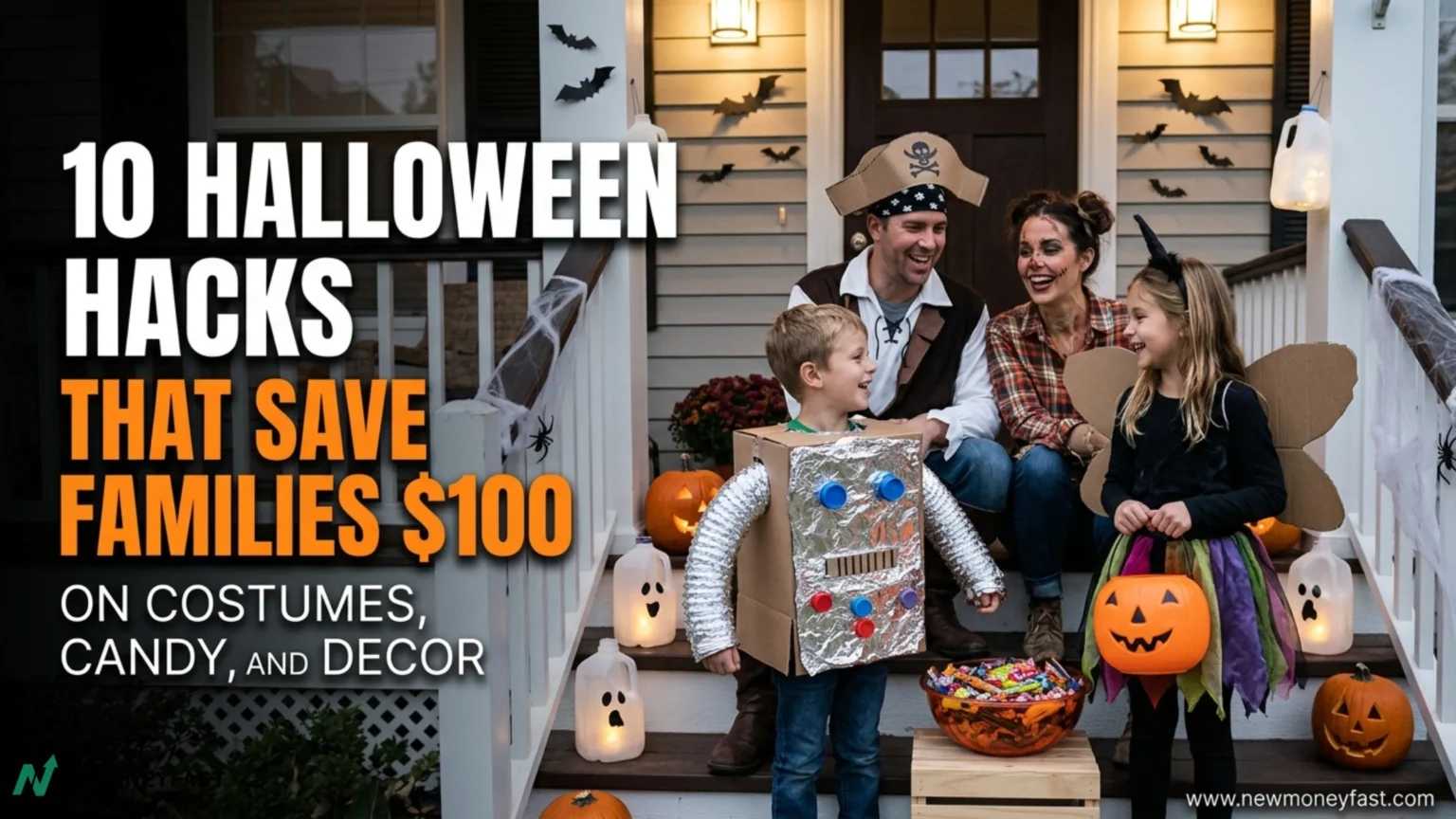
The best cheap Halloween ideas for 2026 follow one rule: spend only on what kids will actually use, and swap, thrift, or DIY the rest. Families who stack four of the hacks below can trim about $100 from a holiday where the average shopper plans to spend $115.14, according to the National Retail Federation.
| Key Takeaways: The NRF projects Halloween spending of $13.5 billion in 2026, up from $13.1 billion in 2025, at an average of $115.14 per person.Costumes ($4.4 billion), decorations ($4.3 billion), and candy ($4.1 billion) are the three biggest budget lines, and every one has a cheaper route.In 2025, chocolate Halloween candy averaged about $8.02 per pound versus $5.77 for non-chocolate candy, so mixing the two cuts the bowl cost.Swapping or thrifting costumes is the biggest single saver, at roughly $15 to $40 per costume (NMF estimate).Halloween falls on Saturday, October 31, 2026, so the best swap and thrift finds are going now. |
Why does Halloween cost so much in 2026?
Because shoppers spend on three things at once. The NRF survey of 7,889 consumers found 71% plan to buy costumes, 78% decorations, and 96% candy. Last year, 79% of shoppers also expected higher prices, and 49% started buying in September or earlier.
If four people in your house spent the per-person average, the bill would be about $460. These cheap Halloween ideas keep the fun and drop the markup.
What are the best cheap Halloween ideas for families?
1. Swap costumes instead of buying new ones
How It Works: A costume swap trades outgrown costumes for free or for a small donation. Kids wear most costumes once, so nearly every neighborhood has a closet of barely used options. Buy Nothing groups and school PTAs run swaps each October.
Real Example: Post in your local Buy Nothing group (the Buy Nothing Project runs hyperlocal gift groups) asking for your child’s size in a Spider-Man, witch, or ghost costume. Those are all among the top kids’ picks in the NRF’s 2025 survey. Offer last year’s costume in return.
Estimated Savings: $20 to $40 per child versus a packaged costume (NMF estimate; prices vary by retailer).
Pros: free, eco-friendly, instant community.
Cons: limited sizes and characters.


Skip this if your child insists on a brand new licensed character.
Best for: families with kids under 10.
Action Step: Post one request and one offer in a local group today. Popular sizes go early.
2. Build the costume at Goodwill
How It Works: Thrift stores stock the raw materials for dozens of costumes: blazers, robes, hats, and boots. Pair two or three thrifted pieces with one accessory and you have a wearable costume.
Real Example: A thrifted blazer, a button-up, and a hat can become a detective, professor, or 1980s businessperson. Our example prices run $3 to $8 per piece, or roughly $12 to $20 for the full look (NMF estimate; prices vary by store).
Estimated Savings: $15 to $30 per costume.
Pros: unique looks, and the clothes work after Halloween.
Cons: takes one or two store trips and some sizing luck.
Best for: teens, adults, and creative kids.
Action Step: Visit your nearest Goodwill this weekend with a $15 cap and a list of three costume ideas.
3. Raid your closet, then add $1.25 accessories
How It Works: Most costumes are an outfit you already own plus one signature prop. Dollar Tree sells costume accessories rather than full costumes, and the Motley Fool found it the cheapest source for the basics. Many items there sell at $1.25.
Real Example: Black leggings, a black hoodie, and $1.25 cat ears make a cat costume for about $3 to $5.
Estimated Savings: $10 to $25 per person compared with a store-bought costume (NMF estimate).
Pros: nearly free, fast, and low waste.
Cons: accessories can look flimsy by November.
Best for: adults and kids who care more about fun than polish.
Action Step: Write down five costume ideas that start with clothes you own before you open any shopping tab.
4. Compare bulk candy by the ounce, not the sticker price
How It Works: Warehouse clubs and big-box stores often beat the grocery aisle on price per ounce, but no one store wins every bag. Costco and Sam’s Club need memberships, so count the fee in your math.
Real Example: In one published Walmart versus Costco comparison, Costco’s 24-count Haribo Goldbears bags were $15.59 versus $23.99 at Walmart, while Walmart’s 135-piece M&M’s assortment was $16.98 versus Costco’s $22.99 for 150 pieces. Prices change, so check current ones.
Estimated Savings: $8 to $20 on a 100 to 150 piece haul (NMF estimate).
Pros: lower cost per piece and fewer shopping trips.
Cons: membership fees, and big bags tempt you to overbuy.
Best for: busy streets with 50 or more trick-or-treaters.
Action Step: Calculate cost per ounce on three candy bags at two stores before you buy.
5. Mix chocolate with cheaper candy and buy by headcount
How It Works: Chocolate costs more per pound than fruity or sugar candy. Mixing both keeps the bowl exciting for less. Pair that with a headcount so you do not buy 200 pieces for 40 visitors.
Real Example: Cheapism reported chocolate Halloween candy at about $8.02 per pound in 2025, compared with $5.77 for non-chocolate. Swapping 3 pounds of chocolate for non-chocolate saves about $6.75.
Estimated Savings: $7 to $25, depending on how much you overbuy today (NMF estimate).
Pros: easy and invisible to kids.
Cons: some kids will skip the non-chocolate pieces.
Skip this if your street is known for full-size bars.
Best for: first-time candy buyers.
Action Step: Jot down last year’s visitor count and buy for that number plus 10%.
6. Decorate with dollar-store and DIY pieces
How It Works: Decor is the second-biggest Halloween budget line, and 42% of consumers plan to decorate their homes or yards, per the NRF. Dollar Tree has the cheapest traditional decorations according to the Motley Fool.
Real Example: Cut cardboard tombstones from moving boxes, drape a bedsheet over a chair for a ghost, and add a $1.25 string of lights. A porch scene like that runs about $15 to $25, versus $50 to $100 for big-box inflatables (NMF estimate).
Estimated Savings: $20 to $50.
Pros: kids can help, and it makes a good family activity.
Cons: DIY takes an evening, and it will not impress like a 12-foot skeleton.
Best for: renters and small spaces.
Action Step: Sketch a three-item porch scene and cap the budget at $20.
7. Pick free community events over paid attractions
How It Works: Trunk-or-treats, library parties, parks and recreation fall festivals, and downtown trick-or-treat nights give kids the full Halloween experience for little or nothing.
Real Example: Search your city parks and recreation page, your library calendar, and local church listings for trunk-or-treat events.
Estimated Savings: $15 to $50 per family compared with ticketed attractions (NMF estimate; prices vary).
Pros: safe, social, and free.
Cons: crowds and fewer options in rural areas.
Best for: families with kids under 12.
Action Step: Find two free events near you and add them to your calendar this week.
8. DIY the pet costume, or skip it
How It Works: The NRF expects $920 million in pet costume spending in 2026, with pumpkins, hot dogs, and ghosts among the most popular looks.
Real Example: A felt cape, a bandana, or a pumpkin-orange bow tie from scrap fabric does the job. Store-bought pet costumes often run $10 to $25 (NMF estimate), so a DIY version is nearly free.
Estimated Savings: $10 to $20.
Pros: cheap and photo-ready.
Cons: many pets dislike costumes.
Skip this if your pet is stressed by clothing. Never use anything that blocks breathing, vision, or movement.
Best for: pet owners posting on social media.
Action Step: Try one DIY accessory for five minutes. If your pet resists, skip it.
9. Stack cash back and store rewards on every purchase
How It Works: Cash back apps and store reward programs pay you a percentage on purchases you were making anyway. Rates change weekly and vary by retailer, and offers often need activation before you buy.
Real Example: Check Ibotta and Fetch Rewards for grocery offers, Rakuten for online retailers, and Target Circle at Target. We estimate $5 to $15 back on a $75 to $100 haul.
Estimated Savings: $5 to $15 (NMF estimate; offers vary).
Pros: passive and stackable.
Cons: activation steps, and the temptation to buy extra to chase a reward.
Best for: anyone shopping online or at big retailers.
Action Step: Activate offers before you check out and never buy something just to earn cash back.
10. Set a hard cap and pay with a Halloween envelope
How It Works: A written budget stops the impulse buys that make the average $115.14 climb.
Real Example: Set a cap well under the NRF average, such as $60 for a family of four, and fund it in cash or a separate account.
Estimated Savings: $15 to $40 in avoided impulse spending (NMF estimate).
Pros: simple and powerful.
Cons: it takes discipline when kids ask for extras.
Best for: households that overspend at Halloween stores.
Action Step: Choose your cap tonight and move the money to a separate account or envelope.
Which cheap Halloween ideas save the most?
Costume swaps and decor give the biggest wins, while cash back and budgets add steady extras. Use this table to pick your four.
| Hack | Category | Est. Savings | Time Needed | Best For |
|---|---|---|---|---|
| 1. Costume swap | Costumes | $20 to $40 per child | 30 minutes | Kids under 10 |
| 2. Goodwill DIY costume | Costumes | $15 to $30 | 1 to 2 hours | Teens and adults |
| 3. Closet plus $1.25 accessories | Costumes | $10 to $25 | 30 minutes | Anyone |
| 4. Bulk candy by the ounce | Candy | $8 to $20 | 1 hour | Busy streets |
| 5. Mix and buy by headcount | Candy | $7 to $25 | 10 minutes | First-time buyers |
| 6. Dollar-store and DIY decor | Decor | $20 to $50 | 1 to 2 hours | Renters |
| 7. Free community events | Activities | $15 to $50 | 20 minutes | Families |
| 8. DIY pet costume | Costumes | $10 to $20 | 15 minutes | Pet owners |
| 9. Cash back and rewards | All | $5 to $15 | 10 minutes | Online shoppers |
| 10. Cap and envelope | All | $15 to $40 | 10 minutes | Impulse spenders |
Savings are NMF estimates based on typical retail prices and vary by store, location, and family size.
| Quick Wins BoxTotal potential savings: $100 or more by stacking four hacks (NMF estimate)Time investment: 2 to 3 hours total, mostly shopping and swappingDifficulty: EasyBest for: Families with kids who want a fun Halloween without a $460 bill |
| The $100 Halloween ChallengePick your level and tell us how much you saved.Beginner: Try 2 hacks and save about $30.Pro: Stack 4 hacks and save about $100.Expert: Use 7 hacks and save $175 or more.Tag a friend who spends too much on Halloween and challenge them to beat you. |
Frequently Asked Questions
How can I save money on Halloween costumes?
Swap or thrift them. Costume swaps through Buy Nothing groups are free, and a Goodwill build usually runs $12 to $20 per costume (NMF estimate), compared with higher prices for many packaged costumes. Add $1.25 accessories to finish the look.
How much does the average person spend on Halloween in 2026?
About $115.14 per person, according to the NRF’s 2026 survey. Total spending is projected at $13.5 billion, up from $13.1 billion in 2025.
Where is the cheapest place to buy Halloween candy?
It depends on the bag. Warehouse clubs like Costco and Sam’s Club often win on price per ounce, but Walmart and Dollar Tree win on some items. Compare cost per ounce before buying.
What are the cheapest Halloween decorations?
Homemade ones. Cardboard tombstones, bedsheet ghosts, and paper bats cost almost nothing, and Dollar Tree has the cheapest traditional decorations according to the Motley Fool.
When should I buy Halloween supplies to save money?
Start now and keep your budget tight. Last-minute shopping leaves fewer sizes and choices, so swap and thrift in the next two weeks, and watch for clearance sales on November 1.
Sources
1. NRF: Halloween Survey Shows Consumer Spending Expected to Reach $13.5 Billion (Sep 22, 2026)
2. Mass Market Retailers: Halloween spending expected to reach $13.5 billion
3. Eyecare Business: Halloween spending expected to hit record $13.1 billion in 2025, says NRF
4. CPA Practice Advisor: 2026 Halloween Spending Expected to Hit $13.5 Billion
5. Cheapism: 16 Hacks for Scoring Bulk Halloween Candy for Cheap
6. Tasting Table: The Cheapest Places to Buy Halloween Candy
7. The Motley Fool: Which Is Cheaper for Halloween, Dollar Tree or Costco?
8. Nasdaq: Walmart vs. Costco, The Best Deals on Halloween Candy