
You have set a savings goal before. You meant it. And then life happened. Research shows that nearly 80% of people who set a financial goal abandon it within 90 days, and the reason has nothing to do with willpower or income. It is your brain working exactly as designed.
Behavioral economists have spent decades studying why smart people consistently fail to save, and the findings are surprisingly actionable. Once you understand the five cognitive biases that hijack your savings goals, you can design a simple system that works with your brain instead of fighting it. No spreadsheets required, and no willpower needed after the first week.
| What You Will Get From This GuideResult: A savings habit that runs on autopilot within 30 daysTime investment: 30 minutes to set up, then almost zero ongoing effortWorks for: Any savings goal, from a $500 emergency fund to a $10,000 vacation fundDifficulty: Beginner-friendly. You do not need a finance background |
Why Willpower Is the Wrong Tool for Saving Money
Willpower is a finite resource. Every time you resist a purchase, you burn a little of it, and by the evening, your defenses are down. This is called decision fatigue, and it is why most people crack on their savings goals at 8 pm on a Tuesday after a long workday.
The good news is that you do not need willpower if you build the right systems. The goal of every strategy in this guide is to make saving the path of least resistance, so your brain does not have to make a conscious decision at all.
The 5 Brain Biases Killing Your Savings (and How to Beat Each One)
1. Present Bias: Why Tomorrow Always Loses
What it is: Your brain hardwires you to prefer a small reward now over a larger reward later. A 2021 study from the University of Chicago found that present bias is the single strongest predictor of low savings rates, stronger even than income level.
The fix: Remove the decision entirely. Set up an automatic transfer from your checking account to your savings account on the same day your paycheck lands. You never see the money sitting there to spend, so present bias has nothing to grab onto.
Action: Log into your bank today and schedule a recurring transfer of even $25 or $50 on payday. Start embarrassingly small. Consistency beats size every time.
2. Status Quo Bias: The Habit Tax You Pay Without Knowing It
What it is: Humans default to whatever is already happening. If you have never set up a savings account, you will keep not having one. If your savings account earns 0.01% APY, you will keep earning 0.01% even when better options are one click away.



The fix: Do a 15-minute money audit once per quarter. Check your savings rate, your subscriptions, and your recurring bills. A single audit session is often worth hundreds of dollars in found savings. If you opened a high-yield account after our
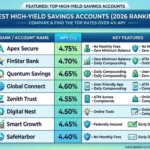
8 High-Yield Savings Accounts Paying Over 4% Right Now guide, you have already beaten status quo bias once this week.
3. Hyperbolic Discounting: The Reason Your Future Self Gets Robbed
What it is: The farther away a reward is in time, the less your brain values it. A vacation fund 18 months from now feels almost imaginary compared to a new pair of shoes today. This is hyperbolic discounting, and it is why vague long-term goals fail constantly.
The fix: Make the future feel present. Give your savings account a specific name instead of calling it “savings.” Name it “Mexico 2027 Fund” or “Emergency Cushion” and add a photo of the goal to your banking app if it allows it. Specificity collapses the psychological distance between now and your goal.
Milestone trick: Break your goal into four quarters. Each time you hit 25%, 50%, 75%, and 100%, do a small celebration, a dinner out, a movie, anything that creates a positive loop. As one financial coach put it, you earn the “dopamine hit of achieving short-term goals while saving for the longer-term ones.”
4. Optimism Bias: The “Nothing Bad Will Happen” Trap
What it is: Most people believe they are less likely than average to experience a job loss, medical emergency, or car breakdown. A 2025 Empower survey found that Gen X households have a median emergency savings balance of just $500, despite knowing they should have months of expenses saved.
The fix: Reframe your savings as insurance, not sacrifice. You are not giving up money today. You are buying yourself the ability to handle a crisis without going into debt. Two in five Americans lack enough savings to cover a $400 emergency (Federal Reserve, 2024). Knowing you are in the protected half is its own reward.
Action: Calculate your bare-bones monthly expenses (rent/mortgage, food, utilities, transport). Multiply by three. That is your target emergency fund. Anything else is a bonus. For a deeper dive, check out the How to Build an Emergency Fund From Zero guide on New Money Fast.
5. Reward Substitution: When Small Treats Eat Your Big Goals
What it is: When we feel stressed or deprived, we substitute smaller, immediate rewards for the larger goal we are working toward. That $7 coffee or $15 impulse buy is your brain trading a big future win for a small present one. Over a month, those substitutions can easily total $150 or more.
The fix: Create a micro-reward system tied directly to your savings. Every time your automatic transfer runs successfully, treat yourself to something small and free: an extra hour of your favorite show, a long walk, a guilt-free lazy morning. You are retraining your brain to associate saving with reward rather than deprivation.
Quick Reference: 5 Biases and Your Fixes
| Brain Bias | What It Does to You | The Fix |
| Present Bias | Values today’s fun over tomorrow’s savings goal | Automate transfers on payday, before you can spend |
| Status Quo Bias | Keeps you in a low-rate account out of habit | Schedule a 15-minute account audit once a quarter |
| Hyperbolic Discounting | Makes future rewards feel less valuable than now | Make goals visual and specific with a savings tracker |
| Optimism Bias | Assumes nothing bad will happen, so why save? | Frame savings as insurance, not sacrifice |
| Reward Substitution | Spends on small treats instead of the bigger goal | Create a micro-reward for every savings milestone hit |
The 3-Part Savings System That Runs on Autopilot
Once you understand the biases, building the system takes about 30 minutes. Here is exactly what to set up:
Part 1: Automate and Separate
Open a dedicated high-yield savings account for each major goal. Never mix your emergency fund with your vacation fund. Separation prevents mental accounting errors (spending from the wrong bucket) and makes each goal feel real and trackable. Round-up apps like the ones listed in our 5 Round-Up Apps That Save Money Every Time You Swipe can layer on extra savings without any manual effort.
Part 2: Make Progress Visible
Track your savings balance weekly, even if just for 60 seconds. Seeing a number go up is one of the most powerful motivators your brain has. Use a notes app, a paper chart on your fridge, or your bank app’s savings tracker. Progress visibility is what separates people who hit their goals from those who drift.
Part 3: Design a Speed Bump for Spending
Add friction to impulsive withdrawals from your savings account. Keep savings at a different bank from your checking account. Transfer delays of one to two business days are a built-in cooling-off period that prevents most impulse withdrawals. According to behavioral economist Richard Thaler, even a 24-hour pause eliminates the majority of non-emergency savings withdrawals.
| The 30-Day Savings Habit ChallengeHere is your challenge this week: set up one automatic savings transfer for any amount, $10, $25, $50, whatever fits your budget. Name the account after a specific goal. Then check back in 30 days and see how much you have saved without thinking about it once.Over 10,000 people have started their savings habit with a single automated transfer. The amount does not matter. The habit does.Which bias hits closest to home for you? Drop a comment below, whether it is present bias, optimism bias, or reward substitution. Naming it is the first step to beating it. |
| Visual Production Suggestions1. Brain Bias Infographic: A circular diagram showing the 5 biases as obstacles on a road to a savings goal, with the fix labeled at each roadblock.2. Savings Milestone Chart: A horizontal progress bar split into 4 quarters (25%, 50%, 75%, and 100%) with a small reward icon at each milestone.3. Before and After Comparison: Two side-by-side timelines showing a savings journey driven by willpower (fails at week 6) versus a system-driven approach (auto-transfers, goal names, and milestones) that reaches the goal.4. 30-Day Challenge Calendar: A simple calendar graphic with daily check boxes for the first 30 days of the savings habit, shareable on social media. |
Frequently Asked Questions
| How much should I save each month? | Start with whatever feels easy, even $20 per month. The goal in the first 30 days is to build the habit, not hit a number. Once automation is running and the habit is locked in, you can increase the transfer amount in small steps without it feeling painful. |
| What if I keep raiding my savings? | This is the spending friction problem. Move your savings to a separate bank from your checking account. The one-to-two-day transfer delay removes the instant-access temptation that makes raiding easy. An account you cannot see on your main banking screen is an account you are less likely to touch. |
| Does the specific savings app matter? | Not as much as the habit itself. What matters most is automation, separation of goals, and visibility of progress. That said, pairing a high-yield savings account with a round-up app means your money earns more while the habit quietly builds itself. |
| How do I stay motivated for long-term goals? | Break big goals into quarterly milestones and attach a small celebration to each one. Research from behavioral finance consistently shows that small, frequent rewards outperform large, distant rewards in sustaining savings habits over time. |
| Is the no-budget approach really enough? | For habit-building, yes. You do not need a detailed budget to start saving. Automating transfers and creating goal-specific accounts handles most of the heavy lifting. If you want to go deeper without a traditional budget, check out the No-Budget Budget guide on New Money Fast. |
| Your Savings System Starts TodayThe biggest mistake people make with savings goals is waiting until they feel motivated. Motivation follows action, not the other way around. Set up one automatic transfer right now and let the system do the rest.Need a high-yield account to send those automated transfers into? Compare the top options in our 8 High-Yield Savings Accounts Paying Over 4% Right Now guide and get your money earning from day one.Already saving automatically? Tag a friend who keeps saying they will start saving “next month” and share this guide. |