

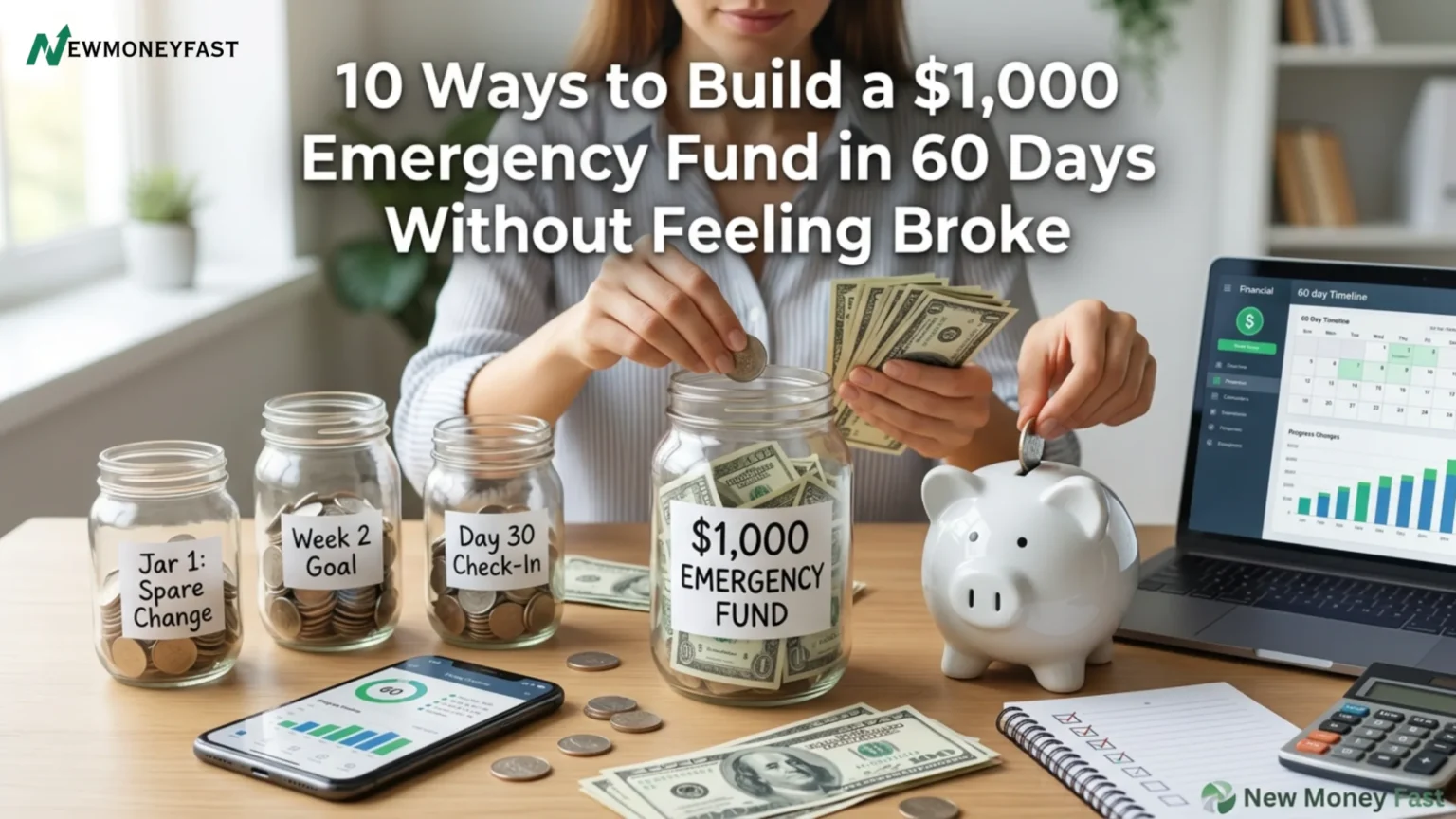
A surprise car repair now averages $838, and only 30% of Americans say they could cover a $1,000 emergency straight from savings. The good news? You can build that $1,000 cushion in the next 60 days without living on instant noodles.
| QUICK ANSWERThe fastest way to build an emergency fund is to open a separate high-yield savings account, automate a transfer every payday, and feed it with found money: canceled subscriptions, sold clutter, cashback, and a few side gig shifts. Stack five or six of the moves below and $1,000 in 60 days is realistic on most budgets. |
Here’s why this matters. Bankrate’s 2026 report found 33% of Americans would reach for a credit card, personal loan, or family IOU to cover a $1,000 surprise. That’s how one flat tire turns into months of interest. This plan isn’t about cutting everything you love. It’s about redirecting money that’s already leaking out of your life. Let’s build your safety net together.
| QUICK WINS SUMMARYTotal potential: $907 to $1,795 in 60 daysTime to set up: About 45 minutes this weekDifficulty: Beginner-friendlyBest for: Young adults, families, and anyone living paycheck to paycheck who wants a real buffer |
10 Ways to Build a $1,000 Emergency Fund Fast
1. Give Your Emergency Fund Its Own High-Yield Home
How It Works: Money parked in checking gets spent. A separate high-yield savings account (HYSA) keeps your fund out of sight and earning more. Top accounts pay around 4% APY this month versus a 0.38% national average, and the Fed’s September 16 rate hike could nudge yields higher.
Real Example: NerdWallet lists Newtek Bank at 4.20% APY with no monthly fee, and CIT Bank advertises up to 4.10% with a promo code. Rename the account “Do Not Touch: $1K Shield” so it feels off-limits.
Estimated Savings or Earnings: About $2 to $5 in interest over 60 days. The bigger payoff is friction: separated money is much harder to impulse-spend.
Action Step: Open a no-fee HYSA today.
2. Automate a Pay-Yourself-First Transfer
How It Works: Schedule a transfer that fires the morning your paycheck lands, before you have a chance to spend it. Automation beats willpower every time.
Real Example: Set $100 per biweekly paycheck. That’s four automatic deposits in 60 days with zero effort after setup.


Estimated Savings or Earnings: $200 (at $50 per check) to $400 (at $100 per check).
Action Step: Set up the recurring transfer in your bank app now. Start at $50 if $100 feels tight, then bump it up after your first month.
3. Run a 10-Minute Subscription Audit
How It Works: CNET’s 2026 survey found Americans spend $111 a month on subscriptions and waste roughly $252 a year on ones they never use. C+R Research found 42% of people kept paying after they stopped using a service.
Real Example: Cancel one streaming service you forgot about ($18), an unused app ($10), and a gym membership you haven’t touched ($30). Rotate streaming instead of stacking it.
Estimated Savings or Earnings: $40 to $60 a month, or $80 to $120 in 60 days.
Action Step: Scan two months of statements or use Rocket Money to spot every recurring charge, then send canceled amounts to your HYSA.
4. Sell 5 Things You Haven’t Used in a Year
How It Works: Your closet, garage, and junk drawer are holding cash hostage. Old phones, consoles, baby gear, and brand-name clothing move fast online.
Real Example: Trade in an old iPhone on Decluttr or Swappa, list a bike on Facebook Marketplace, and post jackets on Poshmark.
Estimated Savings or Earnings: $150 to $300 total, depending on what you own.
Action Step: Photograph five items tonight and list them before the weekend.
5. Schedule Two No-Spend Weekends a Month
How It Works: Pick specific weekends where the only spending is bills and planned groceries. The other weekends stay normal, so you never feel deprived.
Real Example: If a typical weekend costs you $80 in takeout and outings, four no-spend weekends over 60 days keeps up to $320 at home. Swap in park picnics, library movie nights, and game night.
Estimated Savings or Earnings: $160 to $320 in 60 days.
Action Step: Circle your four no-spend weekends on your calendar now and transfer the savings every Monday.
6. Stack Cashback on What You Already Buy
How It Works: Cashback apps pay you for purchases you’d make anyway. The trick is sweeping every payout straight into savings instead of letting it disappear.
Real Example: Use Rakuten for online orders and Ibotta for groceries. Activate offers before you shop, then cash out as soon as you hit the minimum.
Estimated Savings or Earnings: $30 to $60 in 60 days for a typical household.
Action Step: Install both apps before your next grocery run.
7. Work 3 Weekend Side Gig Shifts
How It Works: Gig apps let you earn on your own schedule with no job interview. A few focused shifts can supercharge your fund.
Real Example: Deliver with DoorDash or shop with Instacart on busy Saturday afternoons, or book furniture assembly jobs on TaskRabbit.
Estimated Savings or Earnings: $150 to $300 across 60 days. Earnings vary by city and hours.
Action Step: Apply this week, since approval can take several days.
8. Switch or Negotiate One Big Bill
How It Works: One plan switch or phone call can free up cash every single month without changing how you live.
Real Example: Moving one phone line from a major carrier to a prepaid option like Mint Mobile or Visible often drops the bill to roughly $15 to $30. Or call your internet provider and ask for the new-customer rate.
Estimated Savings or Earnings: About $30 to $40 a month, or $60 to $80 in 60 days.
Action Step: Pull up your phone bill and compare it to two prepaid plans today.
9. Turn On Automatic Round-Ups
How It Works: Round-up tools round each card purchase up to the next dollar and save the spare change. You won’t notice it, but your balance will.
Real Example: Chime’s Save When I Spend feature or Qapital’s round-up rules work automatically. Qapital also lets you add a multiplier to double each round-up.
Estimated Savings or Earnings: $25 to $60 in 60 days.
Action Step: Enable round-ups on your main debit card before your next purchase.
10. Follow the 100% Windfall Rule
How It Works: Any money you didn’t plan for goes straight to your fund: refunds, rebates, birthday cash, overtime, or a returned item.
Real Example: A $45 return, $60 in birthday cash, and a $40 rebate check add $145 without touching your regular budget.
Estimated Savings or Earnings: $50 to $150 in 60 days.
Action Step: Put a sticky note on your laptop that says “Windfall = Fund” and move every surprise dollar the day it arrives.
Your $1K Emergency Fund Scoreboard
Here’s the best part: you don’t need all ten. Hit the midpoint on just five moves (2, 3, 4, 5, and 7) and you land around $1,090 in 60 days.
| Money Move | 60-Day Low | 60-Day High | Effort Level |
|---|---|---|---|
| 1. High-yield savings home | $2 | $5 | Easy |
| 2. Payday auto-transfer | $200 | $400 | Easy |
| 3. Subscription audit | $80 | $120 | Easy |
| 4. Sell 5 unused items | $150 | $300 | Medium |
| 5. No-spend weekends | $160 | $320 | Medium |
| 6. Cashback stacking | $30 | $60 | Easy |
| 7. Weekend side gig shifts | $150 | $300 | Hard |
| 8. Switch one big bill | $60 | $80 | Easy |
| 9. Automatic round-ups | $25 | $60 | Easy |
| 10. 100% windfall rule | $50 | $150 | Easy |
| TOTAL POTENTIAL | $907 | $1,795 | Pick 5 or more |
| THE 60-DAY $1K SHIELD CHALLENGELevel 1, Rookie ($250 by Day 15): HYSA open, auto-transfer live, subscriptions audited.Level 2, Builder ($500 by Day 30): Five items listed and your first no-spend weekend done.Level 3, Guardian ($750 by Day 45): First side gig payout banked.Level 4, Shield Master ($1,000 by Day 60): Screenshot your balance and share it with #NMF1KShield.Pro combo: Level up faster by pairing tips 2 and 9. Automation plus round-ups means your fund grows even on days you forget it exists. Tag a friend who needs a safety net and race each other to Level 4! |
Did you know? Vanguard research found people with at least $2,000 in emergency savings report 21% higher financial well-being. Your $1,000 is the first half of that finish line.
Honest note: This plan works best with steady income. If you’re behind on rent or utilities, cover essentials first and treat any extra as a bonus for your fund.
Which move will you try first? Drop your pick in the comments.
Frequently Asked Questions
Is $1,000 really enough for an emergency fund?
It’s a starter fund, not the finish line. Long term, aim for three to six months of expenses. But $1,000 covers many common surprises, like the average $838 car repair, and keeps them off your credit card.
Where should I keep my emergency fund?
In a separate, FDIC- or NCUA-insured high-yield savings account. Your money stays safe, earns interest, and typically reaches your checking account within one to two business days.
Should I build savings or pay off credit card debt first?
Build the $1,000 starter first so the next surprise doesn’t land on your card, then attack the debt. Bankrate found 29% of Americans have more credit card debt than emergency savings, so you’re not alone.
How quickly will I see results?
Fast. Automation and the subscription audit show results in week one, and most people make their first sale or gig payout within two weeks.
What counts as a real emergency?
Anything unplanned, necessary, and urgent: a car repair, medical bill, job loss, or broken furnace. Concert tickets and flash sales don’t count, no matter how good the deal is.
| START YOUR $1K SHIELD TODAYImagine the next surprise bill showing up and you just… pay it. No panic, no credit card, no stress. Open your high-yield savings account in the next 10 minutes, set your first payday transfer, and you’re already at Level 1.[AFFILIATE LINK: Compare today’s top high-yield savings rates and open your account] |
Sources
1. Bankrate, “Bankrate’s 2026 Annual Emergency Savings Report” (February 2026).
3. Federal Reserve Bank of St. Louis, “When the Unexpected Happens, Be Ready with an Emergency Fund”.
4. Vanguard, “Emergency Savings May Hold Key to Financial Well-Being” (2025).
5. NerdWallet, “Best High-Yield Savings Accounts of September 2026”.
6. Yahoo Finance, “Best High-Yield Savings Interest Rates Today, Wednesday, September 23, 2026”.
7. CNBC Select, “The Best High-Yield Savings Accounts of September 2026”.
9. Walnut, “Subscription Spending Statistics (2026)” citing C+R Research.
10. Self Financial, “Cost of Unused Paid Subscriptions 2026”.