

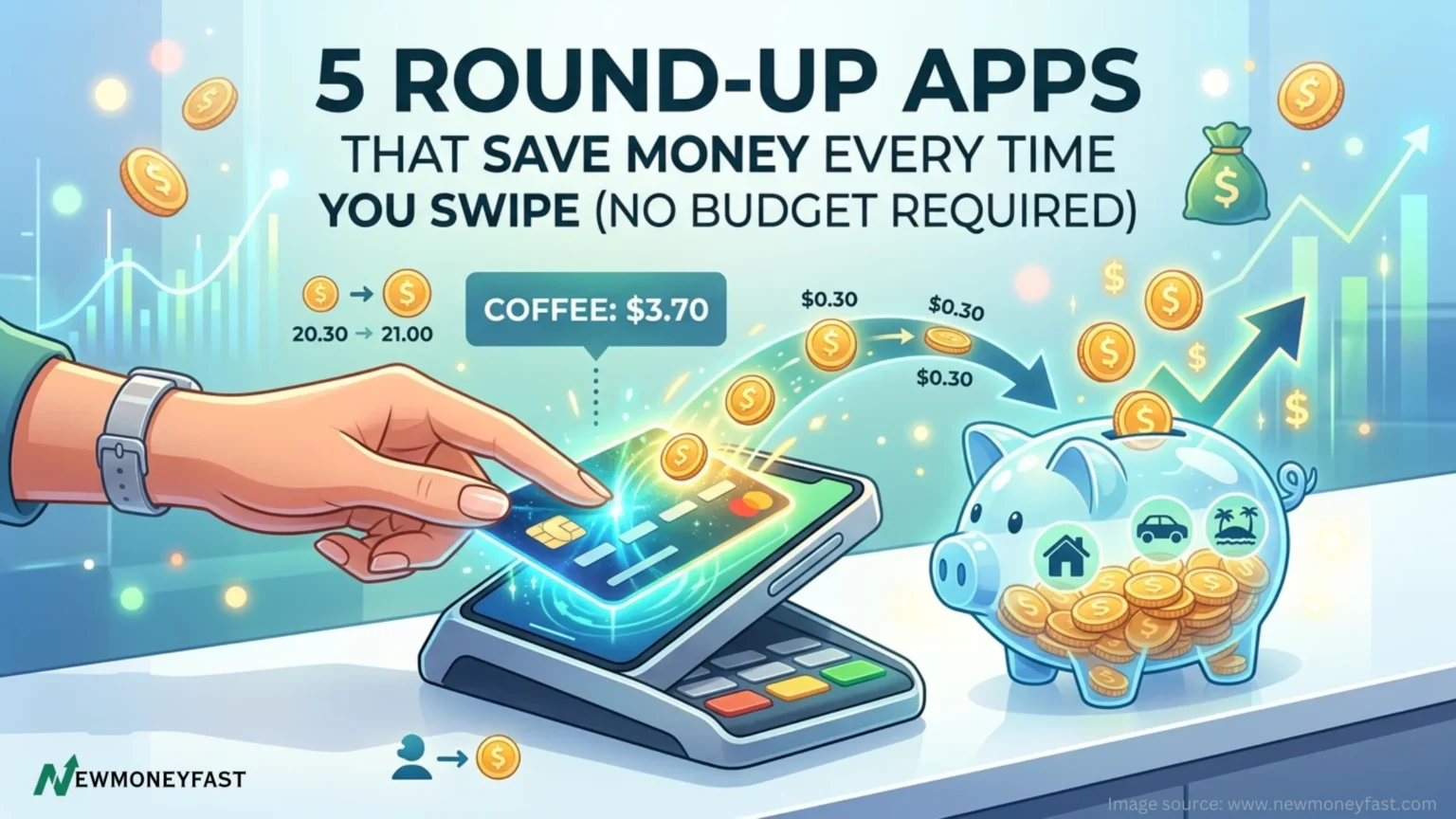
You spent $4.75 on a coffee this morning. You did not feel $4.75 poorer. What if 25 cents of that quietly landed in your savings account without you noticing? Now multiply that across every purchase you make, every day, for an entire year.
That is the round-up savings model, and real data from Acorns shows users who started with just spare change had accumulated an average of $2,500 over nine years from round-ups alone. Not budgeting. Not cutting expenses. Just letting small amounts pile up automatically in the background.
Here are the 5 best round-up apps in 2026, broken down by cost, features, and who each one is actually built for.
Quick Wins Summary
Potential savings/growth: $50 to $200+ per month, depending on spending volume
Time to set up: 5 to 10 minutes once
Ongoing effort required: Zero
Best for: Anyone who struggles to save manually, first-time investors, busy households



Why Round-Up Saving Works When Nothing Else Does
Most savings strategies fail because they require willpower. You have to remember to transfer money. You have to resist spending it. You have to feel the loss every time cash leaves your account.
Round-up apps remove all of that friction. The amounts are too small to feel, the transfers are automatic, and you never make an active decision to save. Research in behavioral economics calls this approach ‘Save More Tomorrow,’ which is the idea that automating small, painless amounts outperforms manual savings consistently over time.
The 60% of Americans living paycheck to paycheck are not necessarily spending frivolously. They often just never find the right moment to save. Round-up apps turn every purchase into that moment.
Now, let us look at the five best options available right now.
Acorns: Best Overall for Passive Investors
| Cost | $3/month (Personal) or $5/month (Family) |
| Best For | Anyone who wants savings AND investing on autopilot |
| How It Works | Links your debit and credit cards. Rounds every purchase to the nearest dollar and invests the difference into a diversified ETF portfolio you choose. Round-ups are transferred once they hit $5. You can also multiply your round-ups (2x, 3x, or 10x) to save faster. |
| Expected Savings | $150+ invested in the first 4 months for average users. Real Acorns data shows users who stayed on the platform for 9 years accumulated roughly $2,500 from round-ups and investment returns combined. |
| Action Step | Sign up at acorns.com, link every card you use, and set multiplied round-ups to 2x to double the impact without feeling a difference. |
What makes Acorns stand out: it is not just a savings app. Every cent of spare change goes into an actual investment portfolio with stocks and bonds. Your round-ups do not just sit in a savings account earning 0.5% per year. They grow with the market.
What to watch: The $3/month fee can eat into small balances. If your portfolio is under $200, wait to activate until you have linked multiple spending cards to increase round-up volume.
Chime: Best Free Option With No Fees
| Cost | Free (no monthly fee) |
| Best For | Savers who want zero-fee banking with automatic round-up savings |
| How It Works | Chime’s ‘Save When You Spend’ feature rounds up every Chime debit card purchase to the nearest dollar and moves the difference to a Chime Savings Account automatically. No investment component, just clean savings growth. |
| Expected Savings | $20 to $60/month in automated savings depending on spending volume, plus interest on the savings balance |
| Action Step | Open a free Chime account, enable the Save When You Spend feature, and use the Chime debit card as your primary spending card. |
What makes Chime stand out: zero fees, zero minimums, and no investment risk. If the idea of your spare change going into the stock market feels uncomfortable, Chime is the right call. Your round-ups go into an FDIC-insured savings account, not a brokerage.
What to watch: Round-ups only activate on Chime’s own debit card, so non-Chime purchases do not trigger the feature. To maximize savings, make Chime your primary day-to-day card.
Qapital: Best for Goal-Setters and Couples
| Cost | $3 to $12/month (30-day free trial) |
| Best For | People with specific savings goals, couples managing money together, and anyone who wants smart custom savings triggers |
| How It Works | Qapital goes beyond simple round-ups. You can create ‘rules’ that trigger savings automatically: round up purchases, save $1 every time you visit a coffee shop (Guilty Pleasure Rule), save the difference when you come in under your grocery budget (Spend Less Rule), or auto-save a percentage of every paycheck (Payday Divvy). Multiple rules can run simultaneously. |
| Expected Savings | $50 to $300+/month depending on which rules are active and your spending habits |
| Action Step | Start the 30-day free trial at qapital.com, activate the Payday Divvy rule plus round-ups, and set a specific savings goal like a vacation or emergency fund. Watching the goal meter fill is motivating. |
What makes Qapital stand out: the rule system is the most sophisticated in the category. The Freelancer Rule alone, which automatically sets aside a percentage of each deposit for estimated taxes, is worth the subscription cost for 1099 workers.
What to watch: The $3/month Basic plan only covers round-ups. The $6/month Complete plan unlocks investing and custom rules. Most users need at least the Complete plan to get full value.
Stash: Best for Aspiring Stock Pickers
| Cost | $3/month |
| Best For | People who want to invest spare change into individual stocks rather than pre-built ETF portfolios |
| How It Works | Stash rounds up purchases and invests the spare change. The key difference from Acorns: instead of assigning you a portfolio, Stash lets you choose from a menu of individual stocks and themed investment bundles. The ‘Stock-Back’ feature earns you fractional shares of companies you shop with. Buy coffee at Starbucks and earn a fraction of a Starbucks share. |
| Expected Savings | $40 to $100+/month invested passively, with potential additional stock-back earnings from frequent purchases |
| Action Step | Open a Stash account, link your spending cards, and enable Auto-Stash to set a weekly recurring contribution on top of your round-ups for faster growth. |
What makes Stash stand out: Stock-Back is genuinely unique. Every time you shop at a participating retailer, you earn fractional shares of that company. Heavy Amazon or Walmart shoppers can accumulate meaningful stock positions over time without putting in a single deliberate dollar.
What to watch: The fee is proportionally high for small balances. Stash makes most sense once your invested balance exceeds $300.
Oportun (formerly Digit): Best for Paycheck-to-Paycheck Savers
| Cost | $5/month (6-month free trial) |
| Best For | People who have tried to save manually and failed, living paycheck to paycheck who fear overdrafting |
| How It Works | Oportun does not use round-ups. Instead, it analyzes your income, spending patterns, and upcoming bills, then automatically transfers the exact amount you can safely save without overdrafting. It recalculates daily. If money is tight, it saves nothing. When there is a comfortable cushion, it moves a small amount automatically. |
| Expected Savings | $20 to $150/month depending on income and spending patterns, with overdraft protection built in |
| Action Step | Start the 6-month free trial at oportun.com, connect your checking account, and let the AI find your savings capacity. Most users see their first automatic transfer within the first week. |
What makes Oportun stand out: the overdraft protection is not just marketing. The algorithm is built to never put you in a negative balance. For people who have avoided saving because they are scared of running out of money mid-month, this is the only app designed specifically for that fear.
What to watch: It requires a 6-month free trial commitment before the $5/month fee kicks in. Use the trial period to evaluate how much it actually saves for your income level before committing.
Side-by-Side Comparison: Which Round-Up App Is Right for You?
| App | Cost/Month | Round-Ups | Also Invests? | Best For |
|---|---|---|---|---|
| Acorns | $3 | Yes | Yes (ETFs) | Hands-off investors who want to grow wealth passively |
| Chime | Free | Yes | No (savings) | People who want round-up savings with no fees or investing risk |
| Qapital | $3-$12 | Yes | Yes (5 portfolios) | Goal-setters and couples who want custom savings rules |
| Stash | $3 | Yes | Yes (stocks) | People who want to pick individual stocks from spare change |
| Oportun | $5 | No | No (savings AI) | Paycheck-to-paycheck savers who need AI to find safe savings |
Power Move: Stack Round-Ups With Cashback
None of these apps interfere with cashback rewards. Use Acorns or Chime for round-up savings while running Ibotta or Rakuten in the background on every purchase. Your spare change gets saved AND you earn 1% to 15% back on qualifying purchases. The two strategies run simultaneously and do not conflict with each other.
Related: Check out our Ibotta vs. Fetch vs. Rakuten breakdown to see which cashback app pays the most: newmoneyfast.com/ibotta-vs-fetch-vs-rakuten
Start Today: The 10-Minute Setup That Saves Money Forever
Pick one app from this list right now. Not tomorrow. Right now. Sign up, link your primary spending card, and activate round-ups. The entire setup takes under 10 minutes and then it runs on its own, every single day, without you doing anything.
Most people who fail to save are not lacking discipline. They are lacking automation. A round-up app closes that gap permanently.
Start with Chime if you want zero fees and zero investing risk. Start with Acorns if you want your spare change to actually grow. Start with Oportun if you have tried to save before and always ended up overdrafted.
Any of the five is a better option than doing nothing. And doing nothing is costing you $50 to $200 every single month.
Also read: Silent Savings: The Low-Effort Money Habits Quietly Making Millennials Richer in 2026
See also: Free vs. Paid Budgeting Apps: Which One Actually Helps You Save More?
And: How to Build an Emergency Fund From Zero
Visual Production Suggestions
1. Compound growth chart: $0.50/day in round-ups invested at 7% annual return shown over 5, 10, and 20 years.
2. App comparison infographic using the table above as a shareable social graphic.
3. ‘Before vs. After’ savings balance screenshot mockup: account balance after 6 months of round-up saving.
4. Step-by-step phone mockup: setting up round-ups in Acorns in 4 screenshots.
The Round-Up Challenge: Track Your First 30 Days
Install one round-up app today. Screenshot your balance on Day 1. Screenshot it again on Day 30. Share the result with a friend who is also trying to save. That small accountability loop is one of the most effective savings habits research has found.
Tag a friend who needs to see this. Saving does not have to be hard.
Frequently Asked Questions
| Are round-up apps actually safe to use? | Yes. All five apps on this list use bank-level encryption and partner with FDIC-insured banks. Acorns also offers SIPC protection on invested funds up to $500,000. Your round-ups are as safe as any standard bank deposit. |
| Can I lose money with a round-up app? | With Chime and Oportun, no. Your savings go into FDIC-insured accounts. With Acorns, Qapital’s investment option, and Stash, your round-ups are invested in the market, so balances can go down during market downturns just like any investment. For short-term savings goals, stick with the non-investing options. |
| How much can I realistically save with a round-up app? | The average person saves $30 to $80 per month through round-ups alone. With multiplied round-ups (2x or 3x in Acorns) and additional recurring contributions, users commonly reach $100 to $200 per month. Acorns’ own data shows average users invest over $150 in their first 4 months. |
| Do I need a good credit score to use these apps? | No. Round-up savings apps do not run credit checks. You link your existing bank account or debit card and the app does the rest. Chime in particular was designed to be accessible to people who struggle to qualify for traditional banking products. |
| Can I use more than one round-up app at the same time? | Yes. You can run Acorns for investing and Chime for fee-free savings simultaneously on different spending cards. Just be aware of any monthly fees stacking up. The combined benefit should clearly exceed the combined cost before using multiple apps. |
Affiliate Disclosure
New Money Fast may earn a commission when you click links to apps or services mentioned in this article, at no extra cost to you. All recommendations are based on independent editorial research and are not influenced by advertiser relationships.