

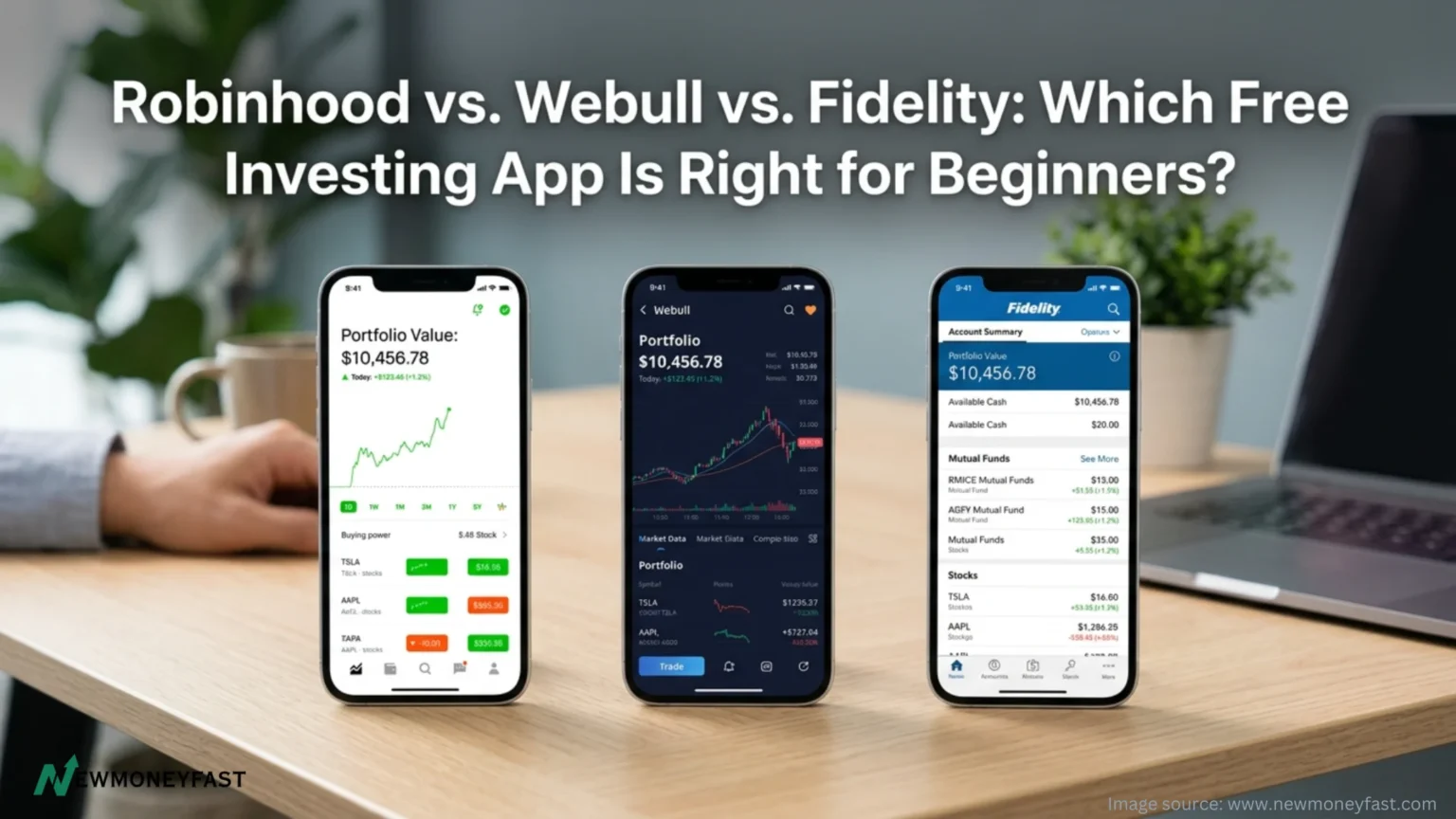
They are all free. They all let you invest with as little as $1. So why does picking the wrong one feel like such a big deal?
Because it is. The app you start with shapes your habits, your strategy, and how fast you actually grow your money. The good news: once you see exactly how these three stack up, the right pick becomes obvious.
| Why This Matters Right NowRoughly 37% of 25-year-olds now use investment accounts, up from just 6% a decade ago. Mobile apps are the reason. But with Robinhood, Webull, and Fidelity each targeting different investor profiles, choosing the wrong one can slow your progress or overwhelm you before you ever make your first trade. |
The Fast Facts: Side-by-Side Comparison
Here is everything that matters, in one place:
| Feature | Robinhood | Webull | Fidelity |
|---|---|---|---|
| Account Minimum | $0 | $0 | $0 |
| Stock Trading Commission | $0 | $0 | $0 |
| Fractional Shares (min.) | $1 | $1 | $1 |
| Options Trading Fee | $0 per contract | $0 (equity) / $0.30-$0.50 (index) | $0.65 per contract |
| Crypto Trading | Yes (22 coins) | Yes (50+ coins) | Yes (limited) |
| IRA / Retirement Account | Yes (with 1% match) | Yes | Yes (strongest) |
| Mutual Funds | No | No | Yes (3,220+ zero-fee) |
| Paper (Practice) Trading | No | Yes | No |
| Customer Support | Chat / Email only | Chat / Email | Phone, chat, in-branch |
| Education Rating (StockBrokers) | 3.5 stars / #7 | Intermediate focus | 5 stars / #1 |
| Best For | Simple beginners | Active / chart traders | Long-term / all-in-one |
Robinhood: The Starter App
Best for: Total beginners who want to start today with zero overwhelm
Robinhood is the app that made commission-free trading famous. It was the first platform to offer 100% free trades, and the whole industry followed. In 2026, it has evolved well beyond its original stripped-down design, now including stocks, ETFs, options, futures, crypto, and retirement accounts.
What makes it stand out: The interface is genuinely beginner-friendly. You can open an account, link your bank, and buy your first stock in under 10 minutes. That friction-free experience is why millions of first-time investors started here.
The IRA match is a real differentiator. Robinhood offers a 1% match on IRA contributions (jumping to 3% for Gold members). No other app in this comparison does that. If you are just starting your retirement savings, that free money adds up fast.
What it is missing: No mutual funds, limited research tools, and customer support is chat and email only. If you like detailed analysis before making a trade, Robinhood will feel thin.
| Robinhood at a GlanceCommission: $0 on stocks and ETFsAccount min: $0Best feature: 1% IRA match (3% for Gold members)Uninvested cash rate: 0.01% (free) / 3.5% (Gold)Watch out for: No mutual funds, limited research, no phone support |
Webull: The Trader’s Playground
Best for: Beginners who are ready to level up and learn technical analysis
Webull is commission-free like Robinhood, but it is built for people who want more than a buy button. You get advanced charting tools, stock screeners, extended-hours trading, and paper trading to practice without real money on the line.



Paper trading is the secret weapon. Webull lets you simulate real trades with fake money before you risk a single dollar. This is huge for beginners who are still learning. No other app in this comparison offers it, and it can shorten your learning curve dramatically.
More crypto options: Webull supports over 50 cryptocurrencies versus Robinhood’s 22. If crypto is part of your strategy, Webull gives you more flexibility.
The downside: The interface is denser than Robinhood’s. For someone who has never invested before, the screen full of charts and indicators can feel intimidating. Webull rewards people who are willing to learn. It can frustrate people who just want simplicity.
| Webull at a GlanceCommission: $0 on stocks and ETFsAccount min: $0Best feature: Paper trading (practice with fake money)Uninvested cash rate: 3.25% (non-Premium) / 3.6% (Premium)Watch out for: Steeper learning curve and a complex interface for true beginners |
Fidelity: The Long Game Winner
Best for: Beginners who are serious about long-term wealth building and retirement
Fidelity has been around for decades, and it shows. It is the only app here rated #1 for education by StockBrokers.com, with 5 stars and a full library of webinars, quizzes, and learning tools. It is also the only one offering mutual funds, including its famous zero-expense-ratio index funds like FZROX (total market) and FNILX (S&P 500), which charge 0% annually.
The education advantage is massive for beginners. While Robinhood and Webull provide basic lessons, Fidelity goes further with live webinars, progress tracking, and quizzes. For someone who wants to understand investing rather than just click buttons, Fidelity is the classroom and the brokerage all in one.
Retirement planning depth: Fidelity offers traditional IRAs, Roth IRAs, rollover IRAs, HSAs, 529 college savings plans, and even 401(k) management. If you are thinking beyond just buying stocks, no other app in this comparison comes close.
The tradeoff: Fidelity is more complex. You will not get the slick, minimal design of Robinhood. But you will get access to a real human being by phone, in-branch support, and a platform that can grow with you for decades without you needing to switch.
| Fidelity at a GlanceCommission: $0 on stocks and ETFs ($0.65 per options contract)Account min: $0Best feature: Zero-expense-ratio mutual funds + #1 rated educationUninvested cash rate: 3.97%Watch out for: Less sleek interface, more complexity upfront |
So Which App Wins for Beginners?
There is no single winner. There is only the right app for your situation:
| Match Your Goal to Your AppYou want the simplest possible start: Go with Robinhood. Open an account in minutes and make your first investment today.You want to practice before risking real money: Go with Webull. Use paper trading until you feel confident, then switch to real funds.You are serious about retirement and long-term wealth: Go with Fidelity. The education, mutual fund access, and retirement tools will serve you for life.You can also use two. Many investors use Robinhood or Webull for active trades and Fidelity for their IRA. You are not locked in. |
The Pro Move: Start With $5 This Week
The single biggest mistake new investors make is waiting. Picking the perfect app matters less than actually starting. Here is the challenge:
| The 30-Day Investing Starter ChallengeWeek 1: Open your chosen account and invest $5 in one index ETF.Week 2: Set up an automatic weekly deposit of $10.Week 3: Check your portfolio without changing anything. Get used to seeing it move.Week 4: Add one more position. Now you have a real portfolio.Your goal: By the end of 30 days, you are an investor. Not a wannabe. Not a planner. An actual investor. |
Build Your Full Money Strategy
Investing is just one piece. Check out these other resources on NewMoneyFast to build a complete financial picture:
Already tracking your spending? See how the right budgeting app can put more money in your investment account every month: Free vs. Paid Budgeting Apps: Which One Actually Helps You Save More?
Using reward cards the right way can fund your brokerage account. Read more: How to Actually Use Reward Credit Cards Without Going Into Debt
Looking for ways to earn more money to invest? These apps pay real cash: 10 Free Money Apps That Actually Pay You (Not Just Points, Real Cash)
Starting with side income to fund your portfolio? Here is where to begin: The Beginner’s Guide to Passive Income: 6 Legit Streams Anyone Can Start in 2026
| Visual Content Suggestions for Design Team1. App UI side-by-side: Three phone mockups showing Robinhood, Webull, and Fidelity home screens2. Decision tree graphic: A simple flowchart matching investor type to app recommendation3. $5 growth chart: Infographic showing what $5/week invested at average market returns looks like over 5, 10, and 20 years4. 30-Day Challenge tracker: Printable or digital challenge card with the 4-week plan |
Frequently Asked Questions
Is Robinhood safe for beginners in 2026?
Yes. Robinhood is SIPC-insured up to $500,000 for securities and regulated by FINRA. It is a legitimate brokerage used by millions of Americans. Enable two-factor authentication when you sign up for an extra layer of security.
Can I really start investing with just $1?
Yes. Robinhood, Webull, and Fidelity all offer fractional shares, which means you can buy a slice of any stock or ETF for as little as $1. You do not need to save up the price of a full share to get started.
What is Webull paper trading and should I use it?
Paper trading is simulated investing with fake money. Webull lets you practice buying and selling stocks without risking real money. It is an excellent way to learn market mechanics, test strategies, and build confidence before you invest your first real dollar.
Does Fidelity charge hidden fees?
No, Fidelity charges $0 commissions on US stocks and ETFs, and their famous zero-expense-ratio mutual funds (FZROX, FNILX) literally cost nothing to hold. The one fee to be aware of is $0.65 per options contract, which only applies if you trade options.
Should I use multiple investing apps at the same time?
Many investors do, and it works well. A common setup is using Robinhood or Webull for active trades and Fidelity for a Roth IRA or long-term index fund portfolio. Just make sure you are not spreading yourself so thin that you lose track of your overall strategy.
| Ready to Start Investing?Your first trade is closer than you think. All three apps are free, require no minimum deposit, and let you start with just $1 in fractional shares. Pick the one that matches where you are today.Beginner? Start with Robinhood.Want to practice first? Open Webull and use paper trading.Building long-term wealth? Fidelity is your forever home.Whatever you choose, choose TODAY. The market does not wait.For more smart money moves, visit newmoneyfast.com |
Sources
1. StockBrokers.com – Robinhood vs Webull 2026
2. StockBrokers.com – Fidelity vs Robinhood 2026
3. NerdWallet – Webull vs Robinhood 2026
4. NerdWallet – Fidelity vs Robinhood 2026
5. FinanceBuzz – Fidelity vs Robinhood 2026
6. Finder – Webull vs Robinhood 2026
7. Unbiased – Webull vs Robinhood
8. Firstcard – Robinhood vs Fidelity 2026