

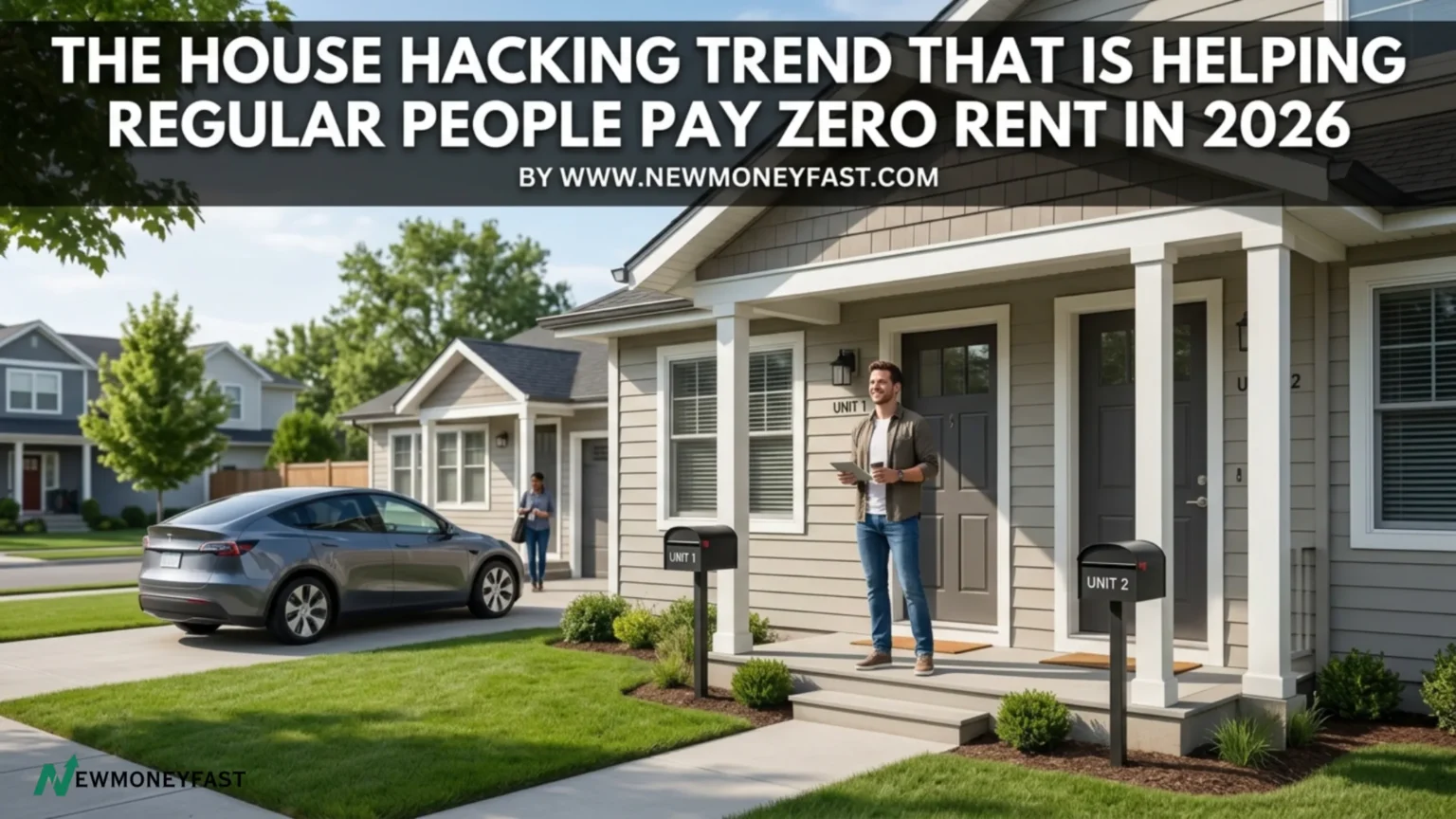
American homeowners now spend a median of more than one fifth of their income just on housing, but a small and growing group of buyers has found a loophole: get someone else to pay your mortgage for you.
It is called house hacking, and it is not a TikTok gimmick. Buyers are using low down payment loans to purchase small multifamily properties, moving into one unit, and renting out the rest. Some are turning spare bedrooms into income. Others are converting garages into rentable units. Done right, it can knock your housing payment down to almost nothing or hand you a check every month instead of writing one. Here is what is actually working in 2026 and how to start without getting burned.
| QUICK WINS SUMMARYTotal Potential Savings: $500 to $1,500+ per month on housing costsTime Investment: 60 to 90 days to find, finance, and close a propertyDifficulty Level: Intermediate (requires a home purchase or a spare room)Best For: First-time buyers, renters with extra space, and anyone tired of a rising rent bill |
7 Ways Regular Buyers Are House Hacking Their Way to Zero Rent
1. Buy a Duplex, Triplex, or Fourplex With an FHA Loan
This is the original version of house hacking, and it still works. An FHA loan lets you buy a two to four unit property with as little as 3.5% down, as long as you live in one unit as your primary residence. You rent out the remaining units, and that rental income can offset most or all of your mortgage payment.
In more affordable metro areas, a duplex priced around $135,000 can carry an all in FHA payment near $1,085 a month. Renting the second unit for roughly $875 drops the owner’s effective housing cost to under $300 a month, which is far below what a typical one-bedroom apartment rents for in that same market.
Expected Savings: $500 to $800+ per month compared to renting your own place
Action Step: Ask a local lender to pre-qualify you for an FHA 203(b) loan on a 2 to 4 unit property and pull current FHA loan limits for your county.
2. Rent Out Bedrooms in a Single-Family Home
Duplexes are not available everywhere, so plenty of house hackers buy a single-family home with extra bedrooms instead and rent those out to roommates. This works especially well in expensive coastal and college markets where multifamily housing is scarce.
In cities like Denver or Phoenix, renting two bedrooms at $800 to $900 each while you keep the primary suite can cover half or more of a typical mortgage payment, all while you keep the whole house instead of splitting a deed.



Expected Savings: $1,000 to $1,800 per month in shared markets
Action Step: List your spare rooms on a roommate matching platform and screen applicants the same way a landlord would, with income verification and references.
3. Build or Convert an ADU
An accessory dwelling unit, or ADU, is a small separate living space such as a converted garage, basement apartment, or backyard cottage. More cities have loosened zoning rules around ADUs, which makes this one of the fastest-growing house hacking strategies in 2026.
An ADU keeps your tenant physically separate from your main living space, which solves the privacy concerns that come with a shared roommate setup, while still generating steady rental income toward your mortgage.
Expected Savings: $400 to $1,200 per month depending on ADU size and local rents
Action Step: Check your city’s ADU zoning rules and get a contractor quote before assuming a conversion pencils out.
4. Target the Right Market Instead of the Trendy One
House hacking math only works if the rent-to-price ratio in your market makes sense. A duplex in a high-cost coastal city will rarely generate enough rent to meaningfully offset your payment. Markets in the Midwest and parts of the Sun Belt tend to offer far stronger rent coverage relative to purchase price.
Expected Savings: The difference between a duplex that cash flows and one that quietly drains your budget every month
Action Step: Before you shop for a property, calculate the rent-to-price ratio for two or three target cities and compare them side by side.
5. Screen for Tenants Who Are Rarely Home
If you are sharing common space with a roommate or renter, who you rent to matters as much as what you charge. Many successful house hackers specifically look for travel nurses, graduate students, or professionals who work irregular schedules and are simply gone more often, which reduces friction in a shared living situation.
Expected Savings: Fewer conflicts, lower turnover, and more consistent on-time rent
Action Step: Mention flexible or non-standard work schedules as a plus in your rental listing to attract this kind of tenant.
6. Budget for Reserves So You Do Not Get Burned
The version of house hacking that goes viral skips the boring part: vacancy and maintenance reserves. Setting aside roughly 15% of collected rent for vacancy periods, repairs, and turnover is what keeps a house hack from turning into a financial emergency the first time a tenant moves out or a water heater fails.
Expected Savings: Avoids an unexpected $1,000 to $3,000 repair bill wiping out months of savings
Action Step: Open a separate savings account and auto-transfer 15% of every rent payment into it before you touch the rest.
7. Use the 12-Month Rule to Roll Into Your Next Deal
FHA and similar owner-occupied loans typically require you to live in the property for at least 12 months. After that year is up, many house hackers move out, keep the property as a full rental, and use a new loan to repeat the process on a second property, stacking rental income over time.
Expected Savings: Compounding equity and cash flow across multiple properties instead of one
Action Step: Mark your 12-month occupancy anniversary on your calendar now so you know exactly when you are free to repeat the strategy.
Where House Hacking Actually Pencils Out
Not every city offers the same rent coverage. Here is how the math compares in a few markets known for stronger house hacking potential.
| Market | Typical Duplex Price | Rent From 2nd Unit | Effective Owner Cost |
|---|---|---|---|
| Cleveland, OH | $135,000 | $875/month | ~$210/month |
| Denver, CO (room rental) | N/A (single-family) | $800 to $900/room | 50%+ of mortgage covered |
| High-cost coastal metro | $650,000+ | Rarely covers full payment | Still reduces net cost |
| THE 90-DAY ZERO RENT CHALLENGELevel up your house hacking game in three stages.Days 1 to 30 (Scout): Compare rent-to-price ratios in 3 target markets and get pre-qualified for financing.Days 31 to 60 (Secure): Make offers, run the numbers on reserves, and lock in your property.Days 61 to 90 (Stack): List your unit or rooms, screen tenants, and set up your 15% reserve auto-transfer.Which stage are you starting at? Reply to your own budget tracker and commit to one action step from this article today. |
Visual Content Suggestions for Design Team
- Before/after housing cost comparison chart: median rent vs. effective house-hacked cost
- Simple diagram of a duplex floor plan showing owner unit vs. rented unit
- City comparison infographic using the market table above
- 90-Day Zero Rent Challenge progress tracker graphic (Scout, Secure, Stack milestones)
Frequently Asked Questions
Is house hacking actually legit, or is it just a social media trend?
It is a real, long-used real estate strategy that predates social media by decades. What changed recently is the marketing around it. The core mechanics, using owner-occupied financing to buy a small multifamily property and renting out part of it, remain sound when the numbers are run realistically.
Do I need perfect credit to house hack?
No. FHA financing generally allows a 3.5% down payment with a credit score of 580 or higher, and a 10% down payment for scores between 500 and 579. Many lenders set their own higher minimums, so compare a few lenders before assuming you do not qualify.
Can house hacking really get my housing payment to zero?
Sometimes, especially in more affordable markets with strong rent-to-price ratios. In expensive coastal cities, it is more realistic to expect a significantly reduced payment rather than a fully eliminated one. Either outcome still beats paying full rent with no equity to show for it.
What is the biggest mistake new house hackers make?
Skipping reserves. Buyers who do not set aside money for vacancy and maintenance are the ones who get burned when a tenant moves out or something breaks. Building in that 15% cushion from day one is what separates a sustainable house hack from a stressful one.
How long do I have to live in the property?
Owner-occupied loan programs like FHA typically require at least 12 months of primary residence. After that period, you are generally free to move out and convert the property into a full rental if you choose.
Sources
1. Amerisave, 10 House Hacking Strategies That Actually Work in 2026
2. Yahoo Finance, Is House Hacking Still a Smart Strategy in 2026? What Lenders Now Look For
3. Kevin Oliver, eXp Realty, House Hacking in 2026: What the Hype Got Wrong and What Actually Works
4. Richify Insights, House Hacking 101: How to Live for Free While Building Real Estate Wealth
5. HonestCasa, Best Cities for House Hacking 2026
6. Ledwell Realty, House Hacking in 2026: What the Hype Got Wrong and What Actually Works
7. Amerisave, 2026 FHA Loan Limits: 8 Things Every Home Buyer Needs to Know
8. Lower, FHA Multifamily Loans: Finance 2-4 Units With 3.5% Down
9. Amerisave, FHA Multifamily Loans: Complete 2026 Guide to Financing Multi-Unit Properties
10. Gustan Cho Associates, Owner-Occupant Multi-Family Mortgage Guidelines
Affiliate Disclosure: New Money Fast may earn a commission from partner links in this article, at no extra cost to you. This helps support our free content. We only recommend products and services we believe can genuinely help our readers save or earn money.