

That credit card balance is not just sitting there. It is compounding against you every single day.
Americans are now carrying $1.252 trillion in total credit card debt as of Q1 2026, at an average APR of 22.3%. For the average person carrying a $6,618 balance, that translates to $1,759 in pure interest charges every year on money they already spent. And if they only make minimum payments? It takes over 7 years to pay off that balance, costing $3,610 in interest along the way.
There is a better way. It’s called the debt avalanche method, and it is mathematically the most efficient strategy for eliminating high-interest debt. This guide explains exactly how it works, why it beats the alternatives, and how to start today.
| THE MINIMUM PAYMENT TRAP: THE MATH THEY NEVER SHOW YOUAverage credit card balance: $6,618Average APR (interest-bearing accounts): 22.3%Average minimum monthly payment (2%): $132/monthTime to pay off on minimums only: Over 7 yearsTotal interest paid on minimums only: $3,610Total Americans paid in credit card interest and fees in 2025: $253.37 billion |
What Is the Debt Avalanche Method?
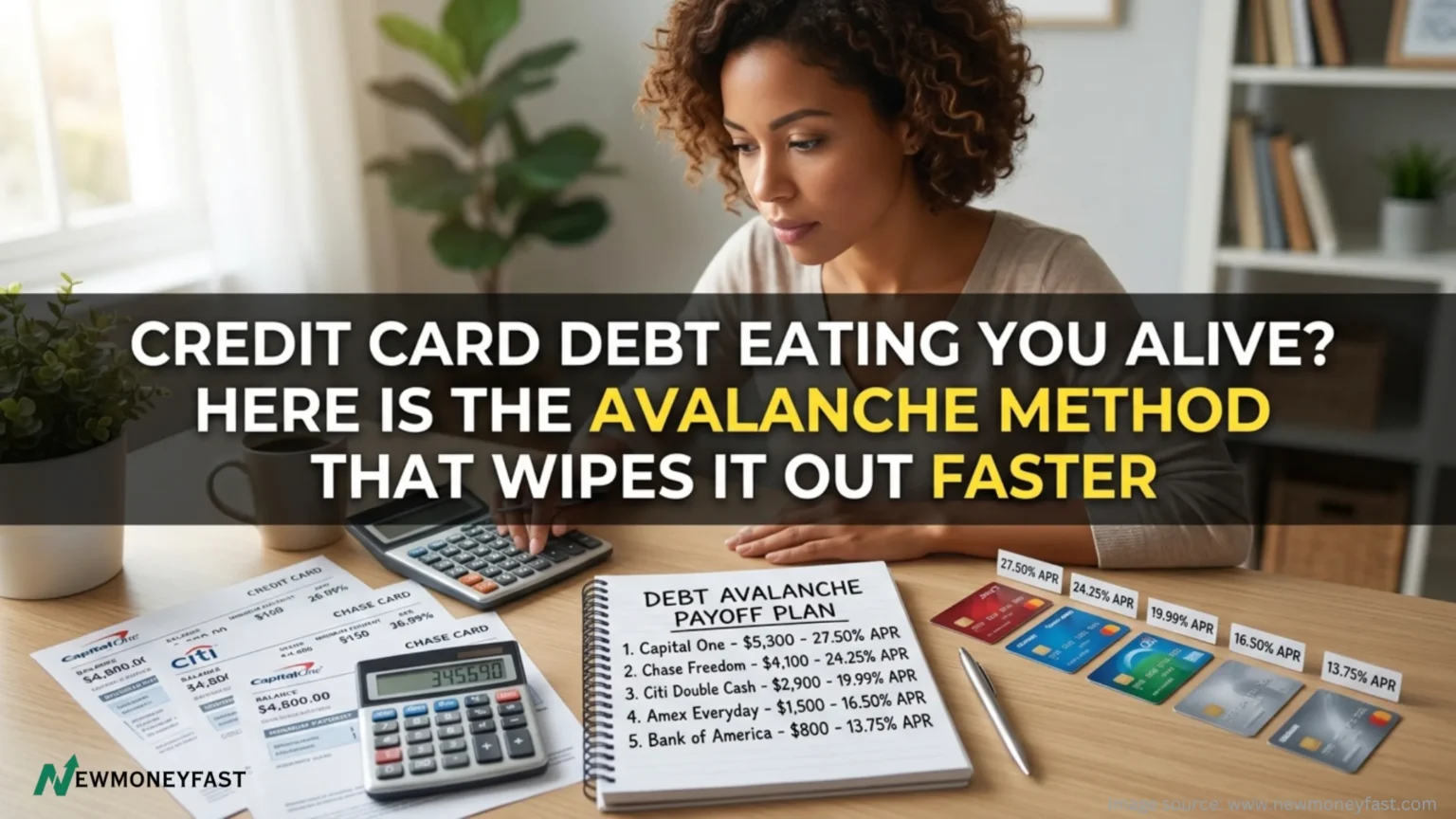
The debt avalanche is a debt payoff strategy built on one core principle: attack the debt that is costing you the most money first. Specifically, you rank all of your debts by interest rate, from highest to lowest, and throw every available extra dollar at the top of that list while paying only the minimum on everything else.
When the highest-rate debt is eliminated, you take the full amount you were paying on it and roll it directly into the next debt on the list. That payment grows larger and more powerful with each debt you knock out, like an avalanche gaining momentum as it moves down the mountain.
The result: you pay less in total interest and become debt-free faster than any other repayment approach that uses the same monthly payment amount.
How to Execute the Debt Avalanche: Step by Step
Step 1: List Every Debt You Owe
Pull every debt you carry: credit cards, store cards, personal loans, medical debt, student loans, everything. For each one, write down three numbers:
- Current balance (how much you owe right now)
- Interest rate / APR (the annual percentage rate being charged)
- Minimum monthly payment (the minimum required by the lender)
You cannot build a payoff plan without accurate numbers. Pull your most recent statement for each account and write them down together in one place.



Step 2: Rank by Interest Rate, Highest to Lowest
This is the avalanche method in its entirety: sort your debts by APR from highest to lowest. That highest-APR debt is your Target. Everything else is on hold at minimum payments.
The reason this works: a 24% APR credit card is compounding against you at twice the speed of a 12% personal loan. Every extra dollar you send to the 24% card saves you $0.24 per year per dollar, permanently. Every extra dollar you send to the 12% loan only saves you $0.12. The math always points to the highest rate first.
Step 3: Find Your Extra Monthly Payment
Look at your monthly budget and find any amount you can add on top of your minimum payments. Even $50 extra per month dramatically accelerates your payoff timeline and reduces total interest paid. This is your Avalanche Payment.
If you are struggling to find extra cash, our subscription audit guide and utility bill reduction guide can free up $80 to $200 per month from your existing budget, often with minimal lifestyle change.
Step 4: Send Every Extra Dollar to Your Target Debt
Pay the minimum on every debt. Then send your entire Avalanche Payment to Debt #1 (highest APR). Do not split it. Do not spread it around. All of it goes to the single highest-rate balance until it is gone.
Set up an extra payment in your online banking to automate this. The less decision-making required, the less chance of slipping back into paying just the minimum.
Step 5: Roll the Payment Forward on Every Knockout
When Debt #1 is eliminated, you now have its minimum payment plus your Avalanche Payment freed up. Send the entire combined amount to Debt #2. When that is gone, roll everything into Debt #3.
This is the compounding power of the avalanche: each time a debt falls, your attack payment gets bigger. The final debt on your list gets hit with the full combined payment of everything that came before it.
The Avalanche in Action: A Real-World Example
Let’s say you have three debts and can put $200 extra per month toward payoff:
| Debt | Balance | APR | Min. Payment | Avalanche Rank |
|---|---|---|---|---|
| Store Credit Card | $2,800 | 28% | $56/mo | #1 (Target First) |
| Visa Credit Card | $5,500 | 22% | $110/mo | #2 |
| Personal Loan | $4,200 | 11% | $84/mo | #3 (Last) |
Your total minimum payments: $250/month. You add $200 extra each month, making your total monthly payment $450.
| AVALANCHE IN MOTIONMonth 1 through payoff of Store Card (Rank #1): Pay $56 minimum on everything else. Send $250 total ($56 min + $200 extra) to the store card every month. The 28% card gets buried first because it is destroying you the fastest.After Store Card is eliminated: Roll its $56 payment into the Visa. Now you are hitting the Visa with $366/month ($110 min + $56 freed up + $200 extra). The 22% balance starts collapsing fast.After Visa is eliminated: The full $450 avalanche hits the personal loan at 11%. It does not last long.Result: You pay off all three debts months earlier and save hundreds to thousands in interest compared to paying minimums only or using the snowball approach. |
Avalanche vs. Snowball: Which One Is Right for You?
The debt avalanche is not the only strategy. The debt snowball, which pays off smallest balances first regardless of interest rate, is its main competitor. Here is the honest comparison:
| Debt Avalanche | Debt Snowball | |
|---|---|---|
| Core logic | Highest APR first | Smallest balance first |
| Interest savings | Maximum possible | Less (slower to attack high rates) |
| Speed to debt-free | Fastest mathematically | Slightly slower in most scenarios |
| Psychological wins | Fewer early wins | Faster early wins (small debts cleared) |
| Best for | High rate spreads between debts | People who need motivational momentum |
| Verdict | Mathematically superior | Psychologically motivating |
The honest take: the avalanche saves more money, always. The interest rate does not lie. But the best debt payoff method is the one you actually stick with. If early wins are what keep you motivated, a hybrid approach works too: pay off one small balance first to build momentum, then switch to strict avalanche order for everything else.
The Avalanche Accelerator: Pairing It With a 0% Balance Transfer
Here is the move that puts the debt avalanche into overdrive: while you are executing the avalanche, consider transferring your highest-rate balance to a 0% introductory APR balance transfer card. This temporarily eliminates interest on your target debt entirely, meaning every dollar of your Avalanche Payment goes straight toward the principal.
Top balance transfer offers as of June 2026:
- Wells Fargo Reflect Card: 0% intro APR for up to 21 months on balance transfers, 3% transfer fee, $0 annual fee
- Citi Simplicity Card: 0% intro APR for 18 months, low introductory transfer fee, no penalty APR, no late fee, $0 annual fee
- U.S. Bank Visa Platinum Card: 0% intro APR for 21 billing cycles on BOTH purchases and transfers, 3% transfer fee, $0 annual fee
The math on a balance transfer: move a $6,000 balance from 22% APR to 0% for 21 months. Instead of paying $1,320 in interest during that period, you pay $0. Every cent of your payment reduces the principal. A 3% transfer fee ($180 on $6,000) pays for itself in the first 2 months of 0% interest savings.
| BALANCE TRANSFER RULES TO NEVER BREAKRule 1: Do NOT make new purchases on the balance transfer card. By law, payments apply to the lowest-APR balance first, meaning new purchases at the regular rate can create a trapped interest-accruing balance alongside your 0% transfer.Rule 2: Never miss a payment. A single 30-day late payment can trigger a penalty APR (up to 29.99%) and immediately terminate your 0% promotional rate on the entire remaining balance.Rule 3: Calculate your required monthly payment on day one. Divide your transferred balance by the number of 0% months. Set up autopay for that exact amount. If you are transferring $5,250 to a 21-month card, your required monthly payment to clear it before the rate expires is $250.Rule 4: Set a calendar reminder two months before your 0% period expires. If any balance remains, you have time to either transfer again, pay it down aggressively, or take out a personal loan at a lower rate than your original card. |
Your 5-Step Avalanche Launch Plan (This Weekend)
You do not need to wait for a better financial moment. Here is what to do right now:
- List every debt today. Pull every credit card and loan statement. Write down balance, APR, and minimum payment for each. Spend 20 minutes and don’t stop until the full picture is on paper.
- Rank by APR, highest to lowest. Circle the top one. That is your target. That is the only debt that gets extra money until it is dead.
- Find your Avalanche Payment. Review your last 30 days of spending. Cancel one unused subscription. Cut one convenience spend. Find $50 to $200 you can redirect every single month.
- Set up an automatic extra payment. Log into your bank or credit card portal. Set up an automatic additional payment to your target debt today. Automation removes the temptation to skip it.
- Consider a balance transfer if your credit qualifies. If your target debt has a high balance (over $2,000) and you have good credit (680+), applying for a 0% balance transfer card can eliminate months of interest charges and dramatically speed up your timeline. Check your eligibility without impacting your score at
| THE 30-DAY DEBT KNOCKOUT CHALLENGEWeek 1: List all debts, rank by APR, calculate total minimum payments. Write your Target debt on paper and stick it somewhere visible.Week 2: Find your Avalanche Payment. Use our subscription audit or utility guide to free up extra cash from your existing budget. Even $50 matters.Week 3: Set up automatic payments. Make your first extra payment to your target debt. If eligible, research and apply for a 0% balance transfer card.Week 4: Track your first month of progress. Calculate how many months until your first debt is eliminated. Put that date on your calendar as a celebration milestone. |
Find the Money to Feed Your Avalanche
The faster you can grow your Avalanche Payment, the sooner the debt is gone. These New Money Fast guides help you find extra cash without taking on a second job:
- Your Subscriptions Are Draining $200 a Month Without You Knowing
- Your Utility Bills Are Too High: 7 Fixes That Save $80 a Month
- 10 Things You Are Paying Too Much for Right Now
- The Beginner’s Guide to Passive Income: 6 Legit Streams Anyone Can Start in 2026
| VISUAL CONTENT SUGGESTIONS FOR DESIGN TEAM1. Avalanche vs. Minimum Payment Timeline: A side-by-side bar chart showing the same $6,618 debt paid off with minimum payments (7+ years, $3,610 interest) vs. the debt avalanche with $200 extra per month (estimated 2 to 3 years, dramatically less interest)2. Step-by-Step Flowchart: A numbered flowchart of the 5-step Avalanche Launch Plan, with each step as a visual card in brand colors, shareable for social media3. Avalanche vs. Snowball Infographic: A side-by-side visual showing the same 3-debt scenario paid off in both orders, with total interest paid and time to debt-free clearly labeled4. Rolling Payment Calculator Visual: An animated or static illustration showing how freed-up payments roll from debt to debt, each getting bigger as debts fall, like a snowball rolling downhill in reverse |
Frequently Asked Questions
Does the debt avalanche actually save more money than the snowball?
Yes, mathematically, the avalanche always saves more money in total interest when using the same monthly payment amount. This is because it eliminates the debt compounding at the highest rate first. The savings range from a few hundred dollars to thousands depending on the spread between your interest rates and the size of your balances. The snowball method trades some of that savings for earlier psychological wins, which is a legitimate trade-off for people who struggle to stay motivated on a long payoff journey.
What if I cannot afford any extra payment right now?
Even $25 to $50 extra per month makes a meaningful difference over a multi-year payoff period. But if your budget is truly stretched, start by reviewing your subscriptions and recurring charges. Our subscription audit guide helps most people find $40 to $100 in monthly spending they had completely forgotten about. That is your Avalanche Payment, already hiding in your existing spending.
Should I pause investing while paying off credit card debt?
At 22% APR, your credit card debt is compounding against you faster than most investments can compound for you. The stock market has historically returned 7 to 10% annually on average. Paying off a 22% debt is a guaranteed 22% return. The conventional financial wisdom is to: (1) contribute enough to your 401(k) to capture any employer match (that is an instant 50% to 100% return you cannot beat), then (2) aggressively pay down any credit card debt above 15% APR before adding more to investments.
Does carrying a balance hurt my credit score?
Yes. Your credit utilization ratio (how much of your available credit you are using) makes up about 30% of your FICO score. Carrying a high balance relative to your credit limit lowers your score. The debt avalanche directly improves this: as you eliminate balances, your utilization drops and your score rises. This can ultimately help you qualify for lower interest rates on future credit, which creates a positive compounding effect in the opposite direction.
What is the best free tool to track my debt avalanche?
Several free tools make the tracking process simple. Undebt.it is one of the most popular free debt payoff calculators, letting you plug in all your debts and compare avalanche vs. snowball timelines side by side. NerdWallet’s debt payoff calculator is another strong free option. Both give you a month-by-month payoff schedule so you can see your exact debt-free date from day one.
| STOP PAYING $1,759 A YEAR FOR NOTHINGEvery day you carry high-interest debt, your lender profits from your delay. The debt avalanche is your counter-move.List your debts. Rank by APR. Find $50 extra. Set up an automatic payment to your target debt today. The avalanche starts with one push.More debt-busting and money-saving guides at newmoneyfast.com. |
Sources
- LendingTree: 2026 Credit Card Debt Statistics — $1.252 Trillion, 21% APR Q1 2026
- WalletHub: Average Credit Card Debt Statistics 2026 — $6,618 Balance, 7+ Years on Minimums
- WalletHub: Americans Paid $253.37 Billion in Credit Card Interest and Fees in 2025
- DropThe.org: Credit Card Statistics 2026 — $1.28T Debt, 22.30% APR, $1,759/year in Interest
- Motley Fool: Average American Credit Card Debt 2025/2026 — 22.3% Average APR
- Fidelity: Debt Snowball vs. Debt Avalanche Method
- Experian: Debt Avalanche vs. Debt Snowball — Interest Savings Comparison
- NerdWallet: Best Balance Transfer Credit Cards of June 2026
- Wealthvieu: Best Balance Transfer Credit Cards 2026 — Wells Fargo Reflect, Citi Simplicity
- The Global Statistics: Credit Card Debt Statistics in US 2026 — 49% of Cardholders Are Revolvers