

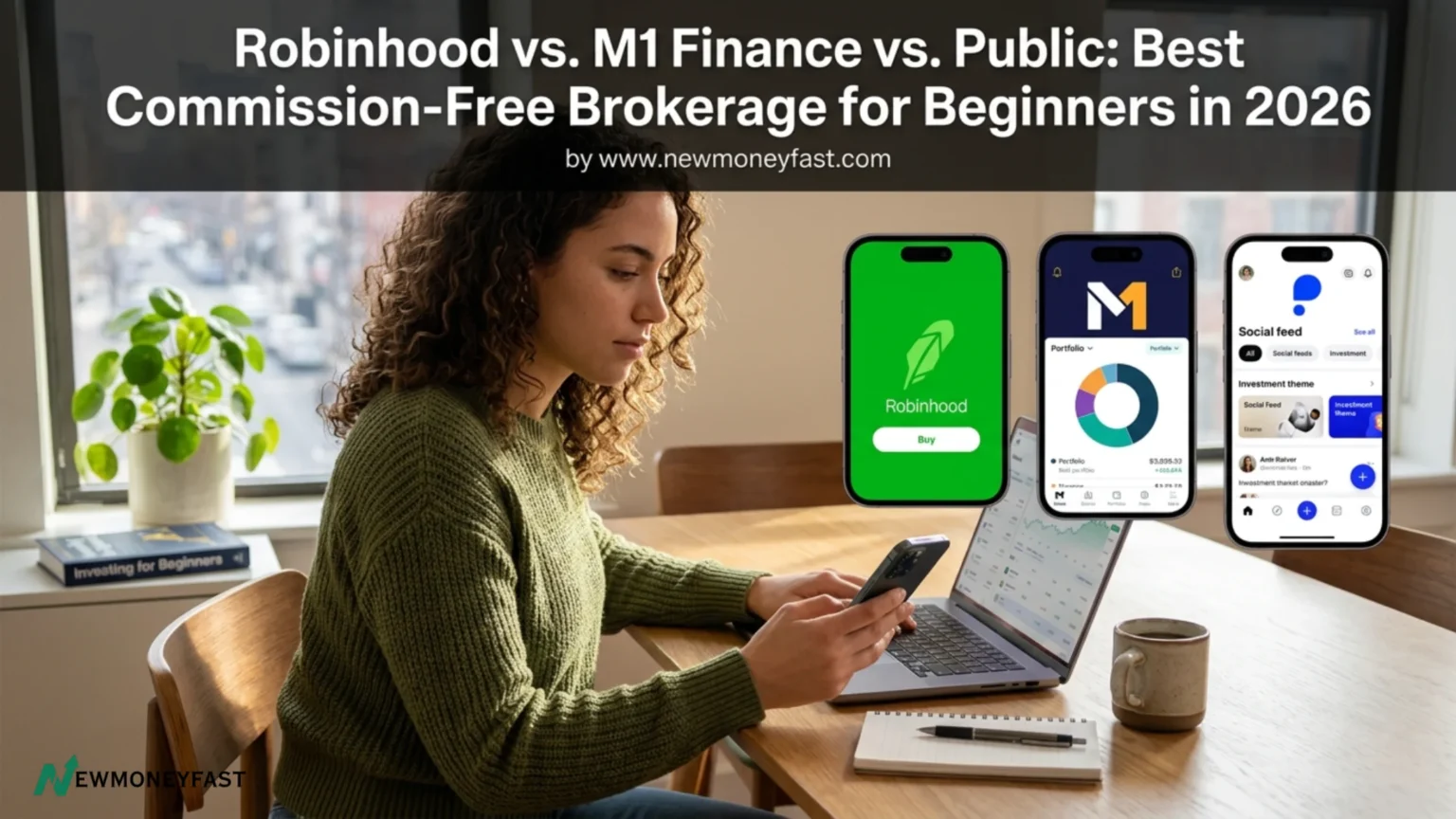
All three of these apps let you trade stocks for $0 in commissions, but only one of them is quietly paying you up to 3.3% APY just to leave cash sitting there, and only one hands you a 3% match on your retirement contributions. Picking the wrong app could cost you hundreds of dollars a year without you ever noticing.
Why This Decision Actually Matters
Commission-free trading used to be the whole pitch. Now every major app offers it, so the real differences are hiding in the fine print: platform fees, cash yield, IRA matches, and whether the app is built for buy-and-hold investors or active traders. Pick based on your actual habits, not just the flashiest homepage, and you can start compounding the savings within your first week.
| ⚡ Quick Wins SummaryPotential value: Up to $258/year from IRA matching alone, plus 0% to $36/year in avoidable platform feesTime investment: About 15 minutes to open an account and fund itDifficulty level: Beginner-friendly (all three apps)Best for: New investors, long-term savers, and anyone tired of paying trading fees |
1. Robinhood: Best for Active Traders Who Want an IRA Match
Robinhood offers zero-commission trading on stocks, ETFs, and options, with no account minimum to get started.
How it works: The free tier is genuinely free, but Robinhood Gold ($5 a month) unlocks the features that make the biggest financial difference: 4.5% APY on uninvested cash instead of 1.5%, zero options contract fees instead of $0.65 each, and a 3% match on IRA contributions instead of 1%.
Specific example: Max out a 2026 IRA contribution while subscribed to Gold, and the 3% match alone is worth roughly $225 to $258 depending on your contribution limit, according to recent Robinhood match breakdowns.
Estimated value: Up to $258/year from the IRA match, plus extra interest on any idle cash.
Action step: Open a Robinhood account, decide if your cash balance and options trading justify the $5/month Gold fee, and set up automatic IRA contributions to capture the match.
2. M1 Finance: Best for Hands-Off, Automated Long-Term Investors
M1 Finance is built around “Pies,” custom portfolios of stocks and ETFs that rebalance automatically every time you add money, so you are never manually clicking buy on ten different tickers.



How it works: M1 charges a $3 monthly platform fee, but that fee is waived entirely once your account holds $10,000 in assets or if you have an active M1 personal loan.
Specific example: On a $5,000 portfolio, the $3 monthly fee works out to roughly $36 a year, a manageable cost for the convenience of fully automated rebalancing once you factor in the time saved.
Estimated value: $36/year fee avoided once you cross the $10,000 threshold, plus time saved from automation.
Action step: Build a Pie with a handful of core ETFs, turn on automatic deposits, and track your progress toward the $10,000 mark to eliminate the platform fee entirely.
3. Public: Best for Beginners Who Want Cash Yield and Simplicity Together
Public combines commission-free stocks, ETFs, options, crypto, and bonds in one clean, beginner-friendly app, with a high-yield cash account layered on top.
How it works: Public’s High-Yield Cash Account pays up to 3.3% APY with no minimum balance and no account fees, while its Bond Account targets yields above 5% for investors who want a lower-risk complement to stocks.
Specific example: Someone parking $2,000 in Public’s cash account while deciding what to invest in next earns meaningfully more sitting idle than in a typical checking account, without paying a cent in fees.
Estimated value: Up to 3.3% APY on idle cash with zero account fees.
Action step: Open a Public account, route any uninvested cash into the High-Yield Cash Account, and explore fractional shares before committing to full-size positions.
Side-by-Side Comparison
| Feature | Robinhood | M1 Finance | Public |
|---|---|---|---|
| Trading commissions | $0 stocks/ETFs/options | $0 stocks/ETFs | $0 stocks/ETFs/options |
| Account minimum | $0 | $100 ($500 for IRAs) | $0 |
| Monthly platform fee | $0 (Gold optional, $5/mo) | $3/mo (waived over $10,000 or with active loan) | $0 |
| Cash account APY | 1.5% standard / 4.5% with Gold | Rate varies, tied to platform features | Up to 3.3% APY, no minimum |
| Retirement accounts | Traditional & Roth IRA, with 1% match (3% with Gold) | Traditional, Roth, SEP IRA | None currently offered |
| Standout feature | 1% to 3% IRA match on contributions | Custom automated “Pies” for hands-off investing | Bond Account targeting 5%+ yield, fractional real-time pricing |
| Best for | Active traders and options/crypto users | Long-term, buy-and-hold automated investors | Beginners who want stocks, bonds and cash yield together |
| 🏆 The 48-Hour Brokerage Setup ChallengeDay 1: Open accounts on all three apps (takes about 15 minutes total) and compare the actual interfaces on your phoneDay 2: Fund whichever account fits your style, set up one automatic recurring deposit, and turn on dividend reinvestmentLevel up: Combine a Public cash account for short-term savings with an M1 Pie for long-term investingOver 10,000 NMF readers have used this exact side-by-side approach to pick a broker with confidence instead of guessing |
Visual Content Suggestions for Design Team
- Three-column feature comparison chart (Robinhood vs. M1 Finance vs. Public) matching the table above
- Screenshot mockups of each app’s home screen for quick visual recognition
- Cost-savings bar chart showing the $36/year M1 fee avoided at the $10,000 threshold
- 48-Hour Challenge progress tracker graphic (Day 1 / Day 2 checklist style)
Frequently Asked Questions
Is it actually free to open any of these accounts?
Yes. Robinhood, M1 Finance, and Public all have $0 account minimums for a standard taxable brokerage account, though M1 requires $500 to open an IRA.
How much time does switching or opening a new account take?
Most users complete signup and identity verification in under 15 minutes, though funding can take one to three business days to clear.
Do I need to pick just one app?
No. Many NMF readers use Public for cash and short-term savings while using M1 Finance for automated long-term investing.
Is the Robinhood IRA match really free money?
It functions as free money as long as you leave the funds in the IRA for five years and, for the Gold-tier 3% match, keep your Gold subscription active for one year afterward.
How quickly will I notice a difference?
Cash yield differences show up in your very first monthly statement, while fee savings and IRA match value compound noticeably over the first year.
Ready to Stop Overpaying for Investing?
Compare real-time rates and open the account that fits your style in the next 15 minutes. [Affiliate link placeholder: Compare Robinhood, M1 Finance, and Public here]
Sources
M1 Finance vs. Robinhood [2026]: Who They’re Best For – FinanceBuzz
M1 Finance Review 2026: Pros, Cons, and Who It Fits – Firstcard
Historical M1 Plus Billing – M1 Help Center
M1 Finance Review 2026: Fees, Pies System & Is It Worth It? – Money Atlas
Public.com Review 2026: High-Yield Cash, Direct Indexing and More – Finder
Public App Review 2026 – Bible Money Matters
Public.com Investing App Review 2026 – Firstcard
Robinhood Gold IRA Match 2026: Is the 3% Worth $5/Month? – SwitchWize
Robinhood Gold 2026: Is It Worth the $5 Per Month? – Wealthvieu