

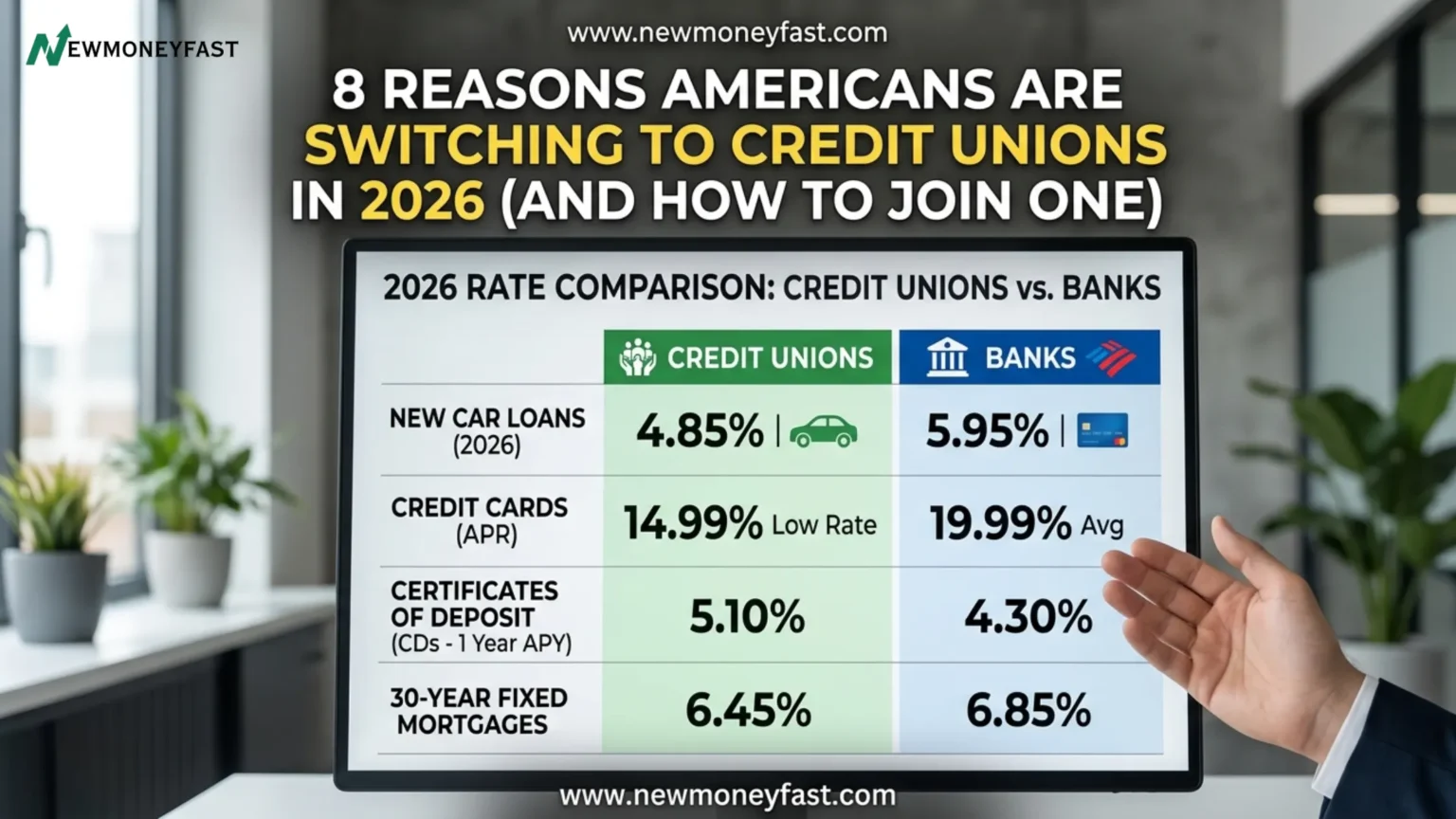
Americans are switching to credit unions in 2026 because they charge less to borrow. NCUA data shows credit unions averaged 5.44% on new car loans versus 7.41% at banks, and 12.58% on credit cards versus 15.27%. Add lower fees, $250,000 federal insurance, and $5 memberships, and the switch pays off fast.
| KEY TAKEAWAYS: Federally insured credit unions had 146.1 million members as of June 30, 2026, according to the NCUA.Credit unions averaged 5.44% on 60-month new car loans vs. 7.41% at banks (NCUA, Dec 2025), about $32 a month less on a $35,000 loan. Credit union deposits are insured up to $250,000 by the NCUA, the same limit the FDIC applies at banks. Federal credit unions cannot charge more than 18% APR on most loans, a cap now extended to September 10, 2027. Credit unions are not always better: banks paid more on regular savings (0.32% vs. 0.19%) and scored higher for apps in the 2026 ACSI study. |
Why Does the Credit Union Question Matter Right Now?
A credit union is a not-for-profit financial cooperative owned by its members, so profits go back to members as lower rates and fees instead of to shareholders. The system is growing, not shrinking. The NCUA reports credit union assets hit $2.50 trillion in Q2 2026, up 5.0% in a year, and loans outstanding rose to $1.76 trillion.
If you carry a car loan or card balance, or plan to buy a home in 2027, the credit unions vs banks 2026 rate gap is real money. Here is where you win, where you do not, and how to join in 15 minutes.
The 8 Reasons, Ranked by How Much They Can Save You
1. Car Loans Cost Up to 2 Points Less
How It Works: Credit unions lend members’ pooled deposits back to members and do not answer to outside shareholders. NCUA’s latest comparison (S&P Global data, Dec 26, 2025) shows 5.44% on a 60-month new car loan at credit unions vs. 7.41% at banks, and 5.53% vs. 7.73% on 48-month used car loans.
Real Example: On a $35,000 new car over 60 months, that is about $668 vs. $700 a month, or $1,936 over the loan. Fresher data agrees: RateAPI tracked a 5.25% median new car APR across 1,456 credit unions on September 25, 2026.
Estimated Savings: $900 to $2,000 on a $20,000 to $35,000 loan, depending on credit, term, and down payment.
Best For: Q4 car buyers and anyone refinancing a dealer loan above 7%.
Skip This If: The dealer offers a promotional 0% to 1.9% manufacturer deal.



Action Step: Get preapproved at a credit union before the dealership, then ask the dealer to beat it in writing.
2. Credit Cards Charge Less, and Federal Law Caps the Rate
How It Works: On February 6, 2026, the NCUA extended the 18% cap on most federal credit union loans through September 10, 2027. Classic credit union cards averaged 12.58% vs. 15.27% at banks. Credit unions also offer Payday Alternative Loans (PALs), small-dollar loans capped at 28%.
Real Example: On a $5,000 balance carried for a year, the 2.69-point gap saves about $135 in interest.
Estimated Savings: $100 to $500 a year on a $5,000 to $10,000 balance.
Best For: People carrying a balance or rebuilding fair credit.
Skip This If: You pay in full monthly and want premium travel rewards.
Action Step: If your card APR is above 20%, compare a credit union card or balance transfer this week.
3. CDs and Money Market Accounts Pay More
How It Works: A share certificate is the credit union version of a CD: you lock money in for a set term at a higher rate. NCUA data shows 1-year certificates at 2.95% vs. 2.29% at banks and money market accounts at 0.74% vs. 0.52%.
Real Example: $10,000 in a 1-year certificate earns about $295 vs. $229, or $66 extra.
Estimated Savings: $50 to $75 a year per $10,000 at average rates.
Best For: Savers parking money for a goal 6 to 60 months away.
Skip This If: You keep cash in regular savings. Banks averaged 0.32% vs. 0.19% there, and top online high-yield accounts paid up to 4.10% APY in September 2026 (U.S. News).
Action Step: Compare two credit union certificate rates before your next CD matures.
4. Fewer Fees for Overdrafts, ATMs, and Checking
How It Works: Bankrate’s latest survey put the average overdraft fee at $26.77 and out-of-network ATM costs at a record $4.86 per withdrawal. Many credit unions offer free checking, and Alliant stopped charging overdraft and NSF fees in 2021.
Real Example: Four overdrafts a year cost about $107. Two out-of-network ATM withdrawals a month add $117. A no-overdraft account with ATM refunds erases most of that $224.
Estimated Savings: $100 to $250 a year for occasional overdrafters and ATM users.
Best For: Anyone paying maintenance, overdraft, or ATM fees now.
Skip This If: You assume all credit unions are fee-free. PenFed charges a $30 overdraft fee (NerdWallet).
Action Step: Total every fee on your last 3 statements. Over $20 means switching pays.
5. Mortgages and Home Equity Loans Cost Less
How It Works: The gap is smaller on mortgages, but the loan is huge. NCUA data shows 30-year fixed rates at 6.26% vs. 6.50% and home equity lines at 7.13% vs. 7.74%.
Real Example: On a $300,000, 30-year mortgage, that is about $1,849 vs. $1,896 a month, or $47 a month and roughly $16,956 over the loan.
Estimated Savings: $30 to $60 a month on a typical mortgage.
Best For: 2027 home buyers and homeowners eyeing a HELOC.
Skip This If: You need a jumbo or specialty loan your credit union does not offer.
Action Step: Request Loan Estimates from one credit union and one bank on the same day.
6. Members Rate the Service Higher, Mostly
How It Works: The J.D. Power 2026 U.S. Credit Union Satisfaction Study scored credit unions 725 vs. 657 for retail banks, led by SchoolsFirst FCU (792), RBFCU (751), and Navy Federal (747).
Real Example: Tech is the weak spot. The 2026 ACSI Finance Study scored banks 80 and credit unions 78. Credit unions won on staff courtesy; banks won on apps, websites, and ATM and branch locations.
Estimated Savings: Indirect, through faster fixes and fee refunds.
Best For: People who want a real person and flexible underwriting.
Skip This If: A top-tier mobile app is your number one priority.
Action Step: Check the app’s ratings and confirm Zelle, mobile deposit, and card controls before applying.
7. Your Money Is Just as Safe as at a Bank
How It Works: The NCUA’s Share Insurance Fund, backed by the full faith and credit of the United States, covers $250,000 per member, per ownership category, matching FDIC limits. Loan delinquency was just 0.96% in Q2 2026.
Real Example: A couple with a joint account plus two individual accounts can be insured well beyond $250,000 because each ownership category counts separately.
Estimated Savings: Same protection, no trade-off.
Best For: Anyone nervous about leaving a big bank.
Skip This If: The institution lacks the NCUA sign. A few state-chartered credit unions use private insurance.
Action Step: Confirm coverage with the NCUA’s Research a Credit Union tool.
8. Joining Now Takes $5 and 15 Minutes
How It Works: A field of membership is the set of rules on who can join, such as where you live or work. Many credit unions now have open charters, and you can belong to more than one.
Real Example: PenFed accepts anyone with a $5 savings deposit. Alliant donates $5 to its foundation for you. Connexus charges a one-time $5 association fee. The CO-OP Shared Branch network adds 5,000+ branches and about 30,000 ATMs.
Estimated Savings: Costs $5 to $25 and unlocks reasons 1 through 5.
Best For: Anyone who assumed they “don’t qualify.”
Skip This If: You need a local branch and the credit union skips shared branching, as PenFed does.
Action Step: Use the NCUA Credit Union Locator, then check the national options below.
Credit Unions vs Banks 2026: How Do the Rates Compare?
National averages from NCUA’s Credit Union and Bank Rates report (S&P Global Market Intelligence data as of December 26, 2025, the latest published). Your personal rate depends on credit, income, and term.
| Product | Credit Unions | Banks | Winner | What It Means |
|---|---|---|---|---|
| New car loan, 60 mo | 5.44% | 7.41% | Credit unions | $32/mo less on $35,000 |
| Used car loan, 48 mo | 5.53% | 7.73% | Credit unions | $20/mo less on $20,000 |
| Classic credit card | 12.58% | 15.27% | Credit unions | About $135/yr less on $5,000 |
| Personal loan, 36 mo | 10.64% | 12.00% | Credit unions | About $232 less on $10,000 |
| 30-year fixed mortgage | 6.26% | 6.50% | Credit unions | $47/mo less on $300,000 |
| Home equity line (80%) | 7.13% | 7.74% | Credit unions | Lower cost on renovations |
| 1-year CD ($10K) | 2.95% | 2.29% | Credit unions | $66 more per $10,000 |
| Regular savings ($2.5K) | 0.19% | 0.32% | Banks | Use a high-yield account instead |
| Interest checking ($2.5K) | 0.15% | 0.20% | Banks | Small gap either way |
How Do You Join a Credit Union? 5 Steps
- Step 1: Find one you qualify for. Check your employer, county, school, or family, then open-charter options.
- Step 2: Compare three things. Loan rates, the fee schedule, and CO-OP branch and ATM access.
- Step 3: Gather documents. ID, Social Security number, and proof of address. Most do not run a credit check just to join.
- Step 4: Open a share savings account. The $5 minimum is your ownership share.
- Step 5: Move gradually. Switch direct deposit and autopays, keep the old account 60 days, then close it.
Which Credit Unions Can Anyone Join?
| Credit Union | How to Join | Access | Best For | Watch Out |
|---|---|---|---|---|
| PenFed | Open a savings account with $5 | Allpoint and CO-OP ATMs; few dozen branches | Car loans, free checking, CDs | $30 overdraft fee; no shared branching |
| Alliant | $5 donation to Alliant Credit Union Foundation (paid for you) | 80,000+ fee-free ATMs; up to $20/mo ATM refunds | Digital-first savers, no overdraft fees | Only two physical branches |
| Connexus | One-time $5 Connexus Association fee | 54,000+ ATMs nationwide | High-yield checking seekers | Mostly online outside Wisconsin |
Sources: NerdWallet (PenFed, Alliant), Crediful (Alliant ATMs, Connexus), Bankrate (Alliant fees). Terms can change, so confirm on each credit union’s site.
| THE CREDIT UNION LEVEL-UP CHALLENGEBeginner (this week): Join one credit union for $5 and download its app. Estimated time: 15 minutes.Pro (this month): Get a preapproval or refinance quote on your car loan or card balance. Target: $30+ a month saved.Expert (by Dec 31): Move direct deposit and autopays, then close your fee-charging account. Target: $0 in bank fees for 2027.Quick question: How much did you pay in bank fees last year? Drop your number in the comments. |
Tag a friend who is still paying 7%+ on a car loan. One preapproval could save them $30 a month.
| QUICK WINSTotal potential savings: About $700 in year one for a household with a $35,000 car loan, a $5,000 card balance, a $10,000 CD, and 4 overdrafts a year. Roughly $17,000 over a 30-year $300,000 mortgage.Time investment: 15 minutes to join, 1 to 2 hours to fully switch.Difficulty: Easy.Best for: Borrowers, fee payers, and CD savers. |
Visual Suggestions
- Rate gap bar chart: Credit union vs. bank averages for 7 products, with the gap labeled in points.
- Car loan cost infographic: $35,000 over 60 months, $668 vs. $700 a month, with the $1,936 total gap highlighted.
- Join in 5 steps graphic: Numbered, mobile-friendly vertical flow of the joining process.
- Scorecard graphic: J.D. Power (CUs 725 vs. banks 657) next to ACSI (banks 80 vs. CUs 78) to show both sides.
Frequently Asked Questions
Are credit unions as safe as banks?
Yes. Federally insured credit unions protect deposits up to $250,000 per member, per ownership category, through the NCUA’s Share Insurance Fund, matching FDIC coverage at banks.
Can anyone join a credit union in 2026?
Yes, in most cases. PenFed, Alliant, and Connexus let almost anyone join for $5, and local credit unions usually accept anyone who lives or works nearby.
Are credit union rates always better than bank rates?
No. Credit unions averaged better rates on car loans, cards, mortgages, and CDs, but banks paid more on regular savings (0.32% vs. 0.19%). Compare each product separately.
Do credit unions check your credit to join?
Usually not for basic membership. Most only check credit when you apply for a loan, card, or overdraft protection.
Can I keep my bank account and join a credit union?
Yes. You can belong to one or more credit unions while keeping your bank. Many people use a credit union for loans and certificates and an online bank for high-yield savings.
| YOUR NEXT MOVEPaying more than 7% on a car loan? Check your credit union refinance rate in 2 minutes and see how much you could keep each month.[AFFILIATE LINK PLACEHOLDER: Credit union auto refinance / preapproval partner][AFFILIATE LINK PLACEHOLDER: Open-charter credit union membership offer] |
Keep Reading on New Money Fast
- 9 Apps That Automatically Save Money (Sep 16)
- 10 Ways to Build a $1,000 Emergency Fund in 60 Days (Sep 23)
- Credit Score 90-Day Fix (Aug 7)
- Debt Snowball vs. Avalanche (Aug 12)
Sources
1. NCUA: Quarterly Credit Union Data Summary, Q2 2026
2. NCUA: Second Quarter 2026 System Performance Data (Sep 14, 2026)
3. NCUA: Credit Union and Bank Rates, 2025 Q4
4. NCUA: Board Extends Loan Interest Rate Ceiling (Feb 6, 2026)
5. Consumer Finance Monitor: NCUA Extends 18% Ceiling, 28% PAL Cap
6. RateAPI: Credit Union vs Bank Auto Loan Rates (Sep 25, 2026)
7. CUToday: J.D. Power 2026 U.S. Credit Union Satisfaction Study
8. ACSI: Finance Study 2026 Press Release
9. Bankrate: Checking Account and ATM Fee Survey
10. Bankrate: Banks That Have Cut or Eliminated Overdraft Fees
11. NerdWallet: Best Credit Unions
12. Crediful: Credit Unions Anyone Can Join in 2026