
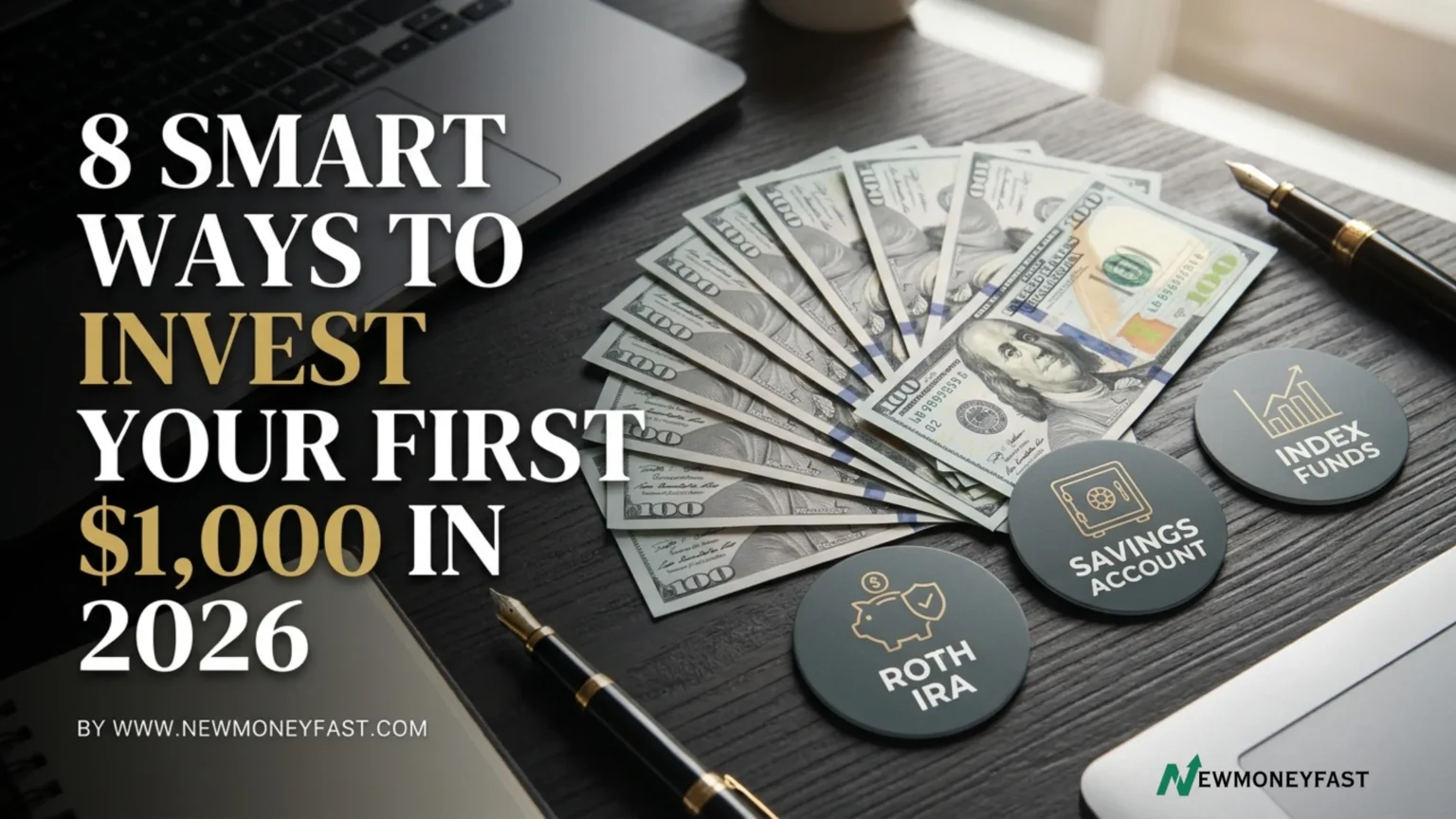
The best way to invest your first $1,000 in 2026 is to match each dollar to a job: take any employer 401(k) match first, put long-term money in a Roth IRA index fund, and park short-term cash in a high-yield savings account paying about 4.2%. Here are eight options, with the costs, risks, and who each one fits.
| Key TakeawaysThe 2026 IRA limit is $7,500 and the 401(k) limit is $24,500, so $1,000 fits easily inside both (IRS).Top high-yield savings accounts paid up to 4.27% APY in late October 2026, versus a 0.62% national average (Bankrate).Vanguard’s Total Stock Market ETF (VTI) charges 0.03% a year, or about 30 cents per $1,000 (ETF Database).A 50% employer match turns a $1,000 contribution into $1,500 the day it posts, a return no market can promise.Betterment’s fee drops to 0.25% only if you deposit $200 a month or hold $24,000, otherwise it is $5 a month, which is 6% a year on a $1,000 balance. |
Why does the first $1,000 matter so much right now?
Two clocks are running. Treasury resets I Bond rates on November 1, and you can still fund a 2026 IRA until April 15, 2027, so there is no rush to pick the wrong account today. Still, learning how to invest 1000 dollars well sets the habit that turns later paychecks into real wealth.
We built this list around one rule: money you need within a year belongs in safe accounts, and money you will not touch for five years or more can take market risk. Every option below says which side of that line it sits on.
Which option is the best way to invest 1000 dollars?
1. Pay down high-interest debt first
How it works: Paying off a credit card is a guaranteed return equal to its interest rate. No index fund promises that. If you carry a balance at 20% or more, every dollar you pay is a dollar that stops growing against you.
Real example: Take a hypothetical $1,000 balance at 24% APR. Paying it off saves roughly $240 a year in interest. The same $1,000 in a 4.27% savings account would earn $42.70.
Estimated savings: $150 to $300 a year on $1,000, depending on your APR.
Best for: Anyone carrying a card balance. Skip this if your only debt is a mortgage or a federal student loan under about 5%.
Action step: Log in and send the full $1,000 to the highest-APR card today, then turn on autopay.



2. Capture your employer 401(k) match
How it works: A 401(k) is a workplace retirement account, and a match means your employer adds money when you contribute. The 2026 employee limit is $24,500, with an $8,000 catch-up at 50 and older (IRS). Matching formulas differ, so check yours.
Real example: Say you earn $60,000 and your employer matches 50% of the first 6% you save. You contribute $3,600, and the company adds $1,800. A single $1,000 contribution becomes $1,500 on day one.
Estimated earnings: A 50% match is an instant 50% return. A dollar-for-dollar match doubles your money.
Pros and cons: Pros are free money and pre-tax savings. The con is that withdrawals before age 59 and a half usually trigger a 10% penalty plus income tax.
Action step: Ask HR for the match formula and raise your contribution to the full matched percentage.
3. Open a Roth IRA and buy a total-market index fund
How it works: A Roth IRA is a retirement account funded with after-tax dollars, so qualified withdrawals are tax-free. You can contribute up to $7,500 for 2026 if your income is under $153,000 (single) or $242,000 (married filing jointly), with reduced limits just above those marks (IRS). You can withdraw your own contributions without tax, though earnings are taxed if you withdraw early (IRS Publication 590-B).
Real example: Put $1,000 into Vanguard’s Total Stock Market ETF (VTI), which holds thousands of U.S. companies for 0.03% a year (ETF Database). Hypothetically, $1,000 growing at 7% a year becomes about $7,612 in 30 years. At 5% it becomes $4,322. Those are illustrations, not forecasts.
Estimated earnings: Unknown by design. Stocks can fall 20% or more in a bad year.
Best for: Money you will not need for 5+ years. Skip this if you may need the cash within a year.
Action step: Open a Roth IRA at Fidelity, Schwab, or Vanguard, fund it with $1,000, and buy a broad index fund or ETF.
4. Use fractional shares to build a mini portfolio
How it works: A fractional share is a slice of a stock or ETF, so you can invest dollars instead of whole shares. At Fidelity, orders can be as small as $1.00, though they only execute during market hours (Fidelity).
Real example: Instead of one share of one fund, you could split $1,000 into three slices: $600 in a U.S. total-market ETF, $250 in an international ETF, and $150 in a bond ETF. This mix is an example of diversification, not a recommendation for your situation.
Estimated earnings: Depends on the funds. The benefit is spreading risk, not boosting returns.
Pros and cons: Pros are low minimums and instant diversification. Cons are that fractional shares may not transfer between brokers in kind, and you should compare each fund’s expense ratio.
Action step: Pick three broad funds, compare their expense ratios against VTI’s 0.03%, and place your first $100 order.
5. Let a robo-advisor do it for you
How it works: A robo-advisor is an automated service that builds and rebalances a diversified portfolio for a small fee. Betterment has a $0 account minimum (with $10 to start investing) and charges 0.25% a year on balances over $24,000 or with $200 in monthly deposits, otherwise $5 a month. Wealthfront requires $500 for automated investing and charges 0.25% (NerdWallet, updated December 2025).
Real example: On a $1,000 Betterment balance with no recurring deposits, $5 a month costs $60 a year, or 6%. With $200 monthly deposits, 0.25% costs $2.50 a year on $1,000. The deposit rule is everything.
Best for: People who want hands-off investing and will automate deposits. Skip this if you cannot commit $200 a month at Betterment.
Action step: Compare current terms on both sites, then set up a recurring deposit before you fund the account.
6. Park short-term cash in a high-yield savings account
How it works: A high-yield savings account pays several times the national average and is FDIC-insured, so your principal is protected. As of October 27 to 29, 2026, Bankrate listed Peak Bank at 4.27% APY ($100 minimum), CIT Bank at 4.25% (the top rate needs a $5,000 balance), and EverBank at 4.20% with no minimum. The national average was 0.62%.
Real example: Your $1,000 earns about $42.70 in a year at 4.27%, versus $6.20 at the national average.
Pros and cons: Pros are safety and instant access. Cons are that rates are variable and can drop when the Fed cuts.
Action step: Open the account in 10 minutes online and set an automatic $50 weekly transfer.
7. Buy I Bonds for inflation-protected savings
How it works: An I Bond is a U.S. savings bond whose rate combines a fixed rate with an inflation adjustment. Bonds bought through October 29 earn a 4.26% composite rate. Treasury resets on November 1, and Tipswatch projected a 4.08% variable rate with a fixed rate of 1.30% to 1.40% (Tipswatch). The limit is $10,000 per person per year, and you cannot cash out in the first 12 months. Cashing out before five years costs three months of interest (TreasuryDirect).
Real example: At the current 4.26% composite rate, $1,000 earns about $42.60 in a year.
Best for: Money you can lock up for 12 months or more. Skip this if you might need the cash this year.
Action step: Create a free TreasuryDirect account, which takes about 15 minutes plus a bank link.
8. Automate it with dollar-cost averaging
How it works: Dollar-cost averaging means investing equal amounts on a schedule regardless of price. Lump-sum investing often comes out ahead because markets rise more often than they fall, but spreading buys out can calm nerves and help you start.
Real example: Invest $100 every Friday for 10 weeks into the same index fund. If prices dip in week four, those $100 buys pick up more shares.
Pros and cons: Pros are discipline and less regret. The con is that cash waiting to be invested earns less than invested money would in a rising market.
Action step: Set a recurring buy for payday so the habit runs without you.
How do the 8 options compare side by side?
| Option | Minimum | Risk | Cost | Best for |
|---|---|---|---|---|
| 1. Pay off debt | None | None | Free | Anyone with a card balance |
| 2. 401(k) match | Any amount | Market | Plan fees vary | Employees with a match |
| 3. Roth IRA + VTI | Broker dependent | Market | 0.03% fund fee | 5+ year money |
| 4. Fractional shares | $1.00 at Fidelity | Market | Per fund | Small, diversified starts |
| 5. Robo-advisor | $0 to $500 | Market | 0.25% or $5/month | Hands-off investors |
| 6. High-yield savings | $0 to $100 | FDIC insured | Free | Money needed within a year |
| 7. I Bonds | $25 (TreasuryDirect) | Government backed | Interest penalty before 5 years | 12+ month money |
| 8. Dollar-cost averaging | Any amount | Market | Per fund | Nervous first-timers |
Sources: IRS, Bankrate, NerdWallet, TreasuryDirect. Rates and terms checked late October 2026 and subject to change.
Can you take the $1,000 Launch Challenge?
| The $1,000 Launch ChallengeBeginner: Open a high-yield savings account and move your first $100 today.Pro: Capture your full 401(k) match and open a Roth IRA with $500.Expert: Split the rest across a total-market ETF, an I Bond, and a weekly $100 auto-buy.Your turn: Which level are you starting at? Tag a friend who keeps saying they will start investing next year. |
| Quick WinsTotal potential: $240 a year (debt payoff at 24% APR), $500 (a 50% match on $1,000), or about $43 (savings at 4.27%).Time investment: 60 to 90 minutes for any single option.Difficulty: Easy to medium.Best for: First-time investors with $1,000 and no clear plan. |
Visual suggestions
- A decision flowchart: debt, match, emergency cash, then Roth IRA.
- A bar chart comparing $1,000 earning 0.62% versus 4.27% over one year.
- A line graph of $1,000 at 5% versus 7% over 30 years, labeled as illustrations.
- A screenshot walkthrough of opening a TreasuryDirect account.
Frequently asked questions
Is $1,000 enough to start investing?
Yes, $1,000 is enough to start. Many brokers have no account minimum, and Fidelity allows fractional share orders as small as $1.00. The habit matters more than the amount.
Should I invest or pay off debt first?
Pay off debt first when the interest rate is above roughly 8% to 10%. Paying a 24% card is a guaranteed 24% return. For low-rate debt, you can reasonably invest at the same time.
What is the safest way to invest $1,000?
The safest options are an FDIC-insured high-yield savings account and U.S. Treasury I Bonds. Savings accounts protect principal up to $250,000 per bank, and I Bonds are backed by the U.S. government. Both give up the higher long-term growth that stocks offer.
Is a Roth IRA or a regular brokerage account better for $1,000?
A Roth IRA is usually better for long-term money because growth is tax-free in retirement. A regular brokerage account is more flexible if you may need the cash sooner. You can withdraw Roth contributions, but not earnings, without tax and penalties in most cases.
How should I invest 1000 dollars if I am a complete beginner?
Start with a broad, low-cost index fund inside a Roth IRA, or a robo-advisor if you want it automated. Keep any money you need within a year in a high-yield savings account. Automate deposits so you keep going.
Ready to put your $1,000 to work?
| Your Next Step: Now that you know how to invest 1000 dollars, open a high-yield savings account or Roth IRA in under 15 minutes and fund it with your first $100. Small starts beat perfect plans.Open an account here: [Affiliate link placeholder] |
Sources
- IRS: 401(k) limit increases to $24,500 for 2026, IRA limit increases to $7,500
- IRS: 2026 inflation adjustments, including Saver’s Credit thresholds
- IRS: Roth IRAs
- IRS: Publication 590-B, Distributions from IRAs
- Bankrate: Best high-yield savings accounts (rates as of October 27 to 29, 2026)
- Tipswatch: The I Bond’s new fixed rate should be 1.40%, October 25, 2026
- Tipswatch: The I Bond’s fixed rate is going higher, August 9, 2026
- TreasuryDirect: I bonds interest rates
- ETF Database: Vanguard Total Stock Market ETF (VTI)
- Vanguard: VTI fund profile
- Fidelity: Fractional shares, August 11, 2026
- NerdWallet: Betterment vs. Wealthfront, updated December 22, 2025
- Betterment: Pricing and account details
- Wealthfront: Pricing and account details
- Investor.gov: Compound interest calculator